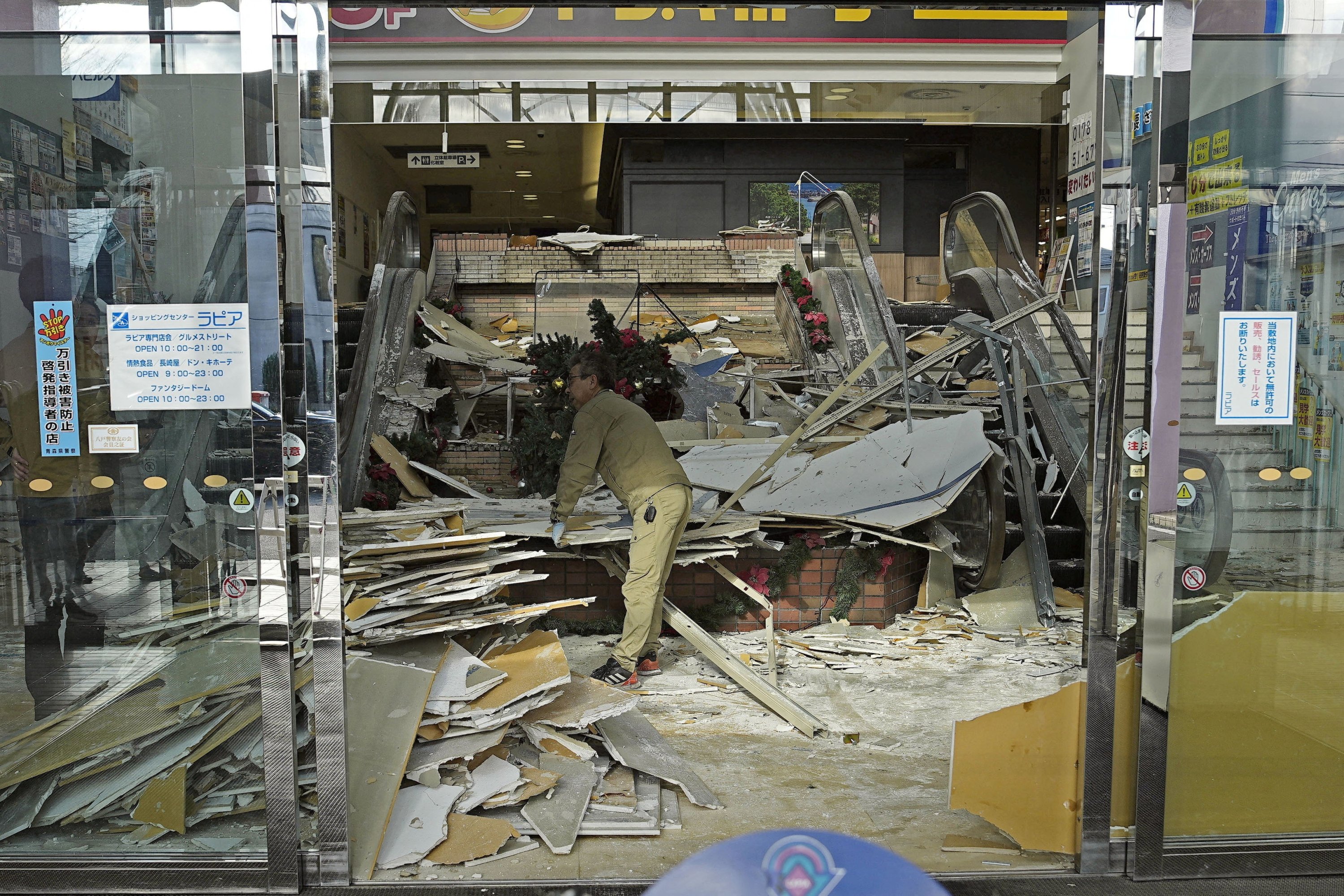
A powerful 7.5 magnitude earthquake struck off northeastern Japan late Monday, December 8, 2025, injuring at least 51 people, causing extensive infrastructure damage, and triggering mass evacuations along the Pacific coast.
The Japan Meteorological Agency (JMA) issued initial tsunami warnings for Aomori, Iwate, and Hokkaido prefectures, reporting waves up to 70 centimeters (2 feet, 4 inches) at Kuji Port.
By Tuesday morning, all advisories were lifted, though authorities remained on high alert due to ongoing aftershocks and a rare “megaquake” advisory, signaling a slight risk of a magnitude 8.0+ event along the northeastern coast.
The quake struck at 11:15 p.m. local time (2:15 p.m. GMT), about 80 kilometers (50 miles) east of Hachinohe, Aomori Prefecture, at a depth of 54 kilometers (33.5 miles).
JMA recorded the tremor at 7.5, while the U.S. Geological Survey (USGS) estimated 7.6, attributing it to thrust faulting along the Japan Trench, where the Pacific Plate converges with the Okhotsk Plate at a rate of 7.9-9.2 cm per year.
Maximum shaking reached upper 6 on Japan’s seven-level Shindo scale in Hachinohe, Oirase, and Hashikami, toppling furniture, cracking walls, and making standing nearly impossible.
Residents described 30 seconds of violent shaking.
Nobuo Yamada, a convenience store owner in Hachinohe, told NHK: “I’ve never experienced such a big shaking.
Luckily, the power lines were still working.” Satoshi Kato, vice principal of a local high school, recounted dishes shattering on his floor before navigating traffic jams and minor accidents on his way to the evacuation center.
By Tuesday, the Fire and Disaster Management Agency confirmed 51 injuries: 36 in Aomori, 11 in Hokkaido, and 4 in Iwate, most minor.
Injuries largely resulted from falling objects, debris, and panic-related incidents, including a man in Tohoku slightly hurt when his vehicle fell into a road crater.
Fires sparked by ruptured gas lines were quickly contained.
Coastal fisheries reported damage to oyster farming rafts, adding economic strain to an area still recovering from prior seismic events.
Evacuation orders affected over 90,000 residents, with approximately 110,000 seeking temporary shelter in schools, community centers, and military bases.
Hachinohe Air Base hosted 480 evacuees, while 18 Japan Self-Defense Force helicopters were mobilized for aerial damage assessments.
At New Chitose Airport in Hokkaido, roughly 200 passengers spent the night stranded after sections of the domestic terminal ceiling collapsed.
Power outages initially impacted about 800 homes in Aomori, though most were restored by Tuesday morning.
Water supply interruptions affected roughly 1,360 households due to burst pipes. Rail services, including the Tohoku Shinkansen, were temporarily halted but resumed by Tuesday afternoon.
Aerial surveys revealed cracked roads and a vehicle precariously perched on the edge of a collapsed section. Several historic sites, including Chojasan Shinra Shrine, suffered damage, with toppled torii gates underscoring the quake’s cultural toll.
Tsunami alerts initially forecast surges up to 3 meters (10 feet), though observed waves were far lower: 70 cm at Kuji Port, 50 cm at Urakawa and Mutsu, 40 cm at Hachinohe, and 20-30 cm at Tomakomai, Shiraoi, and Sendai.
Local oyster farms sustained damage, though widespread flooding was avoided.
Nuclear facilities underwent immediate safety inspections.
At the Rokkasho reprocessing plant in Aomori, a minor 450-liter water spill from a spent fuel cooling pool occurred but posed no radiation threat, while no anomalies were reported at other plants or storage sites.
Prime Minister Sanae Takaichi convened an emergency task force, stating: “We are putting people's lives first and doing everything we can.”
Chief Cabinet Secretary Minoru Kihara urged residents to seek higher ground and monitor alerts.
The JMA issued a “megaquake advisory” for the Hokkaido-Sanriku region – the first since 2022 – highlighting a small (1%) risk of a magnitude 8.0+ quake within the coming week, potentially generating tsunamis up to 30 meters (98 feet).
Officials emphasized that the advisory is a precaution, not a prediction, citing historical events including the 2011 Tohoku quake (magnitude 9.0), which killed nearly 20,000 and devastated Fukushima.
Smaller aftershocks persisted into Tuesday, including magnitude 6.6 and 5.1 events, keeping authorities and residents on edge. The government is continuing detailed damage assessments as schools reopen and rail services normalize.