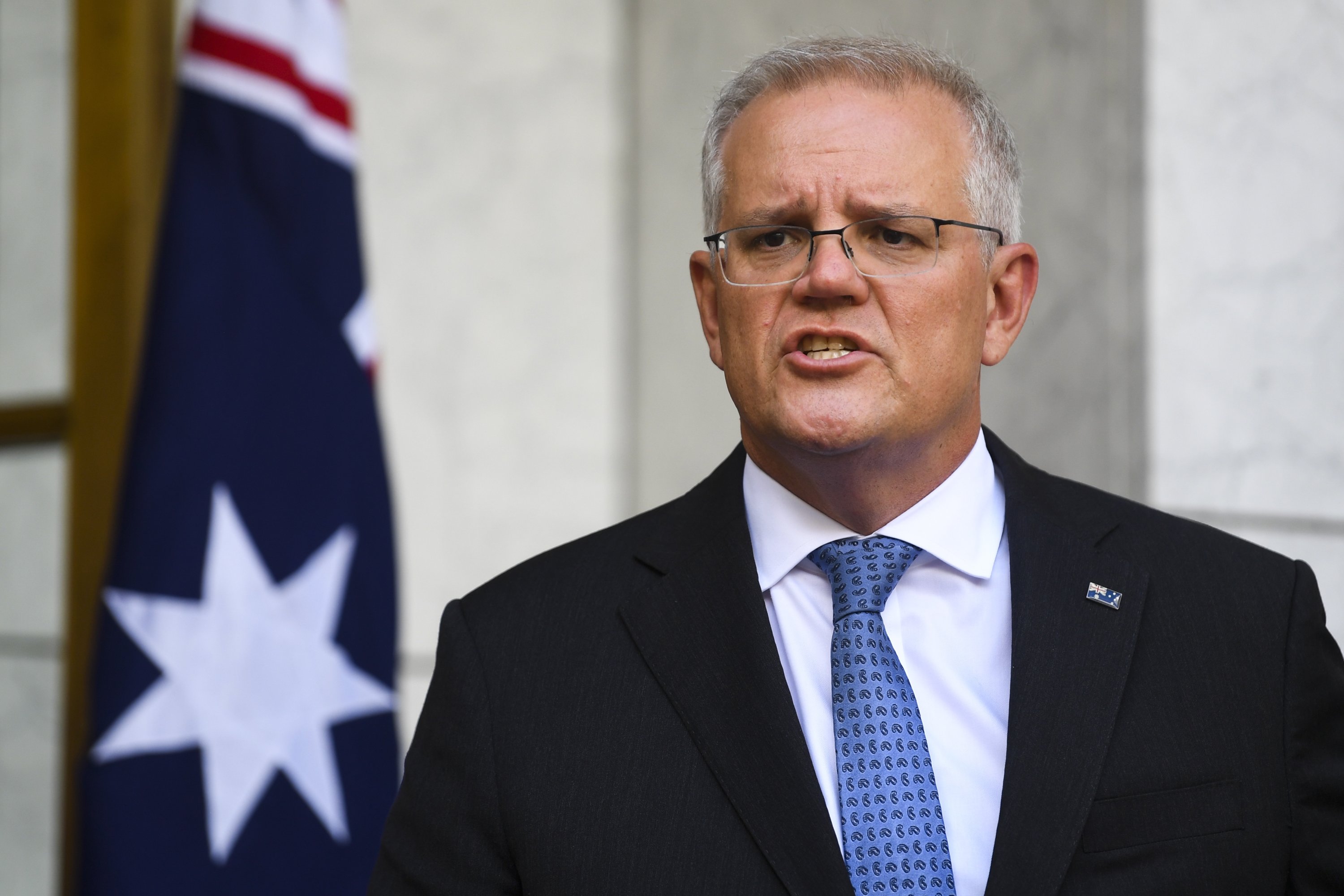
Australian Prime Minister Scott Morrison announced Monday that the country will reopen its borders to tourists from Feb. 21 after remaining closed for almost two years, ending one of the world's strictest and longest-running pandemic travel restrictions.
"It's almost two years since we took the decision to close the borders to Australia," Morrison said after a meeting of the national security Cabinet.
He said the borders will reopen to all visa holders "on the 21st of February of this year," and added, "if you're double vaccinated, we look forward to welcoming you back to Australia."
Australia's borders slammed shut in March 2020 in the hope of protecting the island continent against a surging global pandemic.
For most of the time since then, Australians have been barred from leaving and only a handful of visitors have been granted exemptions to enter.
The rules have stranded Australians overseas, split families, devastated the country's tourist industry, and prompted questions and often bitter debates on Australia's status as a modern, open and outward-looking nation.
Every month of border closures has cost businesses an estimated AU$3.66 billion ($2.6 billion), according to the Australian Chamber of Commerce and Industry.
In recent months, rules have been gradually relaxed for Australians, long-term residents and students.
The latest decision will see almost all remaining caps lifted.
It comes after the country's long-standing failed "zero-COVID" policy was abandoned, vaccination rates rose and the track-and-trace system collapsed under a wave of omicron cases.
Only a handful of countries remain closed to tourists – among them Japan, China, New Zealand and several Pacific Island nations.
For Australia's travel and tourism sector – which was decimated as visitor numbers fell almost 98% compared to pre-pandemic levels – the news brought elation.
"We're very excited about being able to reopen," said Tony Walker, managing director of the Quicksilver Group, which operates cruises, diving and resorts across the Great Barrier Reef.
"The last couple of years have been incredibly difficult for us," he told Agence France-Presse (AFP), urging people overseas to "come visit."
During the pandemic, the firm went from 650 employees down to the 300 it has today.
Walker said he expected "it will take some time to recover" from the past two years.
Many tourism operators around Australia are experiencing staff shortages, given how few backpackers and working holidaymakers are coming to Australia.
Despite the announcement, however, travel within Australia will still be restricted. Australia's states and territories have varying quarantine requirements and caps on international arrivals, which Morrison said would remain in place.
"You must be double vaccinated to come to Australia," Morrison explained. "That's the rule. Everyone is expected to abide by it," he added.
In a clear reference to the recent controversial and high-profile deportation and declaration of the world No. 1 tennis player Novak Djokovic as a "public threat" after an appeals court ruled against the government, reinstated the tennis player's visa and ordered him to be immediately released, Morrison warned, "events earlier in the year should have sent a very clear message I think to everyone around the world that that is the requirement to enter into Australia."
The vast state of Western Australia remains closed to most non-residents. It is currently easier to travel from Sydney to Paris than Sydney to Perth.