Rescue teams struggled Sunday to reach Myanmar’s hardest-hit areas after a devastating 7.7 magnitude earthquake killed more than 1,700 people.
Their efforts were slowed by collapsed roads, destroyed bridges and disrupted communications, all amid the country’s ongoing civil war.
The quake struck near Mandalay, Myanmar’s second-largest city, at midday Friday, toppling buildings and damaging key infrastructure, including the city’s airport.
Many of Mandalay’s 1.5 million residents spent the night on the streets – either left homeless by the quake, which also shook neighboring Thailand and killed at least 17 people there, or fearing aftershocks could bring down weakened buildings.
So far, 1,644 people have been reported killed in Myanmar and 3,408 missing, but many areas have not yet been reached. Many rescue efforts have been carried out by people working by hand to clear rubble, said Cara Bragg, the Yangon-based manager of Catholic Relief Services in Myanmar.
"It's mainly been local volunteers, local people who are just trying to find their loved ones,” Bragg said after being briefed by her colleague in Mandalay.
"I've also seen reports that now some countries are sending search and rescue teams up to Mandalay to support the efforts, but hospitals are really struggling to cope with the influx of injured people. There's a shortage of medical supplies, and people are struggling to find food and clean water,” Bragg added.
The organization was sending a team by road Sunday to assess people's most pressing needs so it could target its response.
With Mandalay's airport damaged and the control tower toppled at Naypyitaw's airport, all commercial flights into the cities have been shut down.
Still, two Indian C-17 military transport aircraft landed late Saturday at Naypyitaw with a field hospital unit and about 120 personnel who were then to travel north to Mandalay to establish a 60-bed emergency treatment center, according to Myanmar’s Foreign Ministry. Other Indian supplies were flown into Yangon, the country’s biggest city, which has been the hub of other foreign relief efforts.
On Sunday, a convoy of 17 Chinese cargo trucks carrying critical shelter and medical supplies was expected to reach Mandalay after making the arduous journey by road from Yangon.
The 650-kilometer (400-mile) trip has taken 14 hours or longer, with clogged roads and traffic diverted from the main highway to avoid earthquake damage.
At the same time, the window of opportunity to find anyone alive is rapidly closing. Most rescues occur within the first 24 hours after a disaster, and survival chances drop each day.
An initial report on relief efforts issued Saturday by the U.N. Office for the Coordination of Humanitarian Affairs noted severe damage or destruction to many health facilities and warned that a "severe shortage of medical supplies is hampering response efforts, including trauma kits, blood bags, anesthetics, assistive devices, essential medicines, and tents for health workers.”
China said it has sent more than 135 rescue personnel and experts along with medical kits and generators, pledging around $13.8 million in emergency aid. Russia’s Emergencies Ministry said it had flown in 120 rescuers and supplies to Yangon, while Moscow's Health Ministry said it had sent a medical team to Myanmar.
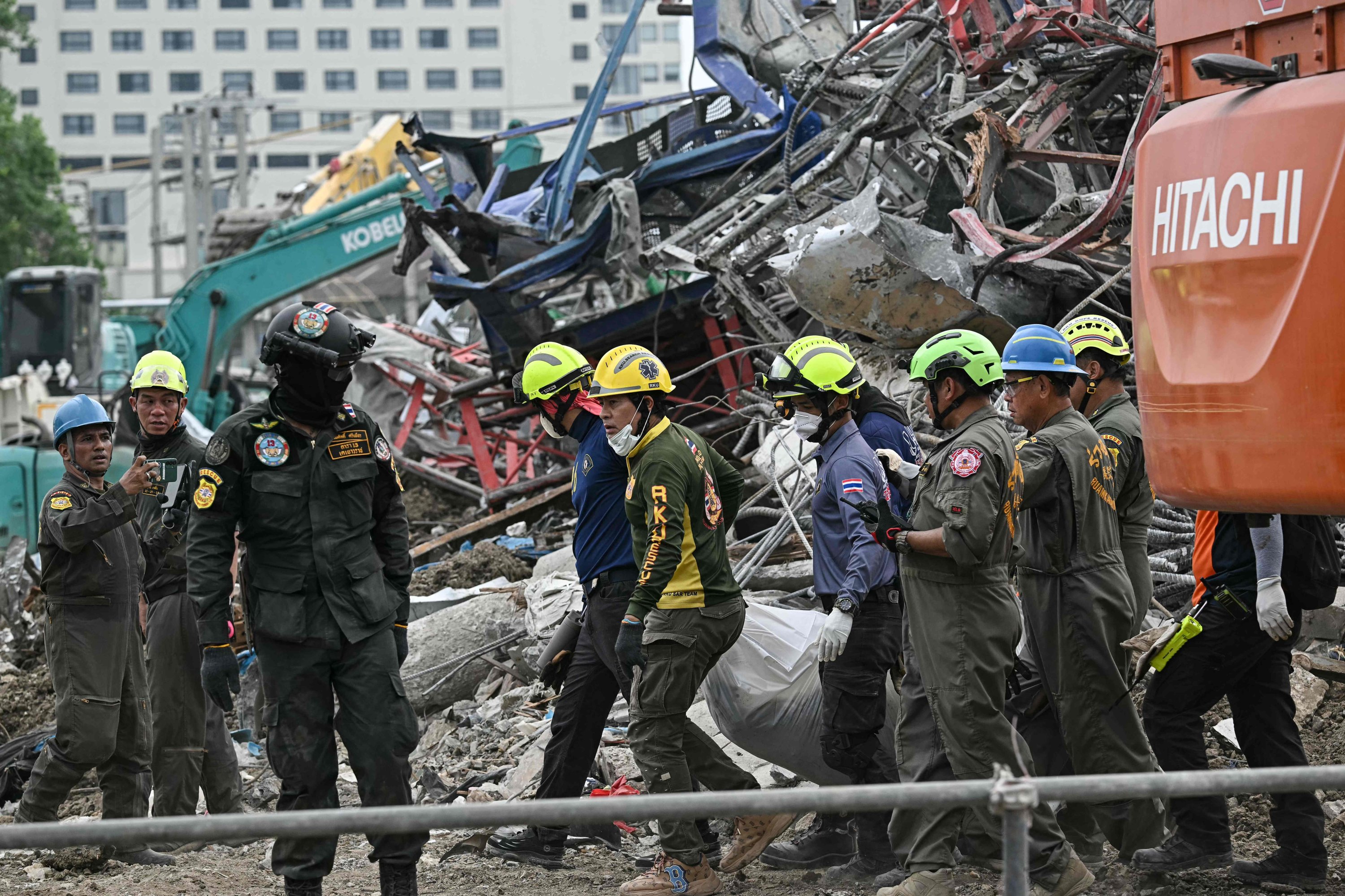
In neighboring Thailand, the quake rocked much of the country, bringing down a high-rise building under construction in Bangkok, some 1,300 kilometers (800 miles) from the epicenter.
So far, 10 people have been found dead at the construction site near the popular Chatuchak market, where 83 people remain unaccounted for. The latest body was recovered from the rubble early Sunday morning. A total of 17 people have been reported killed in Thailand.
In Myanmar, also known as Burma, rescue efforts have focused on Mandalay and Naypyitaw, which are believed to have been hardest hit. But many other areas were affected, and little is known about the extent of damage there.
"We're hearing reports of hundreds of people trapped in different areas,” Bragg said. "Right now we're at 1,700 (known fatalities), and we don't have a lot of data coming out, but you've got to assume it will be increasing in the thousands based on what the impacts are. This is just anecdotal information at this point.”
Beyond the earthquake damage, rescue efforts are complicated by the civil war roiling much of the country, including quake-affected areas. In 2021, the military seized power from the elected government of Aung San Suu Kyi, sparking armed resistance.
Government forces have lost control of much of Myanmar, making many places dangerous or inaccessible for aid groups. More than 3 million people have been displaced by the fighting, and nearly 20 million are in need, according to the United Nations.
The military has been battling long-established militias and newly formed pro-democracy People's Defense Forces and has heavily restricted aid efforts to the large population already displaced by war before the earthquake.
On Saturday, Myanmar’s opposition shadow National Unity Government, to which the PDF militias are loyal, announced a unilateral partial ceasefire to facilitate earthquake relief efforts.
The military did not immediately comment on the announcement and continued airstrikes even after the earthquake.
The Three Brotherhood Alliance, a coalition of three of Myanmar's most powerful and well-armed militias that launched a major offensive in October 2023, did not mention a ceasefire in a statement Saturday but said it was ready to help.
"We will promptly provide assistance to those affected by the earthquake to the best of our ability, with a spirit of humanity, unity and brotherhood,” the group said.