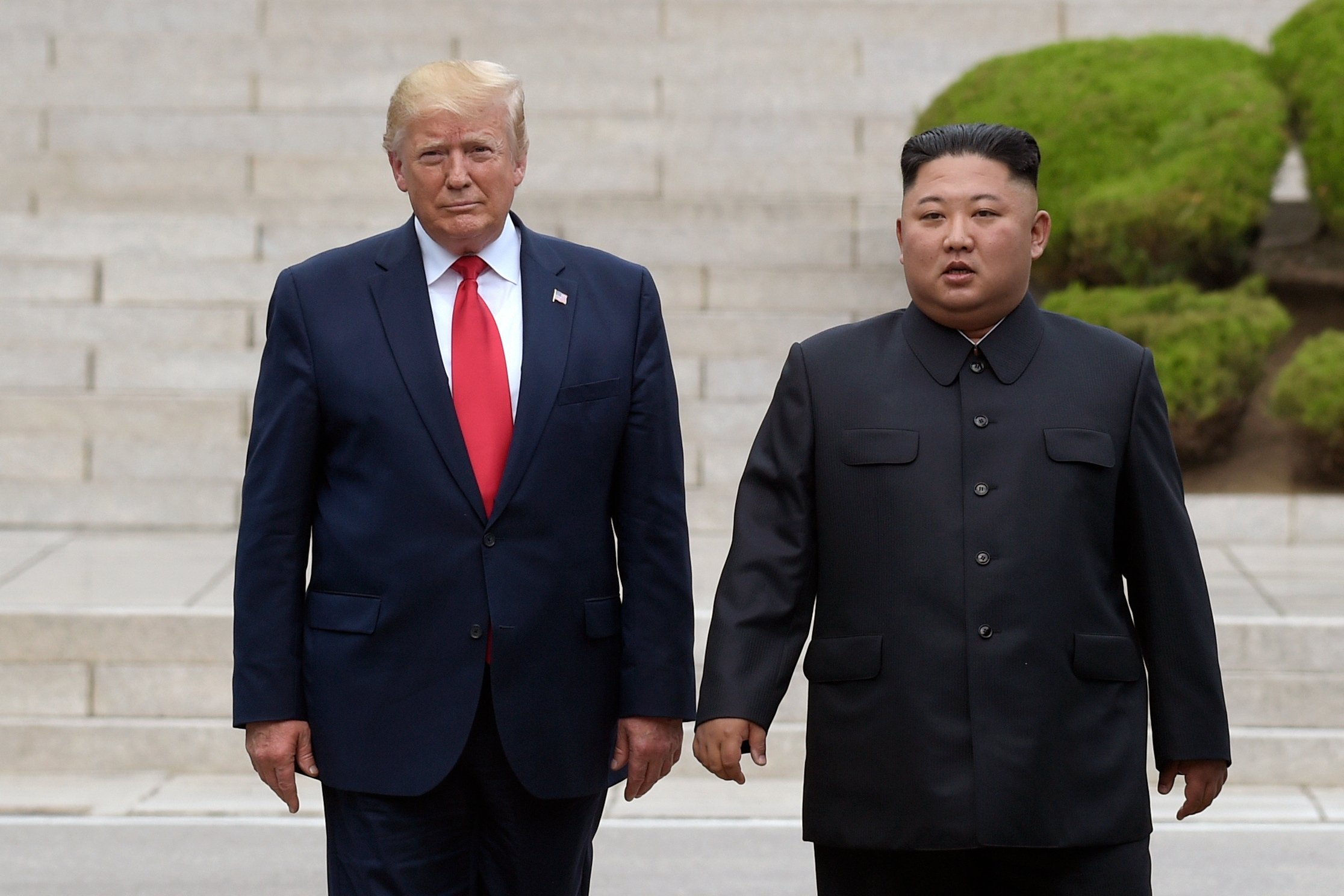
South Korea’s unification minister urged U.S. President Donald Trump and North Korean leader Kim Jong Un to seize what he called a “rare and real” chance to restart peace talks on the Korean Peninsula, as Trump prepares to visit the country next week.
Unification Minister Chung Dong-young said Friday that the Asia-Pacific Economic Cooperation (APEC) summit in South Korea could offer a “natural opportunity” for both leaders to reconnect after years of silence since their historic but stalled summits in 2018 and 2019.
“The leaders of North Korea and the United States should not miss this opportunity. They need to make a decision,” Chung told reporters in Seoul. “Even a one percent chance at peace should not be wasted.”
Trump is scheduled to visit the southeastern city of Gyeongju on Oct. 29-30 for the APEC Forum, where Chinese President Xi Jinping will also be present. Speculation is mounting that a fourth Trump-Kim encounter could take place on the sidelines, though neither Washington nor Pyongyang has confirmed such plans.
The South Korean Ministry of Unification earlier this week suspended tours to the Joint Security Area (JSA) in Panmunjom – the border village inside the Demilitarized Zone (DMZ) – from late October to early November, fueling rumors that the zone could once again host a symbolic handshake.
Chung said South Korean intelligence observed North Korean personnel “sprucing up” parts of the JSA for the first time this year, cleaning pathways, weeding flowerbeds, and even taking photos – signs, he noted, that Pyongyang may be expecting a high-profile visit.
“North Korea appears to be paying close attention to the United States,” Chung added, calling the possibility of a meeting “considerable.”
Kim Jong Un recently said he still held “fond memories” of Trump and remained open to talks if the U.S. abandoned its “delusional” demand that Pyongyang dismantle its nuclear arsenal. Trump, for his part, has continued to speak warmly of Kim, calling him “a smart guy” and hinting at a possible reunion “sooner than people think.”
Trump and Kim’s relationship defined one of the most unconventional chapters in modern diplomacy. They met three times – in Singapore (2018), Hanoi (2019), and in the DMZ later that year – where Trump became the first U.S. president to briefly cross into North Korean territory.
Despite the theatrics and photo ops, the talks collapsed over disagreements about the scope of nuclear disarmament and sanctions relief.
Chung emphasized that renewed dialogue could “set the stage for lasting peace,” but warned that the window for diplomacy “is closing fast.”
Even as Seoul calls for diplomacy, the border remains tense. The South Korean military reported that two North Korean soldiers briefly crossed the border on Oct. 19 – one day after 20 other troops made a similar incursion that drew warning shots from the South.
The incident underscores the fragile calm separating the two Koreas, even as officials cling to the hope that renewed engagement between Trump and Kim might ease hostilities.