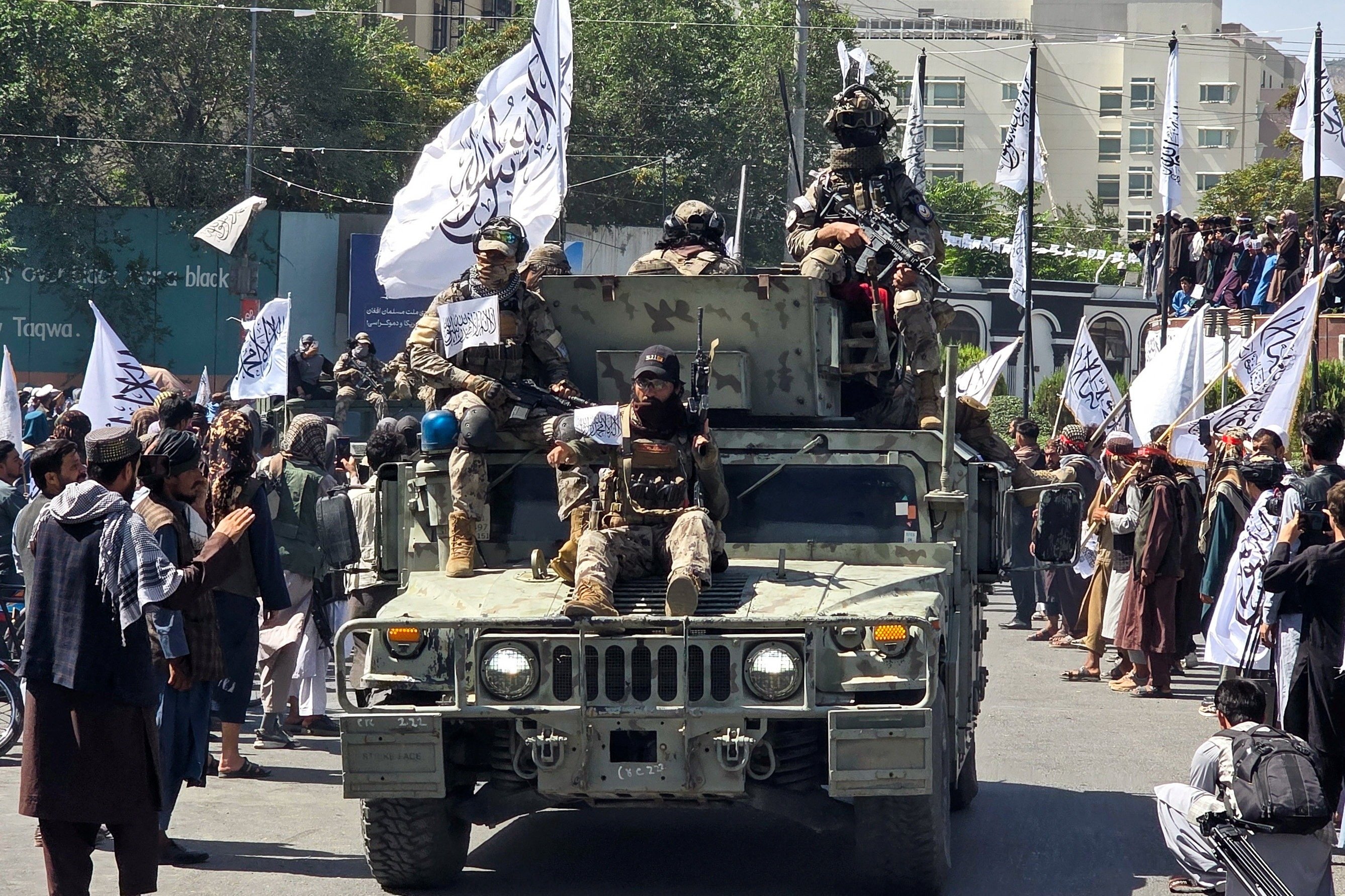
Taliban leaders and other officials gathered Saturday at Afghanistan’s traditional Loya Jirga assembly hall to mark the fifth anniversary of their return to power, touting what they described as an end to decades of conflict and the restoration of stability.
But a senior United Nations official warned of a deepening human rights crisis in a country where girls over the age of 12 remain barred from education.
The Taliban seized power on Aug. 15, 2021, as U.S. and other NATO forces withdrew after nearly two decades of war. The departure triggered chaos at Kabul’s airport, where thousands of Afghans desperate to leave the country crowded into the airport in the hope of securing a place on evacuation flights.
After returning to power, the Taliban banned girls from attending school beyond sixth grade and later barred women from universities and other forms of higher education. The restrictions came despite earlier Taliban assurances that women would be allowed to study, work and participate in public life.
Women have also been banned from public spaces such as gyms and parks, from taking part in sports and from traveling long distances without a male guardian.
At the Loya Jirga, high-ranking officials were joined by some foreign representatives and thousands of ordinary citizens for speeches marking what they said was Afghanistan’s liberation from American forces.
“We pray to Almighty God to forever protect our homeland from occupation, aggression, wars and insecurity, and to enable our people to enjoy peace, tranquility and prosperity under the auspices of the Sharia-based government,” the Taliban government’s deputy spokesman, Hamdullah Fitrat, said during the ceremony.
There were no women present.
Five years on, the Taliban government remains isolated internationally, with Russia being the only country to have formally recognized it.
Foreign Minister Amir Khan Muttaqi said countries that have engaged with the administration have benefited from doing so and called on others that have not established contacts to reconsider their approach.
“Those that engaged and interacted with the Islamic Emirate of Afghanistan benefited,” he said. “As for the countries that have not engaged with the Islamic Emirate, let them state what they have gained or what benefit they have derived.”
“They should move toward a policy of engagement and mutual interaction,” he said.
In Kabul, men took to the squares carrying Taliban flags and chanting slogans in support of the government. Convoys of vehicles wound their way through the city, causing traffic jams.
Security was tight, with a heavy Taliban security force presence and several checkpoints on a main road leading to the Loya Jirga.
Celebrations were also held in provinces across Afghanistan, where Taliban flags and posters emblazoned with slogans praising the Taliban’s return to power were displayed along major roads and in marketplaces.
In a video message, Richard Bennett, the U.N. special rapporteur on the human rights situation in Afghanistan, said the country was undergoing a deep human rights crisis.
“While the era of war has ended, it’s questionable whether there’s real peace, and the human rights situation has steadily deteriorated, most dramatically for women and girls,” Bennett said. “My mandate has concluded that this system amounts to the crime against humanity of gender persecution.”
He said the crisis goes far beyond discrimination against women and girls, citing widespread abuses including arbitrary arrests, torture, extrajudicial killings, corporal punishment, enforced disappearances, restrictions on free expression, attacks on journalists and human rights defenders, persecution of ethnic and religious minorities and shrinking civic space.
Bennett warned the international community against “normalizing” the Taliban’s policies, saying it would legitimize discrimination and tell “victims their suffering is negotiable.”
In an interview with The Associated Press earlier this week, Molvi Hayatullah Mahajar Farahi, a deputy minister in the Taliban government responsible for broadcasting at the Ministry of Information and Culture, said that despite “challenges and difficulties,” the administration had delivered security and infrastructure and created jobs over the past five years.
When asked about the education of girls and women, Farahi did not address the issue but said “the level of investment made in universities surpasses anything seen in the past.”
The U.N. agency for education and culture, UNESCO, estimates that some 2.4 million girls have been excluded from secondary education. The U.N. World Food Program said child malnutrition has reached critical levels in a third of Afghanistan’s provinces and is expected to worsen because of funding shortfalls.
U.N. Women, the world body’s agency for women’s rights, said this week that women and girls are facing the harshest restrictions in the world and that the bans are damaging Afghanistan’s future. The lack of teachers, doctors, nurses and midwives threatens the country’s social and economic foundations.