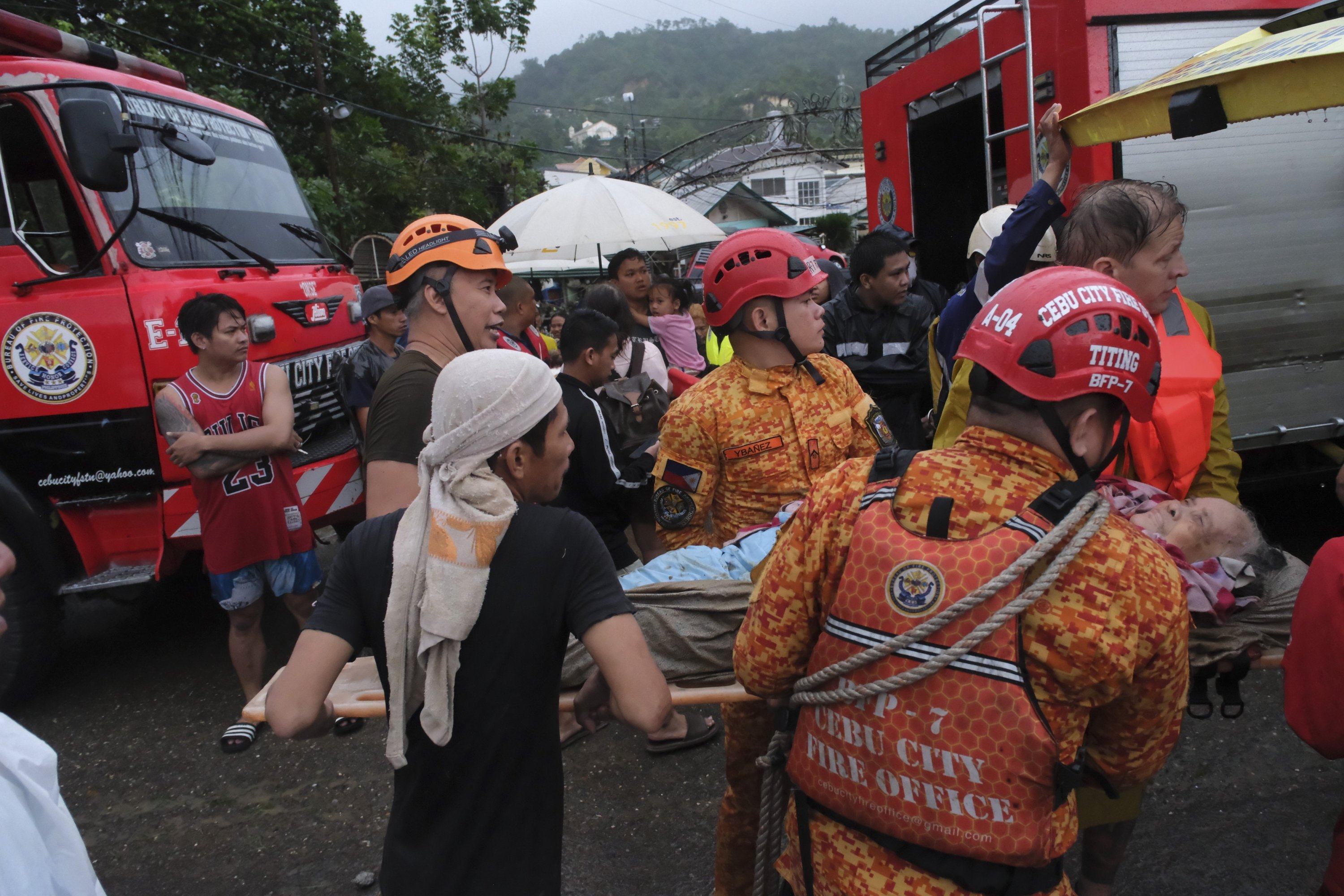
Typhoon Kalmaegi, known locally as Typhoon Tino, tore through the central Philippines on Tuesday, unleashing torrential rains and powerful winds that killed at least 26 people and forced nearly 400,000 from their homes.
Authorities described the flooding, which swallowed entire towns and swept away cars and shipping containers, as “unprecedented.”
The National Disaster Risk Reduction and Management Council (NDRRMC) said most of the victims drowned amid rapidly rising waters, with 21 deaths reported in Cebu province alone – eight in Cebu City, six in Mandaue City, and four in Danao City.
Five people remain missing in Cebu, and at least 12 are unaccounted for nationwide.
“Most of them died from drowning,” said Rafaelito Alejandro, deputy administrator of the Office of Civil Defense, noting how quickly the floods overwhelmed residents.
Cebu, the storm’s ground zero, recorded 183 millimeters (7.2 inches) of rain in 24 hours – surpassing its monthly average – before Kalmaegi made landfall near Borbon at dawn.
Streets turned into rivers, homes vanished underwater, and videos circulating online showed vehicles and even massive cargo containers swept away.
“The situation is really unprecedented,” Cebu Governor Pamela Baricuatro said on Facebook. “We expected the winds to be dangerous, but it’s the water that’s truly devastating.”
In Mandaue City, every district was submerged. In Liloan, residents climbed to rooftops to survive. Rescue teams waded through chest-deep water recovering bodies – including two children in Cebu City.
For many, the storm struck with terrifying speed.
“The water rose so fast,” said 28-year-old resident Don del Rosario. “By 4:00 a.m., it was uncontrollable. I’ve lived here my whole life – this is the worst I’ve ever seen.”
Further east, in Southern Leyte and Dinagat Islands – where Kalmaegi first made landfall before midnight Monday – homes were battered by 130-140 km/h (81-87 mph) winds and gusts nearing 180 km/h (112 mph). Entire provinces were plunged into darkness as power grids collapsed.
The storm’s path cut across the Visayan islands, bringing widespread destruction.
In Sagay, Negros Occidental, and San Lorenzo, Guimaras, Kalmaegi’s successive landfalls toppled trees and tore power lines.
Thousands of travelers were stranded at 42 ports nationwide, while major highways like the Wright-Taft Road in Eastern Samar were rendered impassable.
A Philippine Air Force Super Huey helicopter crashed in Agusan del Sur while en route to deliver aid, with no word yet on survivors.
Kalmaegi – the 20th storm to strike the Philippines this year – is the latest reminder of the country’s extreme vulnerability to climate-fueled disasters. The Philippines endures roughly 20 tropical storms annually, many devastating low-lying communities.
Meteorologists say warmer seas are intensifying storms through “rapid intensification,” allowing typhoons to strengthen in hours. “Storms are becoming more powerful due to climate change,” said PAGASA officials, warning that up to five more storms could still form before year’s end.
With over 187,000 people affected across six regions, the government mounted one of its largest evacuations in recent memory. Hundreds of families still living in tent camps from September’s 6.9-magnitude earthquake were evacuated again for safety.
As Kalmaegi moves west toward Vietnam – where floods have already claimed at least 40 lives – rescue teams in the Philippines continue their grim work amid rising waters, blocked roads, and widespread blackouts.