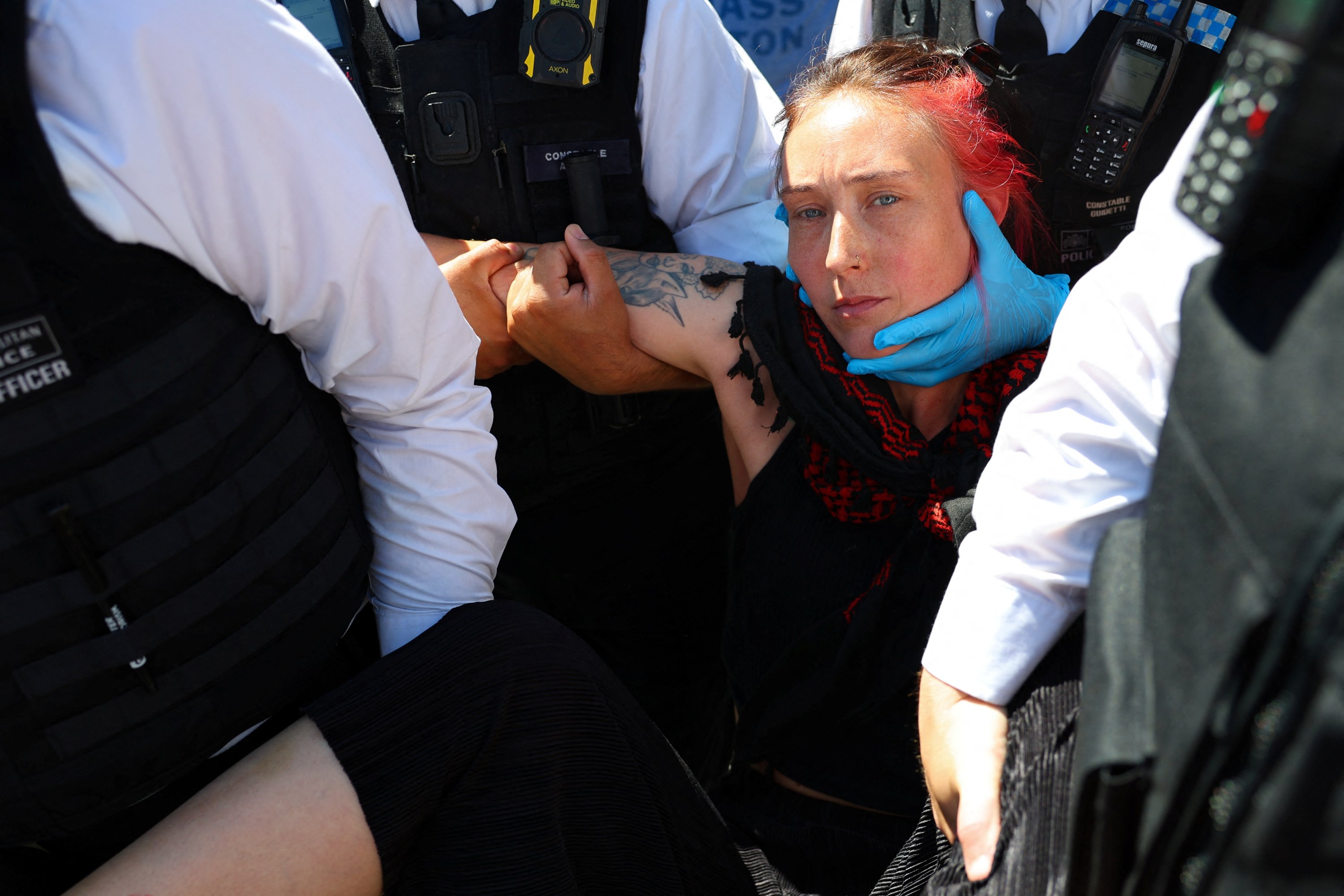
Police in the U.K. cracked down on pro-Palestinian protesters Saturday, arresting many members of a group recently outlawed under anti-terrorism laws.
Police said they had arrested at least 41 people in London and 16 others in Manchester for showing support for the group Palestine Action.
Campaign group "Defend our Juries" said 86 people had been arrested across the U.K., with other protests held in Wales and Northern Ireland.
British lawmakers proscribed the group under anti-terrorism legislation earlier this month after some of its members broke into a Royal Air Force base and damaged planes in protest against Britain's support for Israel.
"Officers have made 41 arrests for showing support for a proscribed organisation. One person has been arrested for common assault," London's Metropolitan Police said in a statement on social media about the demonstration.
After a similar protest in London last week, police arrested 29 people.
Before Saturday's arrests in London, close to 50 protesters had gathered with placards saying "I oppose genocide. I support Palestine Action" near a statue of former South African President Nelson Mandela outside the British parliament.
The International Court of Justice in the Hague is hearing a case brought by South Africa, accusing Israel of genocide against Palestinians in the Gaza conflict, which began after a Hamas incursion into Israel in October 2023. Israel denies committing abuses.
The British government's decision to classify Palestine Action as a "terrorist group" places it in the same category as Hamas, al-Qaeda and Daesh (ISIS). Membership now carries a prison sentence of up to 14 years.
Opponents of the ban say using anti-terrorism laws is inappropriate against a group accused mainly of damaging property rather than harming people. However, some members have in the past been charged with violence in clashes with police.
Palestine Action generally targeted Israeli and Israel-linked businesses in Britain, such as defense company Elbit Systems, often spraying red paint, blocking entrances, or damaging equipment.
In an unsuccessful court appeal against the ban, a lawyer for Palestine Action said the government ban was the first time Britain had proscribed a group that undertook this type of direct action.