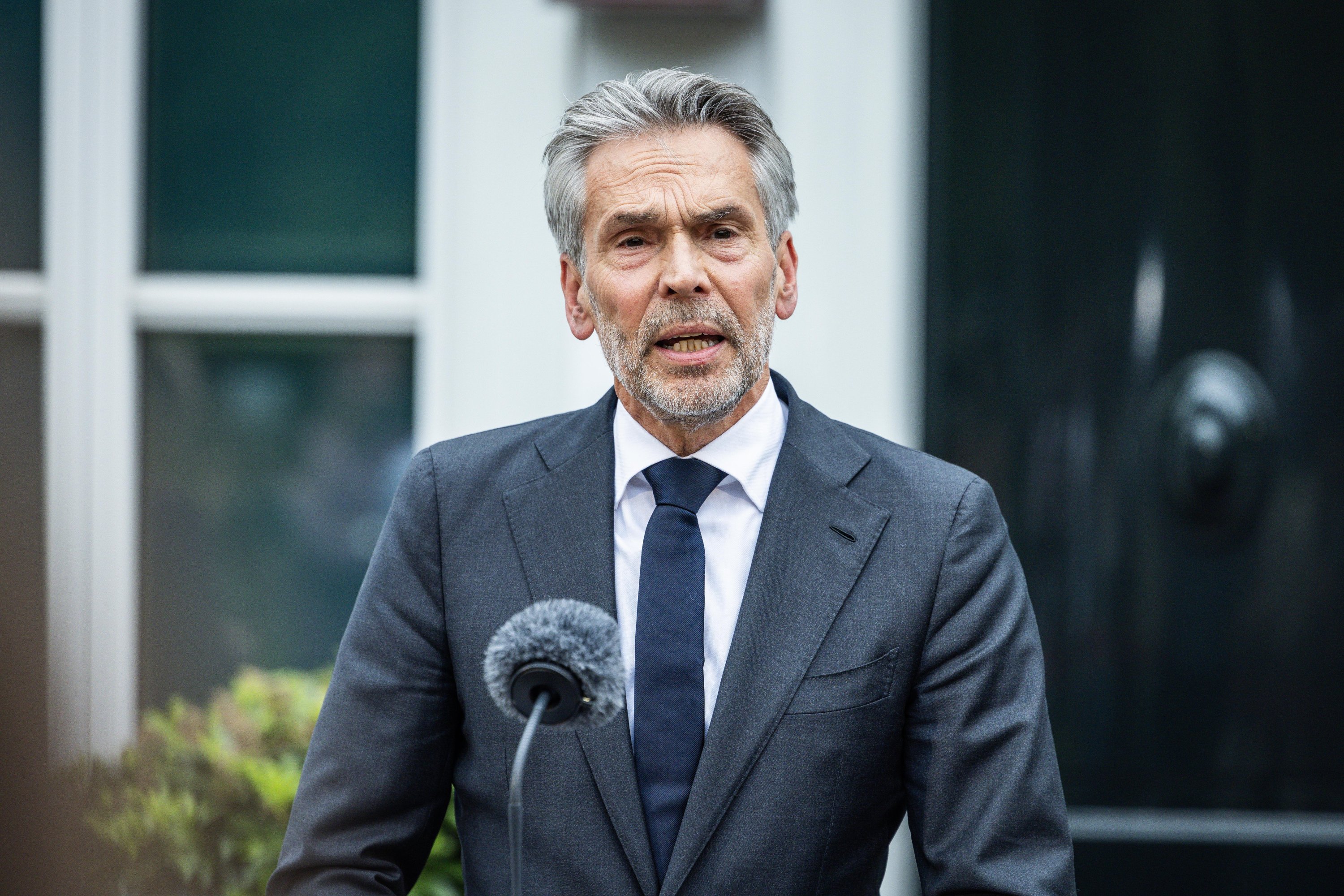
Dutch Prime Minister Dick Schoof confirmed Tuesday that he will step down after the governing coalition unraveled, announcing he would submit his resignation to King Willem-Alexander on behalf of the Cabinet.
"If one party lacks the will, you can't move forward," the prime minister said, according to Dutch broadcaster RTL.
Finding the collapse of the government "irresponsible and unnecessary," Schoof said that there had been "insufficient support" for the Cabinet.
Schoof reaffirmed that the rest of the Cabinet, including the conservative VVD, centrist NSC, and farmers’ party BBB, would continue in a "caretaker capacity" until a new one was formed.
"We will continue undeterred with the three parties. This country has major problems, so decisiveness is required. For citizens who are concerned about their homes and their wallets. And for getting a grip on migration. That requires decisiveness, not procrastination. So, as a caretaker cabinet, we will do everything that is in the best interests of the country, within the scope that parliament allows us," he added.
Although the specific date is yet to be decided, elections are expected between late September and November, according to local media.
Wilders won the last election in November 2023 with an unexpectedly high 23% of the vote.
Opinion polls put his party at around 20% now, roughly on a par with the Labour/Green combination that is currently the second-largest grouping in parliament.
Wilders had last week demanded immediate support for a 10-point plan that included closing the borders to asylum seekers, sending back refugees from Syria and shutting down asylum shelters.
He also proposed expelling migrants convicted of serious crimes and boosting border controls.
Migration has been a divisive issue in Dutch politics for years. The previous government, led by current NATO Secretary-General Mark Rutte, also collapsed after failing to reach a deal on restricting immigration.
Wilders, a provocative politician who was convicted of discrimination against Moroccans in 2016, was not part of the latest government himself.
He only managed to strike a coalition deal with three other conservative parties last year after agreeing not to become prime minister.
Instead, the cabinet was led by the unelected Schoof, a career civil servant.