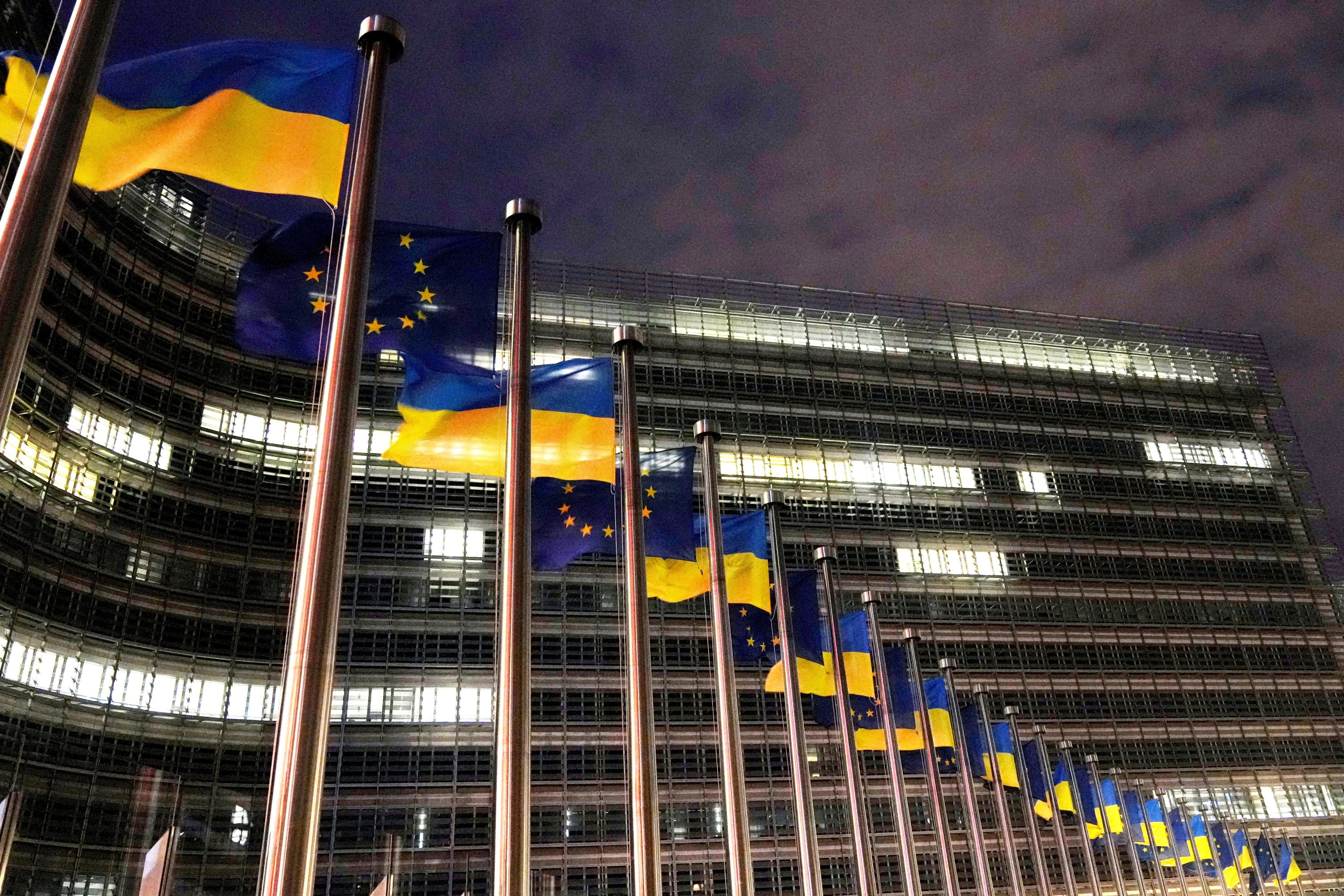
European Union officials on Friday poured cold water on a U.S. proposal to fast-track Ukraine’s EU membership by 2027 as part of a plan to end the war with Russia, calling the timeline unrealistic and beyond Washington’s authority.
The complicated EU accession process usually takes years and requires a unanimous vote from all 27 members of the bloc, and some countries, most notably Hungary, have consistently voiced opposition to Ukraine joining.
The idea of a speedy accession is included in the latest version of a U.S.-led plan to end the war, which would also see Ukraine cede land to Russia, and has triggered a diplomatic frenzy across Europe in recent weeks.
"It's stated there, but it's a matter for negotiation, and the Americans support it," the senior official, speaking on condition of anonymity, said, referring to the U.S. plan.
Washington has the leverage needed to convince leaders opposed to Ukraine's membership to change their stance, President Volodymyr Zelenskyy told journalists, including AFP, on Thursday.
"The United States can take steps to unblock our path to the European Union," he said, adding that "the U.S. president has various levers of influence and that this will have an effect on those who are currently blocking Ukraine."
Kyiv has long strived for EU membership and has been implementing reforms since a pro-European 2014 revolution, but has struggled to eradicate endemic corruption – a core prerequisite for joining the bloc.
After completing a diplomatic tour across Europe last week, Zelenskyy was due in Berlin on Monday for more talks on the plan, full details of which have not been released.
Zelenskyy will discuss "the status of peace negotiations in Ukraine" with "numerous European heads of state and government, as well as the leaders of the EU and NATO," Berlin said.
European diplomats and officials dismissed the U.S. plan as not realistic.
"2027, it's tomorrow," said an EU official speaking on condition of anonymity, referring to the normally long time it takes to get things done in Brussels.
Even the most optimistic types, like enlargement commissioner Marta Kos, had been hoping to see Kyiv join by 2030 at the earliest.
"As if the Americans are going to decide for us!" said a European diplomat. "It's nonsense: there needs to be an appetite for enlargement that isn't there."
The idea of a speedy accession is included in the latest version of a U.S.-led plan to end the war, which would also see Ukraine cede land to Russia, and has triggered a diplomatic frenzy across Europe in recent weeks.
Launched as a powerful statement days after Russia's 2022 invasion, Ukraine's bid for EU membership has stuttered in the face of opposition from Hungary.
The process requires unanimous approval from all member states at dozens of different stages – which has not been forthcoming, as Hungarian Prime Minister Viktor Orban, a nationalist who is Moscow's closest friend in the bloc, has so far blocked progress.
But even if Budapest were to agree, extraordinarily complex questions would need to be resolved.
Negotiations that officially began in June 2024 need to address how to absorb an agricultural powerhouse into Europe's single market without destabilizing it.
French, German and Polish grain producers regularly accuse Kyiv of unfair competition because of the lower prices offered by its producers.
And Ukraine would need to further reform in the midst of a conflict.
"There is a war in Ukraine. How can they be ready? They have no border," said another diplomat.
Accession by 2027 was "completely unrealistic" in the current context, said Lukas Macek, an expert on EU enlargement policy at the Jacques Delors Institute.
"Those who mentioned this date have not even asked themselves a thousandth of these questions," he told AFP.
Finland was the fastest country to join the bloc, with less than three years passing between it applying and acceding.
Türkiye, on the other hand, has been a candidate for nearly three decades, but its file has barely moved and is de facto frozen.
However, to "completely reverse the logic" of accession and "redefine" the procedure, allowing for accession to precede most of the other stages of integration was not inconceivable, said Macek.
But this could cause "enormous frustration" among other candidates, such as Albania, North Macedonia and Montenegro, that have been patiently waiting for years, he added.