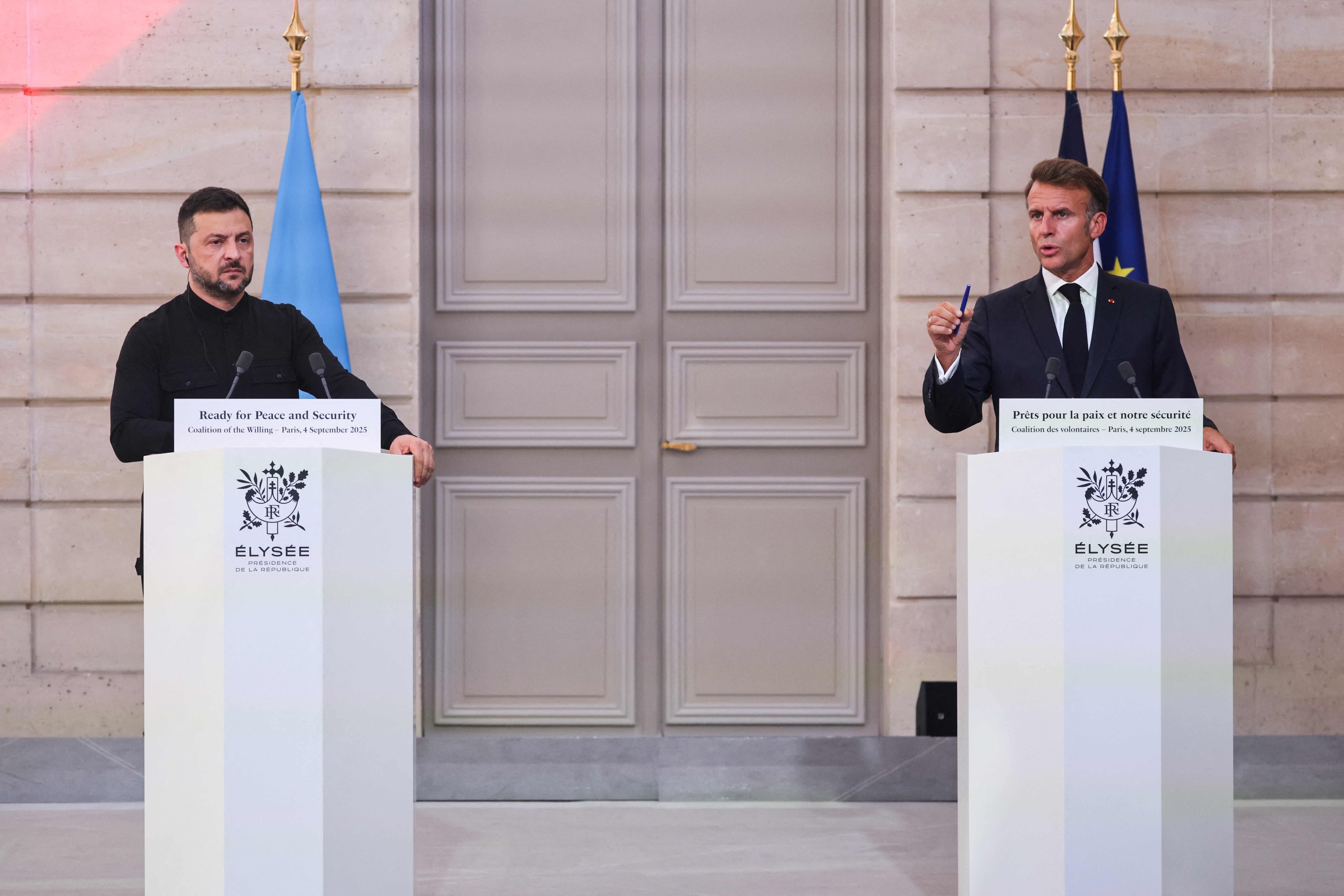
French President Emmanuel Macron said Thursday that 26 of Ukraine's allies have committed to sending troops as a "reassurance force" once fighting ends in the conflict with Russia.
Macron spoke after a meeting in Paris of the so-called "Coalition of the Willing," a group of 35 countries that support Ukraine. He said that 26 of the countries had pledged to deploy troops in Ukraine – or to maintain a presence on land, at sea, or in the air – to help guarantee the country's security the day after a ceasefire or peace is achieved.
Macron said he, fellow European leaders and Ukrainian President Volodymyr Zelenskyy held a call with U.S. President Donald Trump after their summit and U.S. contributions to the guarantees would be finalized in the coming days.
The meeting of the "Coalition of the Willing" was intended to finalize security guarantees and ask Trump for the backing that Europeans say is vital to make such guarantees viable.
Security guarantees are intended to reassure Ukraine and deter Russia, which launched a full-scale invasion of Ukraine in 2022, from attacking its neighbor again.
"The day the conflict stops, the security guarantees will be deployed," Macron told a press conference at the Elysee Palace in Paris, standing alongside Zelenskyy.
European officials say peace looks a distant prospect for now but they want to be ready whenever the war ends. They also see the planning of security guarantees as a way to reassure Kyiv of their support and hope Trump will join their efforts.
Macron initially said the 26 nations – which he did not name – would deploy to Ukraine. But he later said some countries would provide guarantees while remaining outside Ukraine, for example, by helping to train and equip Kyiv's forces.
He did not say how many troops would be involved in the guarantees.
Germany and other countries pledged they would be involved in that effort. But Berlin said it would decide on a military commitment only when conditions were clear, including the extent of U.S. involvement in security guarantees.
Chancellor Friedrich Merz has signalled openness to German participation in a potential peacekeeping mission but has shown more caution than Macron and British Prime Minister Keir Starmer.
Merz has also noted that any German deployment would likely require a Bundestag mandate, a challenge for a chancellor whose own appointment was only voted through on the second attempt.
Italian Prime Minister Giorgia Meloni made clear she would not send troops to Ukraine but said Italy was open to monitoring a ceasefire and training Ukrainian troops outside the country.
France and Britain, which co-chair the coalition of the willing, have indicated they are open to deploying troops to Ukraine after the war ends.
"We are working out which countries will take part in which security component," Zelenskyy said.
"Twenty-six countries agreed to provide security guarantees. Today, for the first time in a long time, this is the first such serious, very specific substance."
Though details of any U.S. participation in the security guarantees remain unclear, both Macron and Zelenskyy said Washington had expressed willingness to be part of the plan, and the Ukrainian president said he was grateful about that. "As for in what format, I am not yet ready to tell you in detail," Zelenskyy added.
"The planning work will be finalized with the United States," Macron said.
On his call with the coalition leaders, Trump said Europe must stop purchasing Russian oil that he said is helping Moscow fund its war against Ukraine, a White House official said. He stressed that Russia received 1.1 billion euros in fuel sales from the EU in one year, the official said.
Trump also emphasized that European leaders must place economic pressure on China for indirectly funding Russia's war efforts, according to the official, who was not authorized to comment publicly about the private talks and spoke on the condition of anonymity.
Macron said the coalition and the United States had agreed to work more closely on future sanctions, notably on Russia's oil and gas sector, and on China.
European governments have said European forces in Ukraine would need their own U.S. security guarantees as a "backstop." Trump has made no explicit commitment to go that far.
His special envoy, Steve Witkoff, met French, British, German, Italian and Ukrainian senior diplomats ahead of the summit, before briefly attending the opening session.
European officials also wanted to highlight a lack of progress toward direct peace talks between Russian President Vladimir Putin and Zelenskyy since Trump hosted the former in August, and to prod the U.S. president to raise pressure on Moscow now.
Having rolled out the red carpet in Alaska, Trump on Wednesday accused Putin of conspiring with China and North Korea after the three countries' leaders staged a show of unity in Beijing at a lavish commemoration of the end of World War II.
Putin told Kyiv on Wednesday there was a chance to end the war in Ukraine via negotiations "if common sense prevails," an option he said he preferred, although he was ready to end it by force if that was the only way.
Zelenskyy on Thursday said a meeting with Putin is needed. "This is not a matter of a desire, this is a matter of necessity," he noted. "We support any format, bilateral meeting, trilateral meeting, I believe that Russia does everything to defer it."
There was no immediate reaction from Russian officials.
Putin also ruled out the deployment of troops from NATO nations to Ukraine as part of a peace settlement. But NATO Secretary-General Mark Rutte dismissed his objections.
"Why are we interested in what Russia thinks about troops in Ukraine? It's a sovereign country," he said at a conference in Prague before joining the Paris summit by video link.
"Russia has nothing to do with this," he said. "I think we really have to stop making Putin too powerful."
Rutte said a broad coalition of nations is needed to support Ukraine's defense against Russian aggression, but also to strengthen Europe to deter further military action by Moscow.
Citing European military and intelligence officials who have warned of Russian plans to strike other European countries, Rutte said that "we have to make sure that our deterrence is such that they will never try, knowing that our reaction will be devastating."
Rutte also called for the world to "not be naive about Russia."
"We know what Putin tries to do and and the evidence is there in Ukraine as we speak," he said.
Meanwhile, in Ukraine, Russia fired 112 strike and decoy drones across the country overnight Thursday, according to Ukraine's Air Force morning report. Air defenses intercepted or jammed 84 drones, the statement said.
Russia on Thursday announced that it was expelling an Estonian diplomat in a tit-for-tat move after Estonia declared a Russian diplomat persona non grata last month.