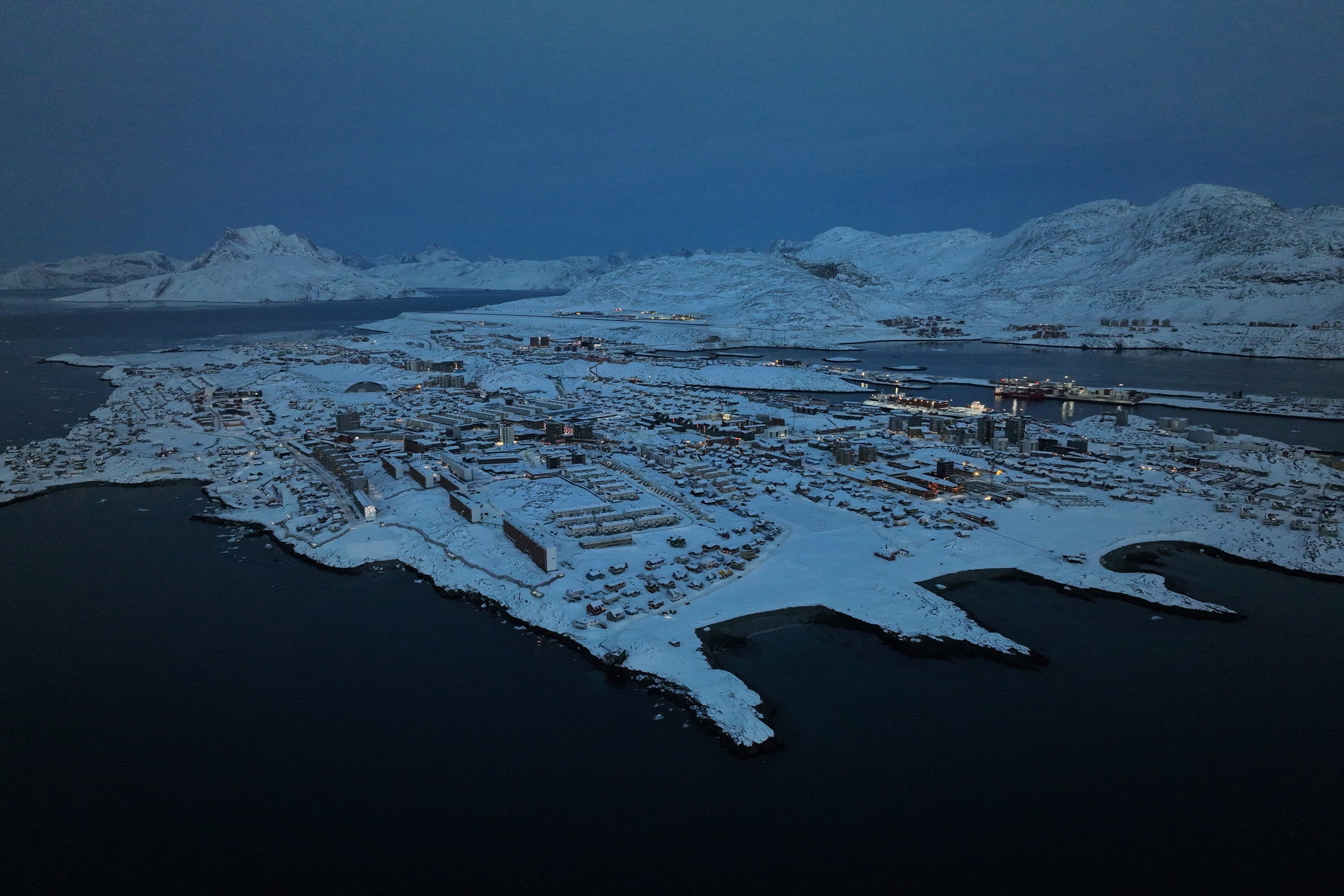
Last December, Per Berthelsen celebrated a stressful year’s end by taking his wife to a restaurant in Nuuk, Greenland’s capital. The 76-year-old parliamentarian and founder of the island’s governing party is one of Greenland’s most vocal opponents of Donald Trump, and had spent months campaigning against threats by the U.S. president to seize his homeland.
After dinner, as the couple stepped outside for a taxi, a man appeared. It was Jørgen Boassen, the most prominent local face of the MAGA movement, sometimes referred to as Trump’s "Greenlandic Son.” Boassen drew close and shouted that the two men could now fight, Berthelsen recalled in an interview. Just then, the taxi arrived and the Berthelsens left.
Boassen’s behavior sparked fury in Greenland’s governing coalition after Berthelsen mentioned the confrontation on social media. His aggressive behavior, along with tactics adopted by a group of Americans - some associated with Boassen and all with ties to the White House - reveal how efforts to promote Trump’s idea of taking over Greenland appear to be backfiring.
Besides Boassen, who has a record of physical and verbal assaults, the group includes a former U.S. special forces officer; a man who contributed to Project 2025, the influential policy blueprint for Trump’s second term; and an American chainsaw artist and biker who advised Kristi Noem during her time as Homeland Security Secretary.
This loose network of Trump allies has used a variety of tactics to spread U.S. influence in Greenland and undermine Denmark, the kingdom that colonized the island of 56,000 people centuries ago and still controls its foreign policy and defense. According to interviews with dozens of politicians and officials, these tactics include negotiating funding for a hallowed dogsledding event, cultivating relationships with opposition politicians, pledging big investments, and highlighting painful chapters in Greenland’s colonial past.
One member of the group spearheading these efforts has coordinated his activities with the Trump administration and advised it on Greenland, Reuters has learned. A second told Reuters he provided reports about local politicians to White House staff.
The people involved in this network have previously been identified in media reports, but Reuters is revealing the extent of their coordination with the Trump administration, of their relationships in Greenland, and of the deep animosity their actions have sparked on the island.
"Those people, they don’t have the respect,” said Mute Egede, Greenland’s foreign minister, of the efforts by these pro-Trump figures. "I don’t respect people who don’t respect that Greenland belongs to the Greenlandic people.”
Pipaluk Lynge, chair of the Greenlandic parliament’s foreign affairs and security committee, told Reuters she was "100% skeptical of any other American” after the influence efforts she had witnessed. "We are a colony. So we know what kind of tactics are usually used against people to take over a country.”
In response to Reuters questions for this story, Olivia Wales, a White House spokeswoman, said the administration was "participating in diplomatic, high-level technical talks with the governments of Greenland and Denmark to address the United States’ national security interests.”
Boassen acknowledged accosting Berthelsen, saying he’d been provoked by Berthelsen calling him a traitor on social media. Berthelsen denied calling Boassen a traitor, but said he had criticized him in the Danish media.
While gaining independence from Denmark remains consistently popular in Greenland, Danish polling in January 2025 showed that 85% of Greenlanders opposed joining America. That month, Trump said the U.S. needed to control Greenland. He has since said that if the U.S. doesn’t occupy the island then China or Russia will. Both Beijing and Moscow have dismissed the claims. The president’s repeated comments about acquiring Greenland - and his refusal to rule out military force to do so - sparked months of tension between the U.S., Greenland and Denmark, and more broadly within the NATO alliance. Ultimately, Trump backed off and the issue moved to a diplomatic track. In March, a U.S. general told a Senate committee the administration was negotiating new bases in Greenland.
But last week Trump revived the issue, making clear he hadn’t relinquished the idea of gaining control of the island. Furious over NATO’s refusal to join the U.S.-Israel war on Iran, he told a news conference on April 6 that the alliance was "a paper tiger.”
"It all began with, if you want to know the truth, Greenland,” he said. "We want Greenland. They don’t want to give it to us. And I said, bye bye.”
He followed that up with another anti-NATO blast a few days later, writing in a Truth Social post that, "NATO WASN’T THERE WHEN WE NEEDED THEM, AND THEY WON’T BE THERE IF WE NEED THEM AGAIN. REMEMBER GREENLAND, THAT BIG, POORLY RUN, PIECE OF ICE!!!”
Asked about Trump’s remarks, a NATO spokesperson declined to comment.
Greenland’s premier didn’t respond to questions about alleged American influence activities sent to his office. Denmark’s foreign ministry said it wasn’t "in a position to go into detail regarding specific intelligence related cases.”
The readiness in Trump circles to embrace Boassen has shocked some in Greenland who view him as a menacing figure.
Allan Josefsen, a carpenter, grew up with Boassen in Qaqortoq, a town of some 3,500 in southern Greenland. Josefsen recounted that in the 1990s Boassen, then a teenager, approached him with two knives and stabbed him in the shoulder after Josefsen danced with a girl Boassen was interested in. Reuters couldn’t independently confirm the incident.
Boassen, a bricklayer by profession, has repeatedly hurled verbal abuse at Greenlandic politicians in public. Last year, while dining at a popular cafe, he approached two parliamentarians and called them "left-wing h....” and "traitors” for their support of Denmark, according to Aqqalu Jerimiassen, one of the MPs and leader of a small party in the ruling coalition.
Boassen has also been banned from the Nuuk public pool, the main hotel in Nuuk, and the city’s mixed-martial-arts fight club.
Boassen, who spoke to Reuters from New Orleans, confirmed the bans, which he said were for confronting people hostile to him or Greenlanders. He said he was banned from the fight club "because of my relationship with Trump.”
A person connected to the hotel said Boassen was barred repeatedly for harassing or threatening patrons.
Boassen didn’t respond to questions about the alleged stabbing of Josefsen and abuse of Jerimiassen. Reuters was unable to establish if Boassen has faced legal repercussions for any of his actions.
Boassen sprang to prominence in January 2025, when he guided Donald Trump Jr. on a visit to Greenland. He met Trump Jr. at the airport and accompanied him to a waterfront statue of Hans Egede, Nuuk’s Norwegian founder, who is viewed as a controversial figure by some Greenlanders for his role in the colonization of the island. Trump Jr. then hosted a lunch at Nuuk’s Hotel Hans Egede, where a social media post shows President-elect Trump addressing a crowd of people in MAGA hats via speakerphone on a mobile device.
The visit enraged political leaders in Greenland and Denmark. Greenland is "not for sale,” Danish Prime Minister Mette Frederiksen said at the time.
Boassen, who has advised officials in the U.S., said his work is now financed by wealthy American donors whom he declined to name. In February, Greenland’s public broadcaster reported, Boassen spoke with Louisiana governor Jeff Landry, Trump’s special envoy to Greenland, about problems in the island’s healthcare system.
According to the broadcaster, Landry later noted the concerns to Trump, who announced he would dispatch a hospital ship to the island.
No such ship materialized, but Trump’s announcement sparked another Denmark-U.S. clash. Frederiksen said she was "happy to live in a country where there is free and equal access to healthcare for everyone” - an apparent swipe at the U.S. healthcare system.
But Boassen had picked an issue with resonance back home, where the healthcare system has limited resources.
Denmark colonized Greenland in the 1700s. Since 1979, the island has become increasingly independent. It is now responsible for most governance, but Denmark still provides roughly $700 million in funding each year.
In a Facebook post, Lars Erik Gabrielsen, a prominent mayor in Greenland's remote north, welcomed Trump's criticism of Greenland’s health set-up. "Our healthcare system is notorious among citizens for only handing out painkillers - that is nothing to brag about!!! The man is right.”
Landry’s office didn’t respond to questions from Reuters.
Some Greenlandic leaders fear Boassen’s loud support for Trump might create the impression that he represents the view of many locals.
"Even though they’re small, they’re loud,” Jerimiassen said of Greenlanders like Boassen. "That’s the concern for Trump’s ears: that it looks like there are many for being taken by the U.S.”
Boassen’s main U.S. contact has been Tom Dans. He contributed to a chapter on restructuring the U.S. Treasury Department for the Heritage Foundation’s Project 2025, which his brother Paul directed. In December, Trump reappointed Dans as chair of the U.S. Arctic Research Commission, a small federal agency, where he served in the president’s first term. Since then, two White House officials told Reuters, Dans has advised the administration on Greenland strategy. A third White House official said Dans and his team were working to build support on the ground for Trump’s plan. The official did not provide details.
Before that, Dans repeatedly met with National Security Council staff to coordinate efforts on the island, a former White House official said.
Boassen said he came to Dans’ attention after Greenlandic diplomats told Dans about Boassen’s support for Trump. Dans then hired Boassen to work for an NGO focused on "strengthening U.S.-Greenlandic ties.”
Sometime in 2024, Boassen and Dans turned their attention to Greenland’s dogsledding association, which needed funds. Dogsledding is an essential part of the culture in Greenland, where locals have used canine helpers to survive the harsh Arctic environment for at least 4,000 years. Manumina Lund Jensen, a dogsledding scholar at the local university, calls it "some of our soul.”
Dans and Boassen met with Doris Jakobsen Jensen, then a Greenlandic parliamentarian and adviser to the dogsledding association. In her office, Jensen said, she and Dans discussed financing for the association’s prestigious annual championship. In exchange, Boassen told her that he and Dans would like the association to invite senior American officials to the event, Jensen recalled.
The association relies on a small government grant, with which it must fund air transport for dozens of racers and dogs, according to Jensen. After the meeting, she said, the association accepted an offer of American financing.
Dans wrote on social media that his NGO had raised $250,000 for the championship. The association later said in a press release that some of its funding came from the U.S. consulate in Nuuk.
The association declined to comment for this story. A State Department spokesperson said the U.S. consulate in Nuuk covered the transport costs of dogs and racers for the 2025 competition, but "did not provide any funding to or through third party groups.” The spokesperson declined to comment on the actions of Dans and the other Americans who have been active in Greenland.
Boassen said the idea of inviting U.S. officials was just a suggestion and that he and Dans had offered financial support after the association solicited the money.
In March 2025, the White House announced that second lady Usha Vance would attend the dogsledding championship. Greenlanders were outraged. "The only purpose is demonstrating force towards us,” the then-premier said.
Vice President JD Vance subsequently said he too would travel to Greenland. With local anger rising, the Vances - accompanied by then-National Security Adviser Mike Waltz - visited an American military base, not the dogsled race.
In January 2025, Dans and Boassen were in Washington for Trump’s inauguration with Kuno Fencker, a Greenland opposition parliamentarian, according to photos posted to social media. The three men visited the White House and attended inauguration events, the photos show.
Fencker didn’t respond to requests for comment. Dans said the White House had instructed him not to comment on stories about Greenland.
Some politicians in Greenland fear American investment offers might tempt locals to support a closer association with the U.S.
Commerce Secretary Howard Lutnick's former investment company has held a stake in a Greenlandic rare-earths mine, Securities and Exchange Commission records show. Lutnick divested from the company, which is now run by his sons.
Lutnick had "fully complied with terms of his ethics agreement, including all divestiture and recusal requirements,” a Commerce Department spokesperson said.
Anna Wangenheim, Greenland’s health minister, is concerned locals could be "lured” by promises of U.S. investment. "Our life standard is still very low,” she told Reuters.
Drew Horn has positioned himself as the most prominent champion of American investment in Greenland. A former U.S. special forces officer, he has built relationships with local politicians and dangled promises of investment in a Greenland that is independent of Denmark.
"If Greenland wants independence and inclusion in North America, the private funding exists to make it a reality,” Horn promised on social media in 2025. In a Fox & Friends interview that year, he said he had "the privilege of being one of the lead White House staffers” working to acquire Greenland in Trump’s first term.
As Trump’s second term got under way, Horn was in Greenland making promises of investment in the cash-strapped island.
Last year, he offered to invest in the company of prominent local businessman Bent Olsvig Jensen, Jensen told Reuters. Horn said he was not working for Trump, Jensen recalled, but repeatedly paused during a meeting to respond to emails he said were from Secretary of State Marco Rubio and Commerce Secretary Lutnick.
Jensen said he didn’t pursue Horn’s offers to connect him to American energy and transportation companies. "There needs to be transparency in who is it you’re dealing with - not some troll,” he said.
Horn told Reuters he had never received nor claimed to have received an email from Rubio or Lutnick.
In February, Horn told another person over breakfast at a hotel in Nuukabout his interest in a mine in southern Greenland that had closed for several years due to a government-imposed uranium mining ban.
Audible from a nearby table, Horn wanted an exclusive agreement for its minerals, he said. A female Greenlandic minister, Horn said, was secretly negotiating with his Greenlandic partner to ensure the permit for the mine "is turned back on.”
Horn said his local partner was Svend Hardenberg, the former permanent secretary of the office of Greenland’s premier. He did not name the minister.
Naaja Nathanielsen was at that time Greenland's minister for business and mining. She told Reuters she had never met Horn and, when told of his comments about the mine permit, said: "No, I haven't had any discussions on that with anybody.”
Hardenberg declined to comment. Horn didn’t respond to questions about the mine.
Horn has also cultivated relations with Greenland’s Naleraq opposition party.
Pele Broberg, Naleraq’s leader, initially told Reuters he had only met Horn once at dinner with a Danish journalist and twice on the street. But photos shared with Reuters show Horn and Broberg also dining with their families at a restaurant accessible from Nuuk via a boat ride.
Told of the photographs, Broberg said he invited Horn on a day trip. In an interview, Horn said Broberg is "a personal friend” with whom he occasionally dines to "talk about ways to advance the interests of both countries.”
In a later interview, Horn told Reuters he maintains "a dialogue” with White House officials, to whom he sent reports detailing Greenlandic political and business insights, including from conversations with opposition leader Broberg.
Broberg dismissed concerns by local politicians that Horn is seeking influence. He said Naleraq opposes giving Trump "an inch” of Greenland.
Some Americans have sought other ways to influence the local population, like highlighting painful chapters in Denmark’s colonial rule of Greenland.
In March 2025, Chris Cox, an adviser to former Homeland Security Secretary Kristi Noem, arrived in Greenland. The South Carolina chainsaw artist, whose group Bikers for Trump provided unofficial security at Trump rallies, was shown around by Boassen.
Following his trip, Cox appeared in conservative U.S. media and said he had spoken to "hundreds” of Greenlanders to identify Danish historical injustices. "The best thing that we can do really is try to help Greenland achieve some independence from Denmark,” he said in an appearance on pro-Trump outlet One America News.
Cox outlined a litany of ways in which he said Denmark was mistreating Greenland, including having "secretly and forcefully given young girls and young women in Greenland birth control” to limit population growth. Danish officials inserted birth control devices in thousands of Greenlandic girls and women, largely in the 1960s and 1970s. In 2024, Greenland’s then-premier called the campaign a genocide. Denmark apologized last year and offered compensation. Cox also called into question the legality of Danish control of Greenland. In 1953, Denmark integrated the island into its kingdom without a vote by the population of Greenland.
In a separate interview, Cox asserted Danish "possession of Greenland is void and null, and this can be argued in court by our President Trump.”
Cox didn’t respond to questions from Reuters.
Berthelsen, the parliamentarian Boassen confronted outside the restaurant, believes Trump’s threats and the influence efforts by the loose network of Americans have alienated Greenlanders, not won them over.
"The mental terror we have experienced from the United States, the present administration,” he said, "has had completely the opposite reaction than the Trump administration hoped for.”