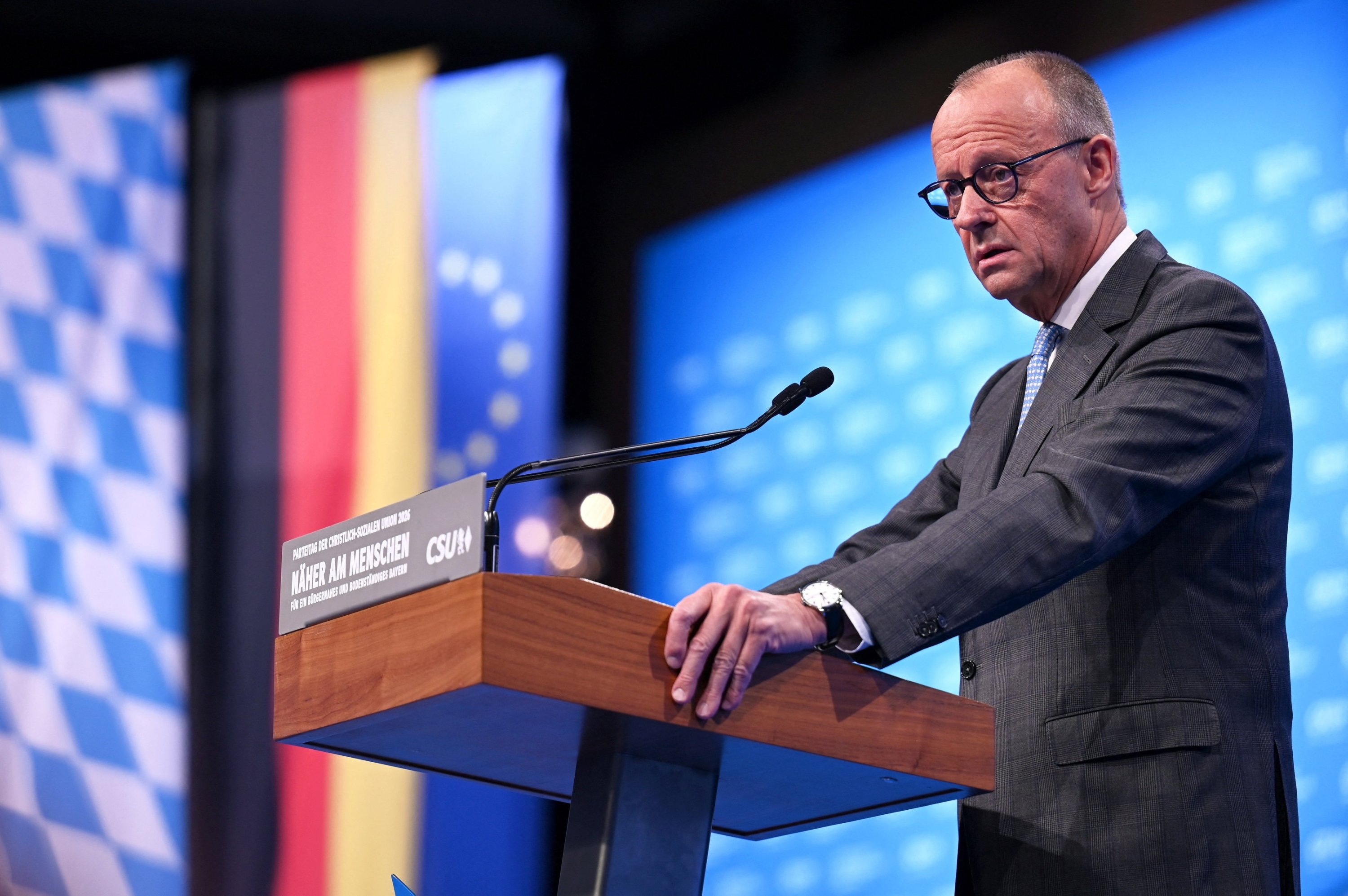
German Chancellor Friedrich Merz warned Saturday that Russia was seeking to destabilize Germany through cyberattacks, sabotage and other threats, urging his struggling coalition to unite behind economic reforms and defend the country's security.
Speaking at a convention of the Christian Social Union (CSU), the Bavarian sister party of his Christian Democratic Union (CDU), in Munich, Merz described the security situation in Europe as increasingly dangerous and called for a stronger response to threats from abroad and political extremism at home.
"We are facing a massive threat in the east of our continent. Russia's war of aggression against Ukraine has profoundly shaken the European peace order," Merz said.
"And we also see that Russia seeks to destabilize Germany, day in and day out," he added.
Merz said the threat extended beyond the war in Ukraine, pointing to cyberattacks, sabotage and attempted attacks against critical infrastructure across Europe. He cited an attempted drone attack involving a Ukrainian cargo plane at Leipzig Airport on Aug. 4 as an example of the risks facing Germany.
"This threat is no longer limited to Ukraine," Merz said, warning that such operations also sought to undermine democratic institutions and weaken public confidence.
"All of this threatens our freedom, and that is why we are investing in preserving our freedom," he added.
Russia has repeatedly rejected accusations that it is conducting a campaign of hybrid warfare against Germany and other European countries. Relations between Berlin and Moscow have deteriorated sharply since Russia launched its full-scale invasion of Ukraine in February 2022.
Merz's warning followed remarks by Germany's foreign intelligence chief, Martin Jaeger, who told parliament's intelligence committee on Oct. 5 that the confrontation with Russia had entered a more dangerous phase.
"Germany is in danger of becoming embroiled in a violent conflict with Russia. The attempted attack in Leipzig is only one example of that," Jaeger said.
"No other country currently poses such a direct, comprehensive and concrete threat to Germany," he added.
Merz's security warning came as his government faced mounting political pressure following poor regional election results and declining public approval.
The far-right Alternative for Germany (AfD) finished first in two eastern German states, while the far-left Left Party topped the vote in Berlin, highlighting the growing challenge facing the country's mainstream political parties.
Merz's approval ratings have fallen to record lows, while disagreements have intensified within the governing coalition and between the CDU and CSU. Although the two conservative parties have a long history of internal disputes, they have generally managed to maintain their alliance.
At the Munich convention, Merz praised CSU ministers serving in his government and paid tribute to CSU leader Markus Soeder in an effort to reinforce ties between the conservative partners.
He also reiterated his opposition to cooperating with the AfD, which leads national opinion polls. Some conservatives have called for a reassessment of the party's political isolation, but Merz insisted that working with the far right was incompatible with membership in the conservative alliance.
"Any politician who votes with the AfD has no place in our Union," he said.
Merz also urged the Social Democrats (SPD) and the Greens not to form a coalition with the Left Party in Berlin, accusing the party of tolerating antisemitism within its ranks. The Left Party denies that antisemitism is systemic within the organization.
The conference also exposed lingering disagreements over the succession to German President Frank-Walter Steinmeier, whose term is due to end next year.
Delegates applauded when Merz mentioned Ilse Aigner, a CSU politician proposed by the Bavarian party as its candidate for the largely ceremonial presidency. The CDU has not endorsed Aigner, and party sources say it has not ruled out putting forward its own candidate.
Beyond security concerns, Merz urged his coalition partners to move quickly on reforms to Germany's pension, tax and welfare systems, arguing that economic recovery was essential to restoring confidence in public institutions.
He said the conservative parties had a responsibility to strengthen Germany's social stability by addressing structural economic problems and implementing reforms that could revive growth.
The government has faced growing criticism over its economic performance, adding to the political challenges confronting Merz as his coalition struggles to maintain public support.
His appeal for unity reflected the pressure on the chancellor to demonstrate that his government can respond to security threats while tackling domestic economic concerns and preventing further gains by extremist parties.