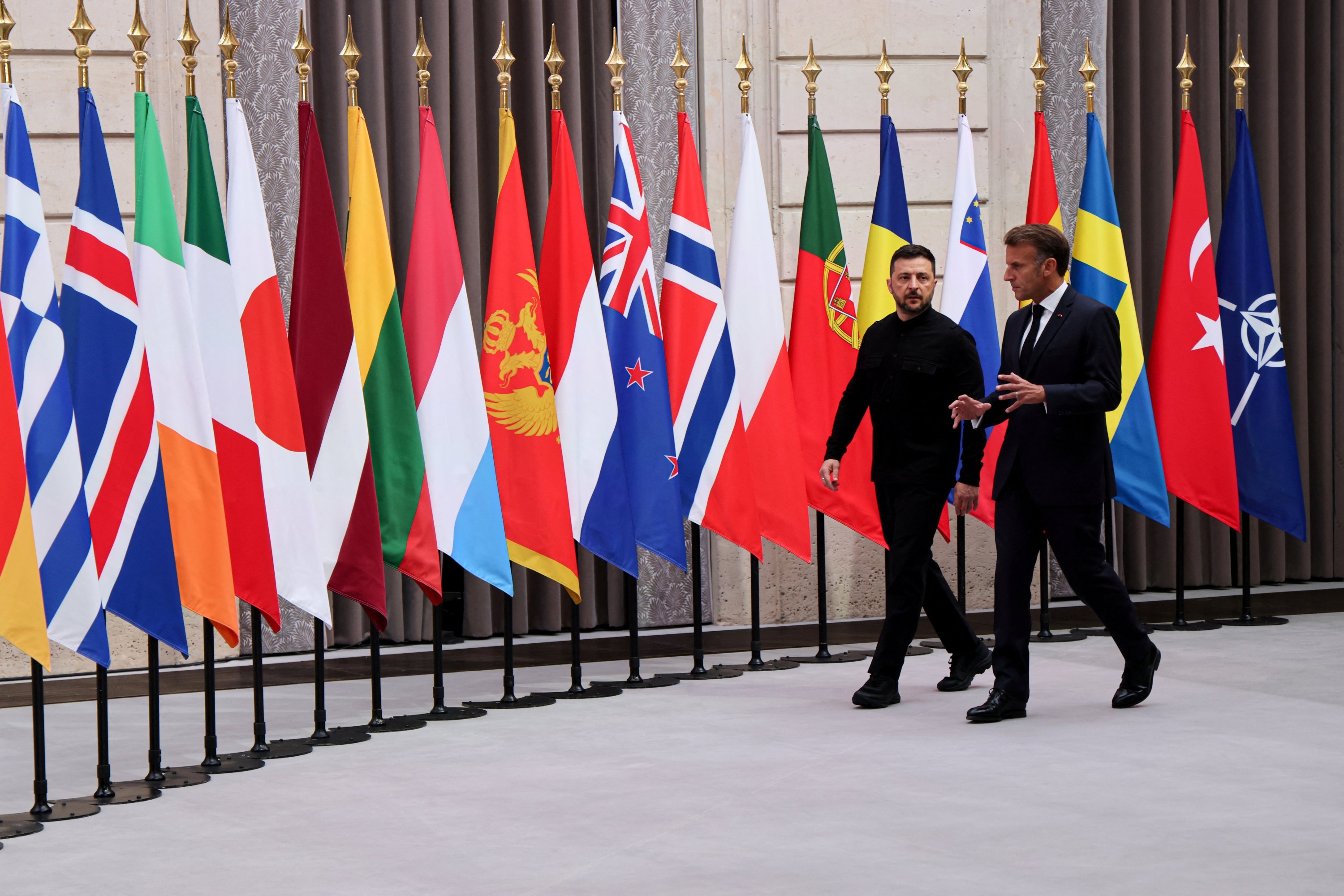
About 30 Western leaders met with Ukrainian President Volodymyr Zelenskyy on Thursday to discuss potential security guarantees for Kyiv under a future peace deal with Russia, seeking to win U.S. support for their plan.
The summit, both in person and by video-link, of the "coalition of the willing" brought together leaders, including Europe's biggest countries, but also the likes of Australia, Canada and Japan.
Members of the coalition, which does not include the U.S., have talked for months at various levels to define their prospective military support for Ukraine to help deter Russia from attacking it again if and when there is a final truce – still a remote prospect.
But those efforts have stalled as governments have said any European military role would need its own U.S. security guarantees as a "backstop." President Donald Trump has made no explicit commitment to provide those.
His special envoy Steve Witkoff met French, British, German, Italian and Ukrainian senior diplomats ahead of the summit, before briefly attending the opening session.
Zelenskyy is expected to have a one-on-one meeting with Witkoff, according to a person familiar with the matter.
French President Emmanuel Macron said alongside Zelenskyy in Paris on Wednesday that the coalition leaders would endorse plans for security guarantees drawn up by their militaries.
Two European officials said the "technical" plans had been finished, without going into detail on what that actually meant.
"We are ready, us Europeans, to provide security guarantees to Ukraine for when there is a signed peace," Macron said.
The two European officials said the aim would be to send a political signal to Trump. This would highlight the lack of progress toward direct peace talks between Russian President Vladimir Putin and Zelenskyy since Trump hosted Putin in August, and prod Trump to raise pressure on Moscow now.
Having rolled out the red carpet in Alaska, Trump on Wednesday accused Putin of conspiring with China and North Korea after the three countries' leaders staged a show of unity in Beijing at a lavish commemoration of the end of World War II.
NATO Secretary-General Mark Rutte said Wednesday he expected that the meeting would pave the way for more intense discussions with Washington on what guarantees it could provide.
Putin told Kyiv on Wednesday there was a chance to end the war in Ukraine via negotiations "if common sense prevails," an option he said he preferred, although he was ready to end it by force if that was the only way.
Western officials say the key element of the guarantees will be continuing strong support for Ukraine's armed forces.
But they were also expected to include an international force to assist and reassure Kyiv, based both in Ukraine and in neighboring countries, even though Russia is emphatically opposed to any foreign deployment in Ukraine.
Diplomats say big differences remain among allies on the issue. A German government source said Berlin was aware that politically it would be difficult to refuse, but militarily it would be difficult given troop commitments for Lithuania.
NATO's Rutte said Russia's views were irrelevant.
"Why are we interested in what Russia thinks about troops in Ukraine, it's a sovereign country. Russia has nothing to do with this," he said at a conference in Prague before joining the summit on Thursday. "I think we really have to stop making Putin too powerful."
European leaders have made clear such a force will only be feasible with U.S. backing – something Trump promised last month in general terms. But Washington has yet to spell out what it is willing to contribute.
Some of the leaders will call Trump after the summit, the French presidency said.
John Foreman, a former British defense attache to Kyiv and Moscow, said it was important to understand exactly what is on offer – especially for Zelenskyy as he weighs his position ahead of any direct talks with Russia.
"There is growing realisation that peace will require a strong Ukraine and Ukrainian army, that European support will need to be long-lasting, and that Ukraine probably can't rely on its allies coming to its aid to punish Russia should it reattack," he said.
"This is all prep work for a peace which remains illusory and remote due to Trump's incoherent diplomacy and the lack of substantive talks."