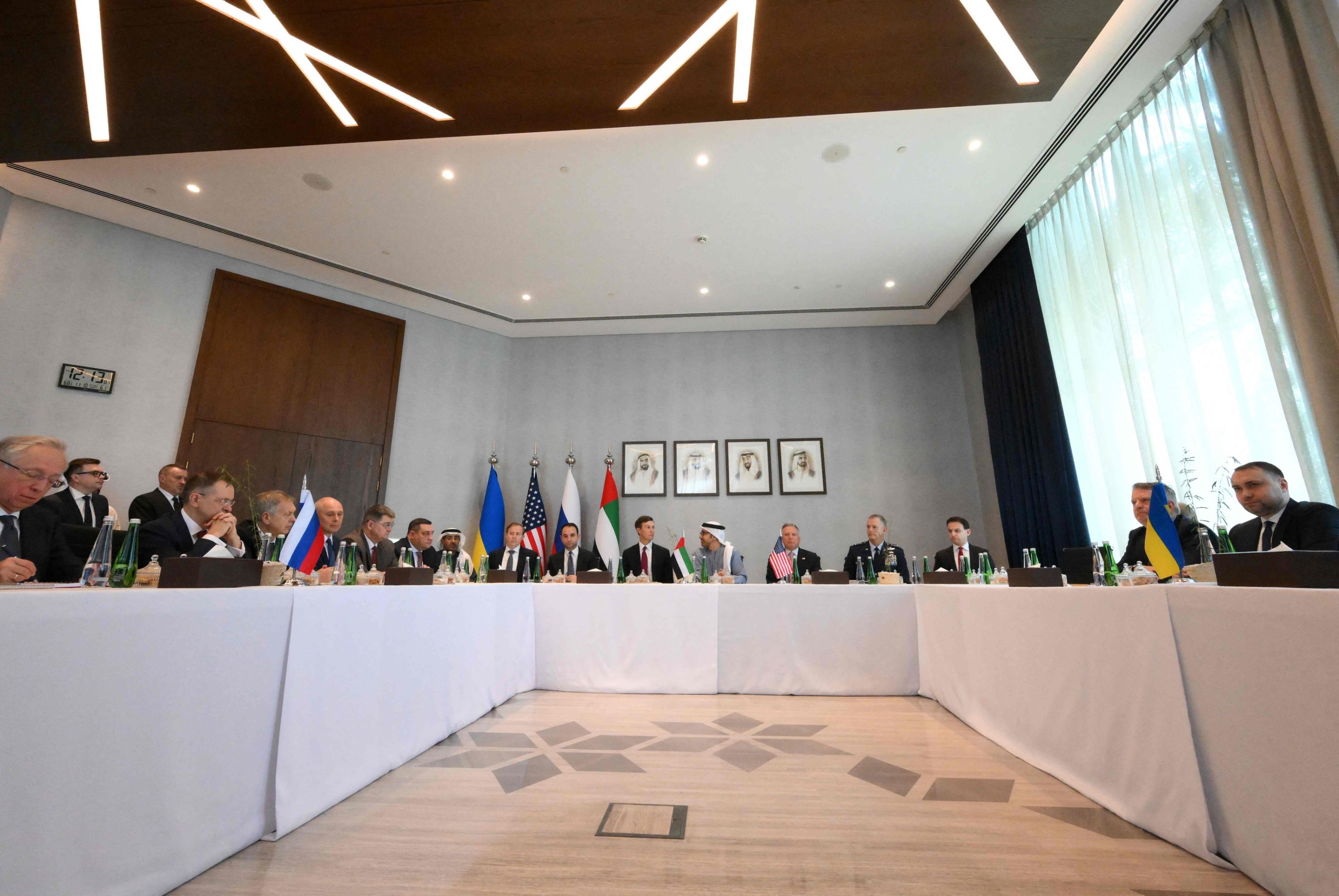
Russia and Ukraine resumed U.S.-mediated peace negotiations Tuesday for the first time in nine months, seeking a diplomatic breakthrough in the 4 1/2-year war as Washington and Kyiv described the discussions as productive and substantive.
Hopes of ending Europe's biggest conflict since World War II are tempered, however, by the absence of any significant breakthroughs in three previous rounds of talks earlier this year.
There's nothing to suggest a new posture that would lead to a breakthrough, but circumstances surrounding the talks have been changed by the outcome of the U.S. midterm elections as well as increased pressure on Russia's wartime economy. Moscow also is seeking to break Ukrainians' will as another winter sets in by ramping up its battering of the country's power grid.
Neither Rubio nor Zelenskyy attended the talks in Abu Dhabi, the capital of the United Arab Emirates. The session lasted four hours and another is scheduled for a second day Wednesday.
Delegations from Moscow and Kyiv met as Washington, represented by U.S. President Donald Trump's son-in-law Jared Kushner and envoy Steve Witkoff, renewed its push to stop the fighting.
"It looks like the talks in Abu Dhabi were very productive," Rubio said in Paris at the Group of Seven meeting, although he urged patience. "There's a lot of work to be done in that regard. It's not like something that's on the verge of being solved in the next 24 hours or anything like that."
Zelenskyy said the talks were largely about humanitarian issues, including prisoner exchanges and returning Ukrainian civilians in captivity, as well as children taken from the country. Security guarantees also were discussed, he added during an appearance at the University of Copenhagen in Denmark.
A senior Ukrainian official who spoke on condition of anonymity because he was not authorized to comment publicly said Ukraine and Russia talked about a large scale prisoner swap, although the details will be discussed in the coming days.
The two-day session is the first such meeting since February on Russia's full-scale invasion, which analysts and humanitarian organizations say has killed hundreds of thousands of soldiers and thousands of civilians.
Kushner said he believed there were "some good ideas how to bridge" the differences between the two sides.
Trump, whose stance on the war has varied, must reckon with Democrats taking over the U.S. Congress in January following the U.S. elections. Democrats could demand more support for Ukraine.
German Chancellor Friedrich Merz told ZDF television Monday night that "I don't have overly high expectations" for the talks.
There are no signs the fighting is abating, and the talks come against a backdrop of new long-range strikes by both Russia and Ukraine. The two armies are largely deadlocked on the front line.
Russia launched 162 drones of various types and a ballistic missile at Ukraine overnight, Ukraine's air force said.
Russia's Defense Ministry said its forces downed 155 Ukrainian drones overnight in eight Russian regions, as well as over the Crimean Peninsula, which Moscow illegally annexed from Ukraine in 2014.
Kushner said in opening remarks that the goal of the talks is to "create a new framework and a new understanding building upon the different institutions and understandings of the past."
"We take what's worked, we try to identify what's failed, why we're in this position and hopefully create a new framework that leads us for decades, if not centuries, of peace," he said.
NATO commander U.S. Gen. Alexus Grynkewich, who was also present, said the U.S. delegation looked forward "to working with both sides as we seek to advance the progress we've made in the past and continue this pursuit to set the foundations for a lasting peace."
Rustem Umerov, the head of Ukraine's Foreign Intelligence Service who leads Kyiv's delegation, thanked the U.S. for its peace efforts.
"Our people are waiting to end this war. And we hope that we will achieve the lasting peace for Ukraine," he said.
The head of the Russian delegation, Vladimir Medinsky, expressed hope the meeting "will allow us to advance on the path towards peace in the interests of the people of Russia and the people of Ukraine."
Umerov said the day began with a meeting between the Ukrainian team, the U.S. envoys and representatives from the United Kingdom, France, Germany, Italy, NATO and the European Commission.
Russia has objected to the Europeans' involvement in the three-way talks, but said EU representatives could join at a later stage.
The Russian and Ukrainian governments remain far apart on key elements of any prospective deal.
Russian President Vladimir Putin wants Ukraine to pull its troops back from four regions of Ukraine that Moscow annexed in September 2022 but has never fully captured. He also demands that Ukraine abandon its bid to join NATO and accept strict limits on its military, among other issues.
Putin wants a comprehensive peace deal on those conditions and won't agree to a general halt in hostilities, arguing that it would only allow Ukrainian troops to rest and replenish their weapons stockpiles.
Zelenskyy rejects Putin's demands to voluntarily cede territory. He also rejects any limits on Ukraine's military or its arrangements with Western partners, which Kyiv sees as essential security guarantees to stop Moscow from invading again.
Ukraine argues an immediate ceasefire is the necessary first step toward negotiating a wider settlement and says a direct meeting between Putin and Zelenskyy is the only way territorial issues can be settled. Putin has spurned those suggestions.
The Russian and Ukrainian delegations include senior officials who have attended previous rounds of talks.
Russia's chief negotiator is Medinsky, a Putin aide who has led Moscow's team since the first full-fledged peace negotiations with Ukraine in Istanbul in March 2022, although exploratory talks took place earlier in neighboring Belarus. The Russian delegation also includes deputy foreign ministers Sergei Ryabkov and Mikhail Galuzin and military intelligence chief Igor Kostyukov.
Ukraine's delegation includes Zelenskyy's chief of staff, Kyrylo Budanov.
Last week, Trump declared that some kind of grand deal about European security was in the works, describing it as "a big agreement" that is "going to involve more than Ukraine."
Kushner said Monday on X that a "comprehensive and lasting settlement will also require direct engagement between Russia and our European partners on the broader security arrangements that affect them."
Moscow has welcomed that approach. "The idea of defining clear parameters for a future security architecture, and only then moving on to resolving the actual Russian-Ukrainian conflict, is quite sensible," said Russian Foreign Minister Sergey Lavrov.