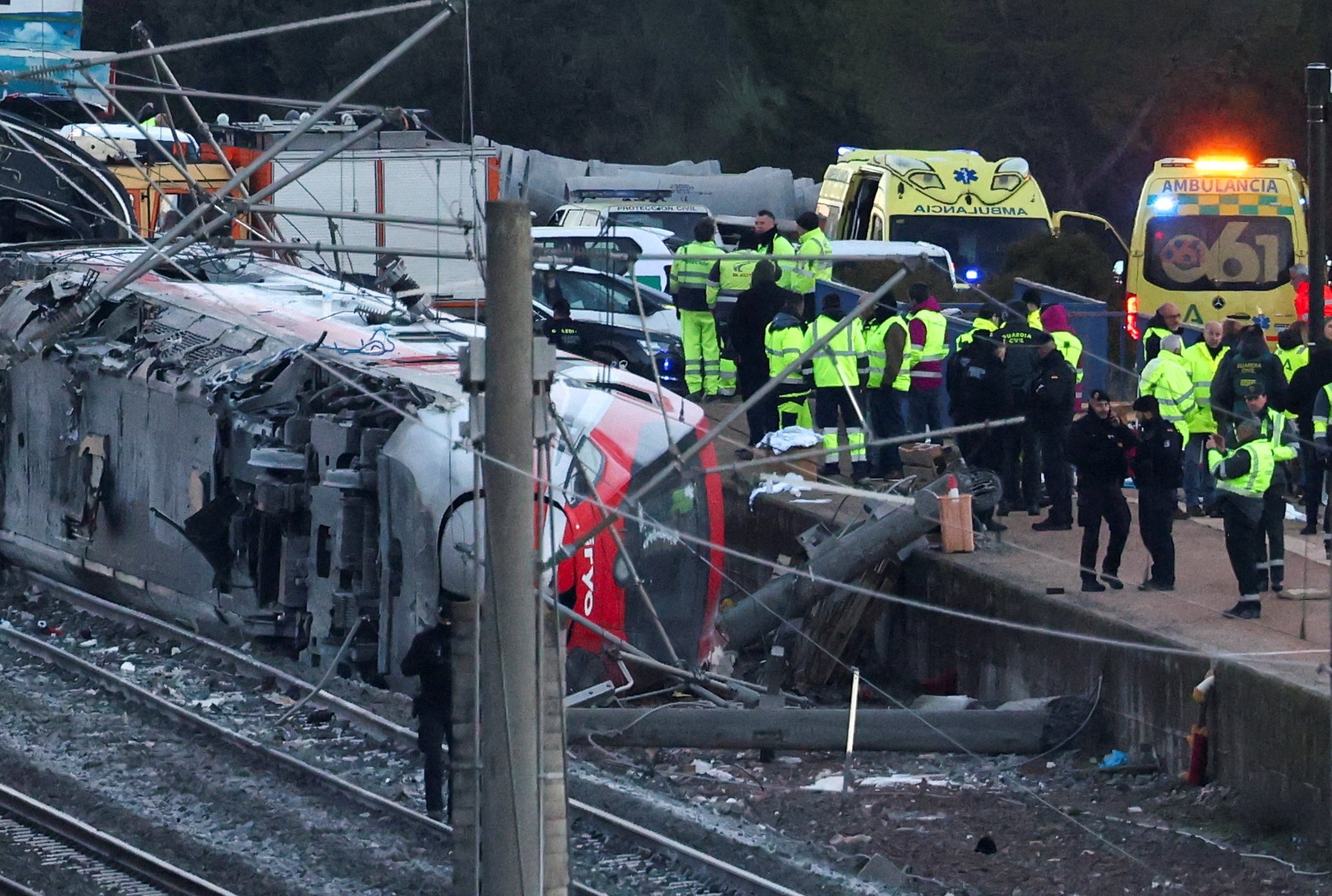
A high-speed passenger train derailed and slammed into an oncoming service in southern Spain on Sunday night, killing at least 39 people and injuring more than 120 in what officials described as an “extremely strange” disaster on one of Europe’s most modern rail networks.
The collision occurred near the town of Adamuz, in the province of Cordoba, when a Malaga-to-Madrid train operated by private company Iryo jumped the tracks at around 7:45 p.m. The rear section crossed onto the opposite line and struck a Madrid-to-Huelva train run by state operator Renfe, derailing both services, authorities said.
Spain’s Interior Ministry confirmed Monday that 39 deaths had been verified, sharply revising an earlier toll of 21. At least 123 people were injured, including five in critical condition and 24 seriously hurt. Officials warned the death toll could still rise.
Transport Minister Oscar Puente said the crash occurred on a straight, recently renovated stretch of track, a detail that has baffled investigators.
“This is a very strange accident,” Puente told reporters. “The train was practically new, the infrastructure was renewed just months ago, and there is nothing obvious at this stage to explain what happened.”
Rail experts, he added, were “very surprised” and cautioned that determining the cause could take weeks. Puente estimated a full investigation may last about a month.
Around 300 passengers were on board the Iryo train, the company said. Renfe has not disclosed passenger numbers on its service, which took the brunt of the impact.
Emergency crews worked through the night amid twisted metal and overturned carriages, some of which slid down a four-metre embankment.
Floodlights illuminated the scene as firefighters cut through mangled cars to reach survivors.
“The carriages are twisted, the metal is twisted with people trapped inside,” Francisco Carmona, head of Cordoba’s fire service, told public broadcaster RTVE. “In some cases, we had to remove a body to reach someone still alive. It’s hard, tricky work.”
A nearby sports centre was converted into a temporary medical facility, while the Red Cross set up an assistance hub for victims’ families. Civil Guard and civil defence units remained on site throughout the night.
Passengers described scenes of terror inside the trains.
Montse, a passenger on the Renfe service, told Spanish television that the train jolted violently before plunging into darkness.
“I was thrown around, luggage was flying, children were crying,” she said. “The attendant behind me hit her head and was bleeding. I was in the last carriage, I feel like I’ve been given a second chance at life.”
Lucas Meriako, who was travelling on the derailed Iryo train, said the impact felt catastrophic.
“We felt a huge hit from behind, like the whole train was about to collapse,” he told La Sexta. “Glass shattered everywhere. It looked like a horror movie.”
Journalist Salvador Jimenez, who was also aboard one of the trains, said passengers smashed windows with emergency hammers to escape after what felt “like an earthquake.”
Prime Minister Pedro Sanchez called the crash a national tragedy.
“Tonight is a night of deep pain for our country,” he wrote on X. “No words can ease such suffering, but Spain stands with the victims and their families.”
King Felipe VI and Queen Letizia said they were following developments “with great concern” and offered condolences to the families of the dead and wishes of a swift recovery for the injured.
French President Emmanuel Macron and European Commission President Ursula von der Leyen were among international leaders who expressed solidarity.
High-speed rail services between Madrid and the Andalusian cities of Cordoba, Seville, Malaga and Huelva were suspended on Monday, rail infrastructure manager Adif said.
Spain operates Europe’s largest high-speed rail network, with more than 3,100 kilometres of track designed for speeds exceeding 250 kph (155 mph).
The system is widely regarded as safe, affordable and heavily used, Renfe alone carried more than 25 million high-speed passengers in 2024.
The Adamuz crash is Spain’s deadliest rail disaster since 2013, when 80 people were killed after a train derailed near Santiago de Compostela while travelling at more than double the speed limit on a sharp curve.
Authorities stressed Monday that there is no indication yet of a similar cause in this case, underscoring the unusual nature of the accident.