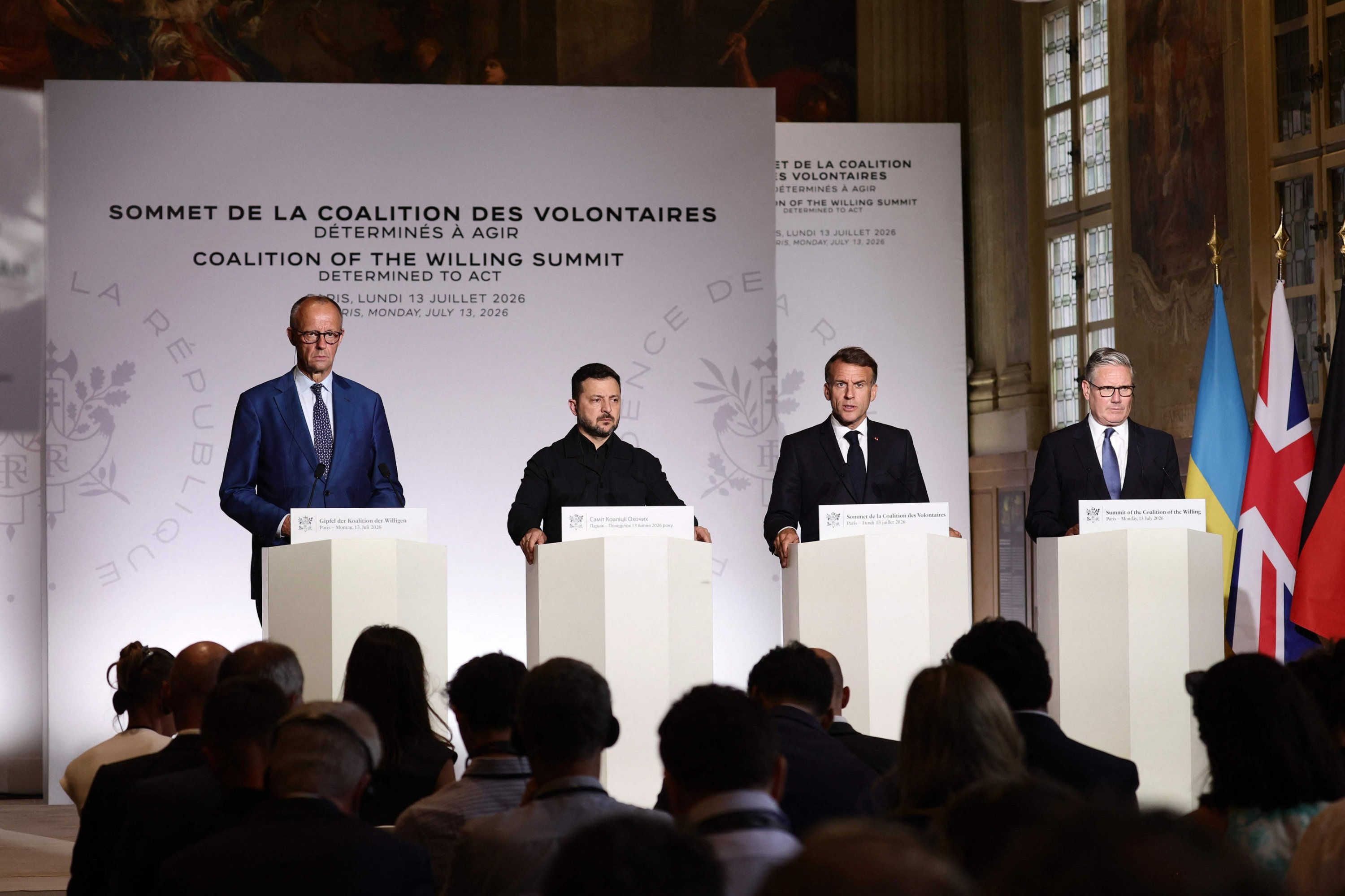
Ukraine and key Western allies launched on Monday an air-defense coalition that would include jointly developing a new anti-ballistic missile system as an alternative and more affordable solution to the U.S. Patriot system, as Kyiv continues to fight Moscow.
With Ukraine increasingly exposed to Russian ballistic missiles, leaders gathered in Paris for a summit, where 10 countries, along with about a dozen firms from the defense sector, met to press on with what they called the Integrated Anti-Ballistic Missile Coalition.
"We believe that the protection of Europe requires a global solution of integrated missile defense architecture to deter and defeat future missile threats," the leaders of Denmark, France, Germany, Italy, the Netherlands, Norway, Spain, Sweden, Ukraine and the U.K. said in a statement.
"It will complement existing ballistic missile defense systems, including sovereign European solutions already acquired, or to be acquired by participating countries."
Ukraine is critically low on munitions for its systems and has been largely unable to down ballistic missiles, which travel at several times the speed of sound, over the past month.
It has pleaded with allies for more supplies and has also pushed Europe to work with it on its own anti-ballistic air defense system.
As Russia's strikes have increased, Kyiv has intensified drone attacks inside Russia, targeting oil facilities and weapons production as it has shifted the battlefield momentum in the war.
Ukrainian President Volodymyr Zelenskyy joined some 25 leaders for a broader summit of the Coalition of the Willing, part of efforts that include putting together a common position that could be taken to Russia, and security guarantees to support any eventual peace deal.
Monday's meetings come days after a NATO summit that aimed to show trans-Atlantic unity and long-term support for Ukraine.
Russia has stepped up strikes on Kyiv and the surrounding region in recent weeks, killing dozens. Officials said Russian missile and drone attacks across Ukraine on Saturday left eight dead and many more wounded.
Moscow says it only attacks targets of military relevance and denies targeting civilians.
The ballistic coalition's efforts will center around the Freyja project, Ukraine's attempt to build a European-backed, lower-cost alternative to the Patriot system.
"The more means Ukraine has to shoot down Russian ballistic missiles, the greater the chance that Putin will come to the negotiating table, as his last argument in this war will no longer work," Zelenskyy said after Monday's announcement.
"Our work on a joint system, Freyja, is not intended to replace existing systems. It is a way to supplement our defense, create a strong shield over the entirety of Europe, and do all of this faster and at a lower cost."
He later said the system, which would be like a Lego bringing in expertise from different European firms, could be operational within 12 months and enable all stakeholders to produce the weapon.
About a dozen companies from across Europe, including the SAMP-T manufacturer Eurosam, Leonardo, Thales, Saab, as well as Ukraine's Fire Point, were among those attending.
"It will also help our defense industries in Europe work even more closely together and learn from one another," German Chancellor Friedrich Merz said.
The meeting also addressed how more U.S. Patriot interceptors could be sourced, but also advanced the deployment of the Franco-Italian SAMP-T air defense system.
Speaking alongside Zelenskyy, France's President Emmanuel Macron said Ukraine had ordered the delivery of the next- generation SAMP-T, which would follow deliveries of the older version and a batch of missiles.
In the meantime, France was also allowing Ukraine to produce the interceptor missile for the system, which it already operates, precision guided bombs and the long-range SCALP cruise missile, a move that marked the first time Paris was licencing capabilities to Ukraine.
Ukraine would also receive sixteen Rafale warplanes by 2028-2029, Macron said.
The coalition also announced joint military exercises in countries bordering Ukraine as it sought to make the concept of a future multinational force in Ukraine (MNFU) more of a practical reality, Macron said.