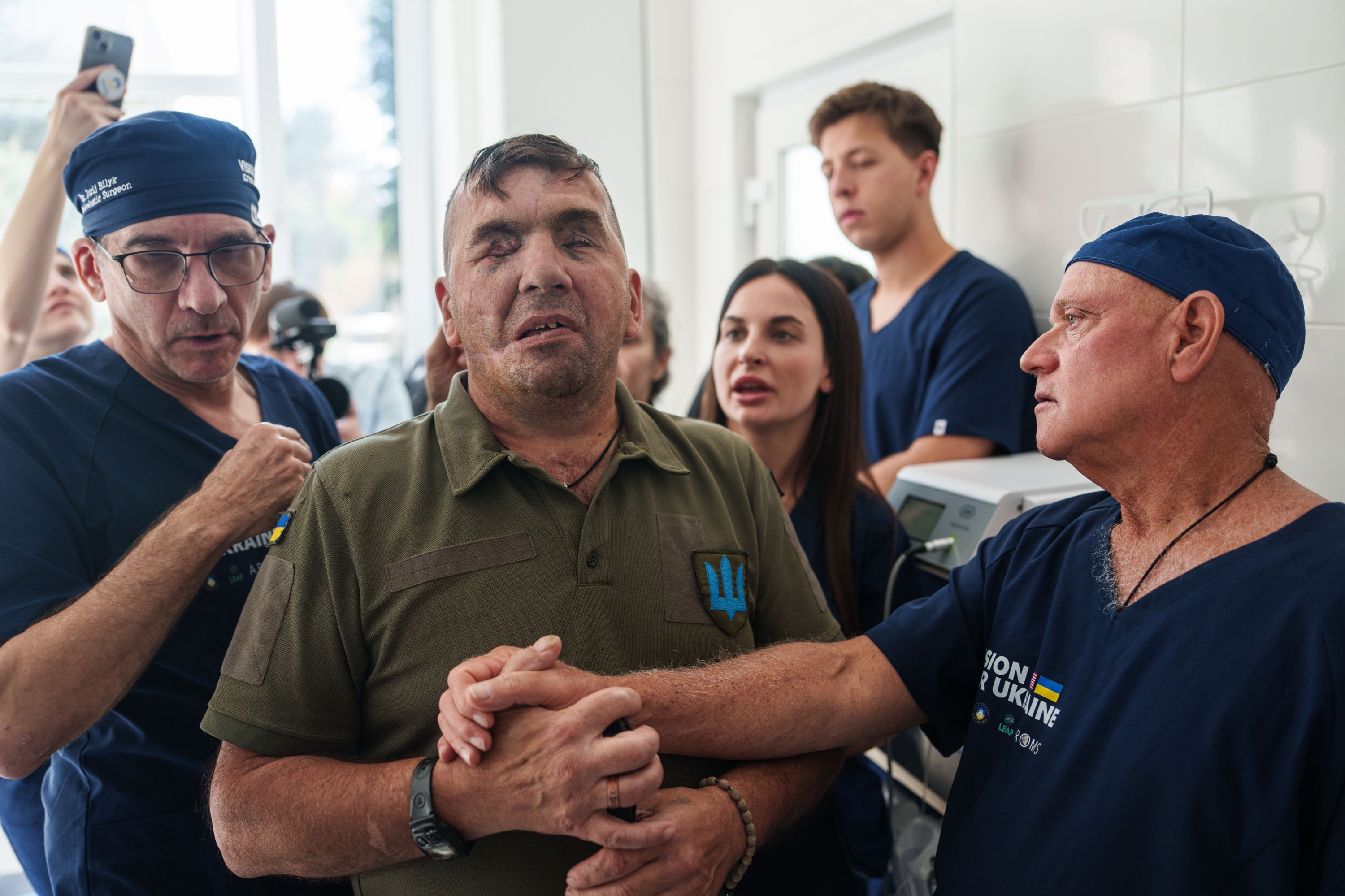
Mykola Kasiuk refused to give up on his remaining eye, even after doctors told him he had lost his sight and recommended removing it. Two years after a land mine left him nearly blind, the Ukrainian soldier was placing his hopes in a team of U.S. surgeons working to repair the damage.
Lying in a hospital bed in Kyiv before surgery, Kasiuk crossed himself and prayed.
“I want to be able to see my children again,” he said.
Russia’s war in Ukraine has left soldiers and civilians with devastating eye and facial injuries, while specialists capable of treating complex cases remain scarce.
Before Russia’s full-scale invasion in 2022, eye care at many Ukrainian hospitals was largely limited to routine procedures such as cataract surgery.
A visiting team of American surgeons is helping fill that gap by treating severely injured patients and training Ukrainian doctors in oculoplastic surgery, which repairs the structures around the eyes. The procedures range from reconstructing damaged eye sockets and eyelids to fitting artificial eyes.
For Kasiuk, the operation offered a chance to preserve an eye that local doctors had considered beyond saving.
“No, I won’t let them,” he told his wife, Tetyana, when she relayed the recommendation to remove it. “This is my last hope.”
Kasiuk had trained as a military cook, not an infantryman. But after joining the military, he was given a rifle and sent into some of the fiercest fighting in eastern Ukraine.
His final memories of the world around him are scenes of devastation in the Donetsk region: fellow soldiers killed in combat, homes reduced to rubble and dogs wandering through the ruins. He remembers hearing Russian soldiers nearby and the pervasive smell of death.
On April 16, 2024, Kasiuk was walking with fellow soldiers when he stepped on something and fell. His commanders later told Tetyana that he had triggered a land mine.
The evacuation vehicle carrying him came under fire. Almost everyone inside was killed.
When Tetyana arrived at the hospital, she struggled to recognize the swollen, bandaged man covered in shrapnel wounds. His teeth had been shattered, and his face was barely recognizable.
“This is not my husband,” she told a hospital attendant.
Then she noticed the tattoos on his hands. They were his.
Doctors removed one eye after shrapnel pierced it and raised concerns about infection. They operated on the other but suspected the optic nerve had been damaged. Kasiuk was transferred between hospitals and underwent repeated operations, with little improvement in his vision.
He gradually learned to navigate life without sight. He uses an old mobile phone to make calls and listen to the news, and recently learned to style his own hair. When Tetyana switches on a lamp, he tells her that the faint light he can still perceive becomes brighter.
That small trace of vision has kept hope alive.
The American surgeons came to Kyiv through Vision for Ukraine, a medical mission organized by the Christian Medical Association of Ukraine. They would not know the full extent of the damage until they operated on Kasiuk’s eye socket.
Stuart Seiff, an oculoplastic surgeon from San Francisco, approached the case cautiously. The immediate priority was to reconstruct the socket and eyelids, improve the eye’s protection and restore some of Kasiuk’s appearance and sense of normality.
“The socket on the right is very contracted,” Seiff said.
Surgeons can rebuild the damaged lining using tissue taken from inside the mouth or behind the ear, or a specially prepared amniotic membrane that helps healing and reduces scarring. If vision cannot be restored, an artificial eye can provide a more natural appearance.
That was the outcome for Artem Deresh, another wounded Ukrainian soldier. His prosthetic eye, meticulously hand-painted in a Kyiv laboratory, looks almost real.
“I don’t want to stand out from the crowd. I also don’t want to make people uncomfortable,” Deresh said.
For Kasiuk, the stakes extended beyond his appearance. He wanted to regain even a small measure of independence and, if possible, see his family again.
On the day of surgery, a nurse helped him into scrubs and wheeled him toward the operating room. He prayed aloud along the way, repeatedly asking questions about the procedure and whether it would work.
The nurse tried to reassure him, telling him not to worry and that he would be beautiful.
The operation unfolded under the constant threat of Russian attacks. An air-raid alert interrupted the hospital’s routine, potentially delaying procedures for hours. When the alert ended, applause broke out across the ward as staff rushed to resume their work.
During the hourslong operation, a major strike hit Kyiv’s National Sciences Building, sending plumes of smoke into the air. Hours later, another strike hit a medical facility in the city.
Back home in Chernivtsi, in western Ukraine, Tetyana waited anxiously, knowing that the surgeons’ findings could shape the family’s future.
The man she had known before the war was gone, she said. Kasiuk had worked in factories to support the family, and together they had raised three daughters.
“He lives in his own little world now,” Tetyana said.
Kasiuk lives with almost constant pain, and his days and nights have lost their rhythm. Sometimes he sleeps through the day and remains awake all night.
His daughters are growing up, each moving toward a future he cannot see. His eldest is studying psychology, while his middle daughter is pursuing art and has won awards for her paintings. The youngest, now in sixth grade, remembers a father who could see, play with his children and take them on trips.
His condition has traumatized the children, Tetyana said.
She tries to shield her husband from worries she fears he cannot bear while navigating disability paperwork, pursuing further treatment and holding the family together. The burden has left her exhausted.
“Sometimes I wish someone would understand that I get tired, too,” she said.
The surgeons found more potential for recovery than they had expected.
They restored movement in Kasiuk’s eye and used skin grafted from behind his ear to help the eyelid protect it. The procedure also opened the possibility of a corneal transplant.
“He has a fantastic result at this point, absolutely fantastic,” Seiff said.
Whether Kasiuk will regain his sight remains uncertain. Doctors suspect scarring on the cornea, the transparent front surface of the eye, is clouding his vision. They still do not know how much damage lies deeper inside the eye or whether it can transmit visual signals to the brain.
His recovery will depend partly on how the eye heals. Scar tissue could form again and cloud the cornea, potentially undermining the gains made during surgery.
“That’s the big enemy. We try to control it, but there’s only so much you can do,” Seiff said.
Doctors plan to monitor Kasiuk for up to six months before deciding whether he needs another intervention. Options could include using stem cells to support a corneal transplant or implanting an artificial cornea.
For now, Kasiuk is holding on to the possibility that some of the world he remembers might return.
“I remember what the world looked like: the sun, the blue sky, the clouds,” he said. “I hope I’ll be able to see this beautiful world again, even if only a little.”