The United States is still insisting that Ukraine give up significant amounts of territory to Russia in order to bring an end to the conflict initiated by Moscow's February 2022 invasion, Ukrainian President Volodymyr Zelenskyy said on Thursday.
Negotiators in the U.S.-led peace talks are wrestling with the question of territorial possession, including the future of Ukraine's eastern Donetsk region and the Russian-occupied Zaporizhzhia nuclear power plant, one of the world's 10 biggest atomic plants.
Zelenskyy revealed details of the ongoing discussions before he headed into urgent talks Thursday with leaders and officials from about 30 countries that support Kyiv's efforts to obtain fair terms in any settlement to halt nearly four years of fighting.
Ukraine submitted a 20-point plan to the U.S. on Wednesday, with each point possibly accompanied by a separate document detailing the settlement terms, Zelenskyy said.
"We are grateful that the U.S. is working with us and trying to take a balanced position," he told reporters in the Ukrainian capital Kyiv. "But at this moment it is still difficult to say what the final documents will look like."
"We have two key points of disagreement: the territories of Donetsk and everything related to them, and the Zaporizhzhia nuclear power plant. These are the two topics we continue to discuss," he said.
Later on Thursday, Zelenskyy said he had discussed U.S. security guarantees with top officials from the Trump administration.
Secretary of State Marco Rubio, Trump's special envoy Steve Witkoff, Defense Secretary Pete Hegseth and Trump's son-in-law Jared Kushner were all on the call, as was NATO Secretary-General Mark Rutte, Zelenskyy said on social media.
He said Ukraine must know how its partners would respond if Russia launched a new attack after a peace deal. "In the near future, there will be a clear understanding of the security guarantees," he noted, without providing details.
Russia has in recent months made a determined push to gain control of all parts of Donetsk and neighboring Luhansk, which together make up Ukraine's valuable Donbas industrial region.
Ukraine doesn't accept the surrender of Donbas, Zelenskyy said, stressing that both sides remaining where they currently stand along the line of contact would be "a fair outcome."
American negotiators have put forward the possibility of a "free economic zone" in the Donbas, with the Russians terming it a "demilitarized zone," according to Zelenskyy.
Russian officials have not publicly disclosed their proposals.
U.S. negotiators foresee Ukrainian forces withdrawing from the Donetsk region, with the compromise being that Russian forces do not enter that territory, Zelenskyy said.
But he said that if Ukraine must withdraw its forces, the Russians should also withdraw by the same distance. There are "many questions" still unresolved, including who would oversee the Donbas, he added.
Zelensky has long said he has no "constitutional" or "moral" right to cede Ukrainian land, and said his citizens should have the final say on the issue of territory.
"I believe that the people of Ukraine will answer this question. Whether through elections or a referendum, there must be a position from the people of Ukraine," he said on Thursday.
The Russians want to retain control of the Zaporizhzhia plant in southern Ukraine, which is not currently operating, but Ukraine opposes that.
The Americans have suggested a joint format to manage the plant, and negotiators are discussing how that might work, Zelenskyy said.
The leaders of Germany, Britain and France were among those taking part in Thursday's meeting of Ukraine's allies, dubbed the Coalition of the Willing, via video link.
Zelenskyy indicated the talks were hastily arranged as Kyiv officials scramble to avoid getting boxed in by U.S. President Donald Trump, who has disparaged the Ukrainian leader, painted European leaders as weak, and set a strategy of improving Washington's relationship with Moscow.
In the face of Trump's demands for a swift settlement, European governments are trying to help steer the peace negotiations because they say their own security is at stake.
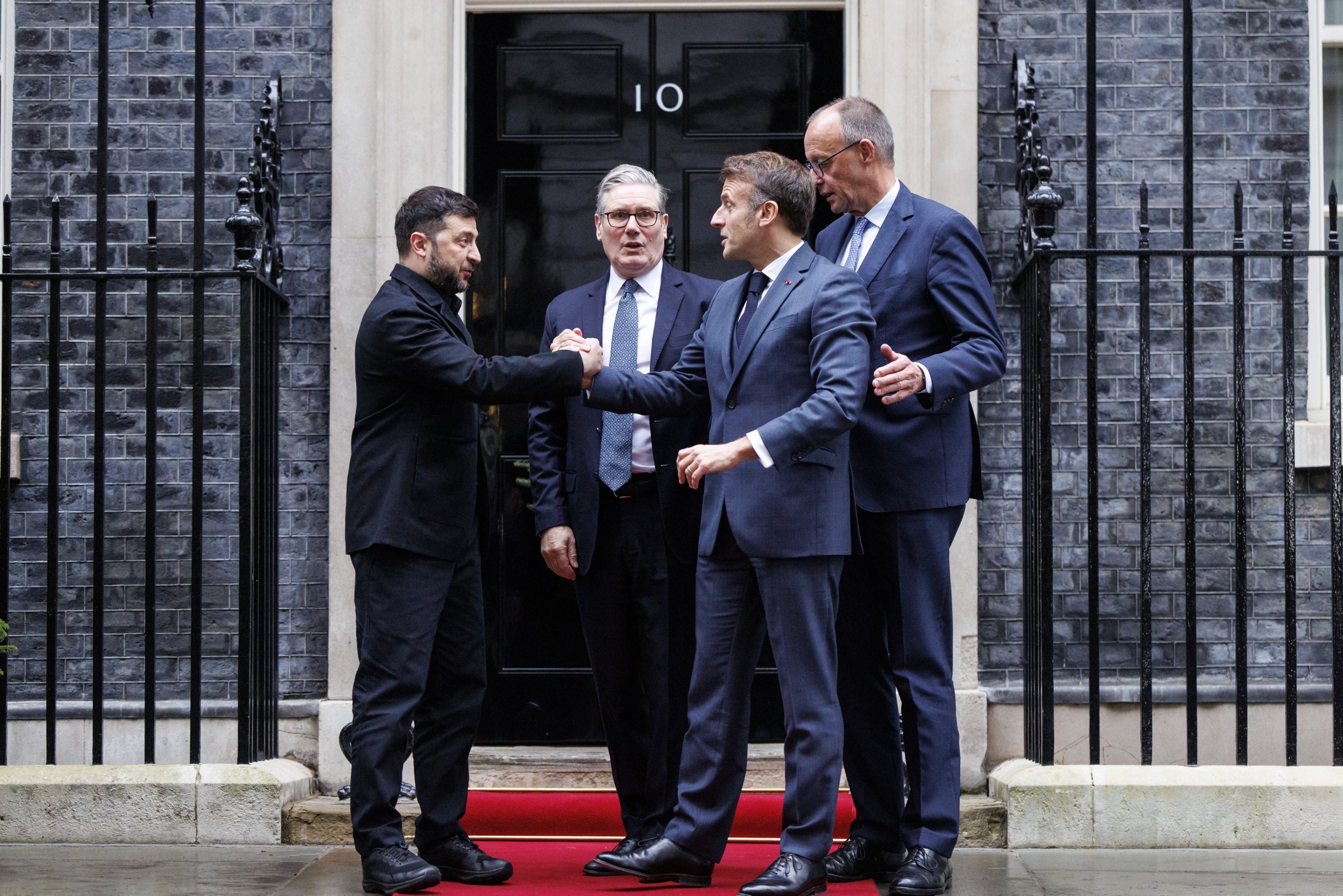
German Chancellor Friedrich Merz said Thursday that he, British Prime Minister Keir Starmer and French President Emmanuel Macron suggested to Trump that they finalize the peace proposals together with U.S. officials over the weekend. There may also be talks in Berlin early next week, with or without American officials, he said.
The talks are at "a critical moment," European leaders said Wednesday.
Next week, Ukraine will coordinate with European countries on a bilateral level, Zelenskyy said late Wednesday, and European Union countries are due to hold a regular summit in Brussels at the end of next week.
Trump's latest effort to broker a settlement is taking longer than he wanted. He initially set a deadline for Kyiv to accept his peace plan before Thanksgiving. Previous Washington deadlines for reaching a peace deal also have passed without a breakthrough.
Russia is also keen to show Trump it is engaging with his peace efforts, hoping to avoid further U.S. sanctions. Russia's Foreign Minister Sergey Lavrov said Thursday that Russia has relayed to Washington "additional proposals ... concerning collective security guarantees" that Ukraine and Europe say are needed to deter future aggression.
NATO Secretary-General Rutte said Thursday that so far this year Russia has launched over 46,000 drones and missiles against Ukraine.
He warned his European audience at a speech in Berlin: "We are Russia's next target."
He also described China as "Russia's lifeline" for its war effort in Ukraine by providing most of the critical electronic components Moscow needs for its weapons. "China wants to prevent its ally from losing in Ukraine," Rutte said.
Putin claimed Thursday in a call with military leaders that Russian armed forces are "fully holding the strategic initiative" on the battlefield.
Russian troops have taken the city of Siversk, in the Donetsk region of eastern Ukraine where fighting has been fierce in recent months, Lt. Gen. Sergei Medvedev told Putin.
Ukrainian officials denied Siversk had been captured.
Putin wants to portray himself as negotiating from a position of strength, analysts say, although Russia occupies only about 20% of Ukraine. That includes Moscow's 2014 illegal annexation of Crimea and the seizure of territory in the east by Russia-backed separatists later that year, as well as land taken after the full-blown invasion in 2022.
Meanwhile, Ukrainian long-range drones hit a Russian oil rig in the Caspian Sea for the first time, according to an official in the Security Service of Ukraine who was not authorized to talk publicly about the attack and spoke on condition of anonymity.
The oil rig in the northern part of the Caspian Sea, about 1,000 kilometers (600 miles) from Ukraine, belongs to Russia's second-biggest oil company, Lukoil, the official told The Associated Press (AP). The rig took four hits, halting the extraction of oil and gas from over 20 wells, he said.
Russian officials and Lukoil made no immediate comment on the claim.
Ukraine also launched one of its biggest drone attacks of the war overnight, halting flights in and out of all four Moscow airports for seven hours. Airports in eight other cities also faced restrictions, the Russian civil aviation authority Rosaviatsia said.