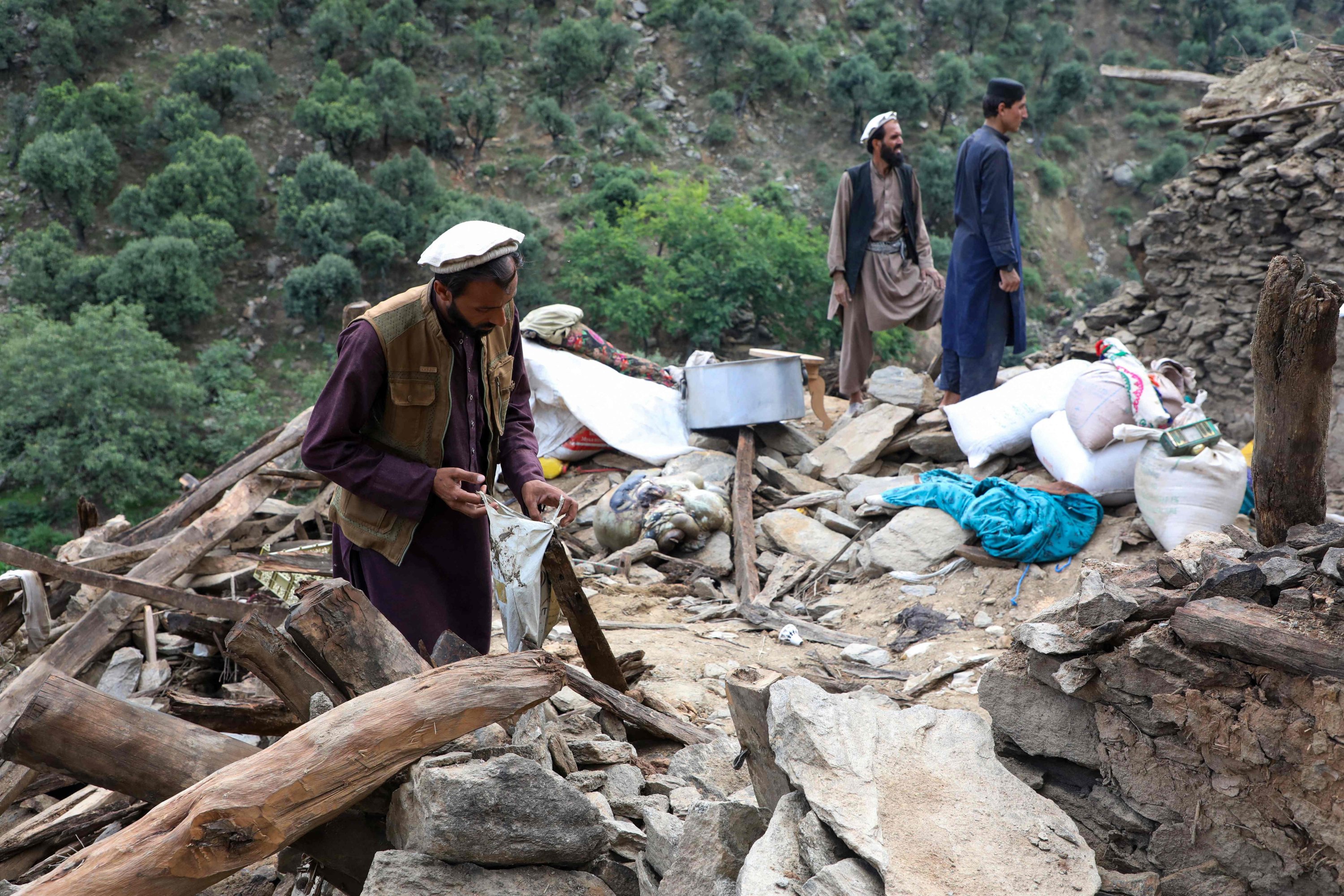
Following a powerful magnitude 6.0 earthquake that struck eastern Afghanistan late Sunday, rescue and relief efforts are being hampered by aftershocks, blocked roads, and widespread destruction, the United Nations Office for the Coordination of Humanitarian Affairs (OCHA) said.
Amy Martin, OCHA’s head of office in Afghanistan, told Anadolu Agency (AA) that Kunar province has been particularly devastated, with entire villages reduced to rubble.
“It’s a very mountainous, rural area with small communities. Most of the structures were made of mud and stone and simply could not withstand a shallow quake of this magnitude,” Martin said.
The earthquake shook at least four eastern provinces – Nangarhar, Laghman, Panjshir, and Kunar – with Kunar reporting the majority of fatalities.
Martin described the crisis as both devastating and urgent, noting that relief and assessment teams are struggling to reach some of the most isolated villages.
“Teams are out assessing affected communities and the damage in Kunar province. It is particularly hard hit, as are some of the smaller districts. But we’re also experiencing aftershocks, which are causing landslides and rockslides that block access roads,” she said.
According to the Afghan Red Crescent, the death toll in Kunar, the epicenter of the earthquake, has climbed to at least 2,205, with 3,640 injured.
At least 12 deaths have been reported in Nangarhar, and the total number of injured across all provinces has surpassed 4,000.
More than 8,000 houses have been destroyed, the Red Crescent said.
Martin cautioned that access challenges mean new figures are arriving slowly and are expected to rise as teams reach cut-off communities.
The U.S. Geological Survey recorded the quake at 11:47 p.m. local time Sunday (7:17 p.m. GMT), 27 kilometers (17 miles) east-northeast of Jalalabad, at a depth of 8 kilometers (5 miles). Most residents were asleep when the earthquake struck.
It is the third major earthquake to hit Afghanistan since the Taliban returned to power in August 2021.
In June 2022, a 6.1-magnitude quake in eastern provinces killed at least 1,036 people and caused thousands of homes to collapse.
In October 2023, a 6.3-magnitude earthquake in Herat province killed more than 2,000 people and injured over 9,000.
Despite the difficult situation, search and rescue teams have reached the hardest-hit areas, deploying heavy equipment and helicopters to reach remote locations where people remain trapped under rubble.
Relief efforts include mobile health teams, food supplies, tents, and water and sanitation support.
With winter approaching, OCHA is prioritizing non-food items such as blankets and tarpaulins.
Hundreds of animals also perished in the quake, raising concerns about waterborne diseases.
“We’re very mindful of the risks of waterborne diseases, and measures are being taken to safely dispose of livestock killed in the quake to prevent contamination,” Martin said.
The Taliban-led interim administration, with U.N. support, has established tent villages to shelter thousands of displaced people.
Türkiye dispatched 25 tons of aid this week, including shelter materials, hygiene kits, and food boxes.
Neighboring Pakistan, Iran, China, and India, as well as several Western nations, have pledged additional aid.
The quake’s shallow depth of 8-10 kilometers (5-6 miles) amplified its destructive power, causing significant damage in eastern Afghanistan and being felt across the border in Pakistan.
“The shallowness of the quake was a major factor. Combine that with the fact that rural homes here are not built to withstand such shocks, and the result is catastrophic,” Martin said.
Local residents described widespread destruction. “I went to some villages for rescue efforts and witnessed a very painful situation.
Some houses were completely wiped out, and no one from those families survived,” said Abdul Wahid, a resident in Kunar.
Most homes were built from mud by poor families.
Authorities had planned to relocate residents to safer locations, but many refused, prompting the interim administration to establish tent villages within their own communities.
OCHA plans to launch a flash appeal next week after collecting complete data on the damage.
“People will only want to stay in temporary shelters for as short a time as possible. They want to return to their crops and livelihoods,” Martin said. “We will support community by community, but ultimately people must decide where and how they rebuild.”