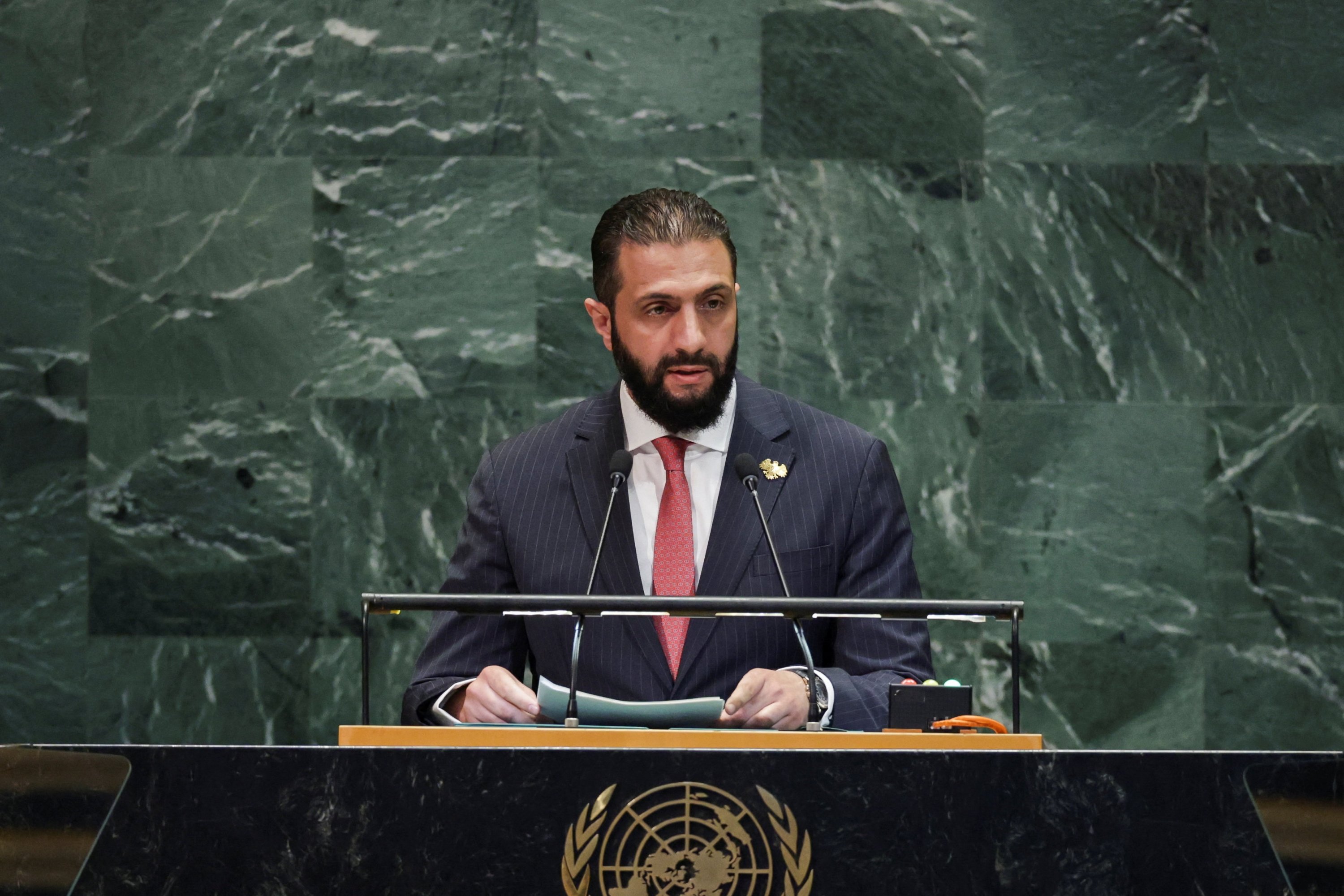
Syrian interim President Ahmad al-Sharaa said Wednesday that the country is recovering from years of conflict and urged the international community to back its reconstruction efforts.
"Syria today is rebuilding itself, and as a nation of civilization, it deserves to be a state of law," al-Sharaa told world leaders at his historic appearance at the U.N. General Assembly, the first by a Syrian head of state since 1967.
Syria is "writing a new chapter in its story, titled peace, stability, and prosperity," he said.
The leader expressed gratitude to countries that stood by Syria during difficult times, particularly Türkiye, Qatar, Saudi Arabia, all Arab and Muslim countries, the U.S., and the EU.
Al-Sharaa further pledged Syria's commitment to the 1974 Disengagement Agreement with Israel, urging the international community to respect Syria's sovereignty and territorial integrity.
"We call on the world to stand with us in the face of these dangers," he stressed.
Hundreds of Syrians gathered outside the United Nations headquarters in New York on Wednesday to welcome al-Sharaa ahead of his historic address to the U.N. General Assembly, the first by a Syrian head of state since 1967.
Images released by the Syrian Arab News Agency (SANA) showed large crowds waving flags near the U.N. building, describing the gathering as a show of support for Sharaa. State television Al-Ikhbariya aired similar footage, calling it a welcoming rally before the president’s speech.
Al-Sharaa arrived in New York on Sunday with several ministers to take part in the annual U.N. meetings, ending nearly six decades of Syrian absence from the world body’s top forum.
Syria has boycotted the Assembly at the presidential level since the 1967 Arab-Israeli war, when Israel occupied the Golan Heights. Damascus long accused the U.N. and other international institutions of siding with Israel because of backing from the U.S. and its Western allies.
The last Syrian leader to attend the U.N.summit was former President Nureddin al-Atassi, who served from 1966 to 1970.
Since Bashar Assad’s ouster in late 2024, Syria’s new administration has pursued political and economic reforms while promoting social cohesion and working to expand cooperation with regional and international partners.
Assad, Syria’s leader for nearly 25 years, fled to Russia last December, ending the Ba'ath Party regime, which had been in power since 1963. Al-Sharaa’s new transitional administration was formed in January.