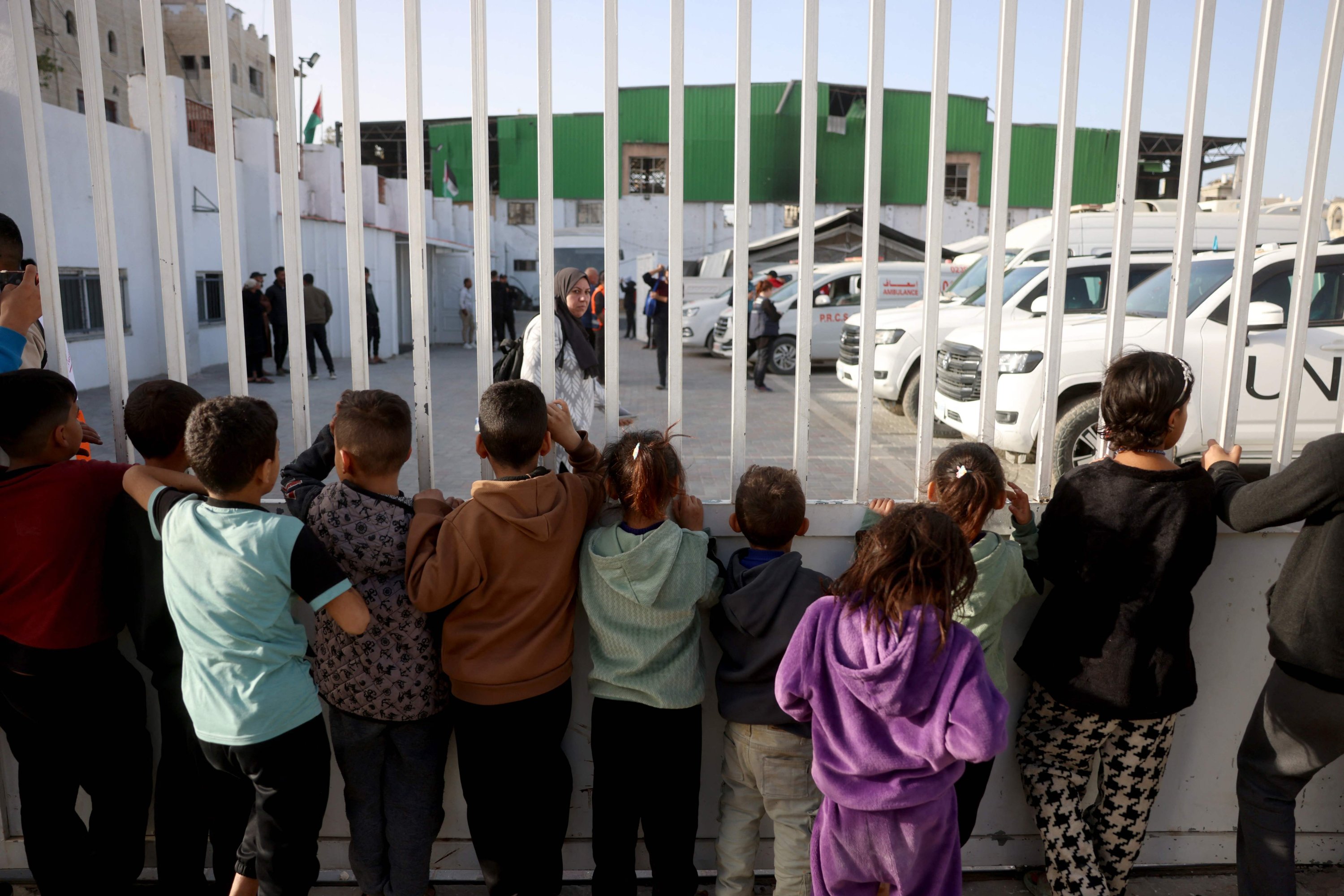
Palestinians attempting to return to the Gaza Strip through the Rafah border crossing with Egypt describe interrogations, detentions and alleged pressure tactics, including offers of money to leave or cooperate with the Israeli army, according to testimonies and human rights groups.
On Wednesday, Gaza's Government Media Office said only 488 travelers of 1,800 had been able to cross Rafah in both directions since its reopening through Tuesday -- an Israeli compliance rate of about 27%.
In a statement, the office said 275 people left Gaza while 213 entered, and 26 travelers were denied permission to leave for Egypt during the same period.
Israel reopened the Palestinian side of the crossing on Feb. 2 after closing it since May 2024, but only in a very limited manner and under extremely strict conditions.
On Feb. 5, the U.N. Office of the High Commissioner for Human Rights in the Occupied Palestinian Territory said returnees reported after crossing, that they were taken by armed Palestinians, backed by the Israeli army, identified as members of the Abu Shabab militia, to an Israeli military checkpoint. There, some were handcuffed, blindfolded, searched, threatened and had personal belongings confiscated.
The same day, Israel's public broadcaster KAN reported that Israeli authorities had allowed members of the Abu Shabab militia to take part in searches of Palestinians entering and leaving Rafah.
A day later, the Yedioth Ahronoth newspaper reported that Israel was secretly supporting armed militias in Gaza with money, weapons and field protection to counter Hamas, operating in areas where Israeli forces are deployed under a ceasefire agreement.
According to the paper, the Israeli army has used the militias "for limited tactical tasks, including pursuit and arrest operations and searching for Hamas fighters in tunnels or among the rubble."
The U.N. human rights office said returnees described a pattern of violence, degrading interrogations and intrusive body searches that violated their privacy. In some cases, people in need were denied medical care or access to toilets, resulting in severe humiliation.
Several returnees said they were asked whether they would accept money to go back to Egypt with their families and never return to Gaza. Others said they were offered money to act as informants for the Israeli army.
Taken together, the testimonies point to a pattern of conduct that violates Palestinians' rights to personal security and dignity, and their protection from torture and cruel, inhuman or degrading treatment, the office said.
It warned that the reported practices raise serious concerns about coercive measures aimed at discouraging Palestinians from exercising their right to return to areas from which they were forcibly displaced, a dynamic that could amount to ethnic cleansing in Gaza.
Ajith Sunghay, head of the U.N. human rights office in the occupied Palestinian territory, said the international community has a responsibility to ensure that all measures related to Gaza comply with international law and fully respect Palestinian human rights.
"After two years of destruction, their ability to return safely and with dignity to their families and whatever remains of their homes is the absolute minimum," he said.
According to returnees, the crossing process involves passing through five stages: the Egyptian side, the Palestinian Authority, European Union representatives, a militia operating with Israeli backing, and Israeli soldiers.
In response to the accounts, two Israeli human rights organizations, Adalah and Gisha, called for an end to "a policy of abuse and unlawful restrictions" imposed on Gaza residents seeking to return through Rafah, warning that the measures amount to "forced displacement."
In a statement Thursday, the groups said they had sent an urgent letter to Defense Minister Israel Katz, Attorney General Gali Baharav-Miara and the military prosecution.
They demanded an immediate halt to "the policy of abuse and illegal restrictions imposed on Gaza residents seeking to return via the Rafah crossing on the Palestinian-Egyptian border."
Testimonies collected by the organizations, including from elderly people and children, described harsh Israeli military interrogations, while stressing that returnees remain determined to stay on their land and reject any attempt to displace them.
The groups said the closure of the crossing has prevented wounded and sick Palestinians from leaving for treatment and blocked the return of thousands who had left Gaza or were stranded abroad.
They said all travelers are subject to prior Israeli security approval, with severe restrictions on entry and exit, and that only limited numbers of those who left during the war are allowed to return.
Field reports indicate that only small numbers, mostly women and children, have been permitted back, despite claims of an agreement allowing about 50 people to enter daily, without any clear explanation for the discrepancy.
The testimonies also describe blindfolding, handcuffing and confiscation of personal belongings. Some Palestinians were transported inside Gaza by armed groups coordinating with the Israeli army and subjected to security interrogations involving pressure and threats of arrest.
The organizations said the practices violate international law, which guarantees the right of return without arbitrary restrictions, and warned that preventing return and imposing security conditions could amount to "forcible transfer prohibited under the Geneva Conventions."
They called for the removal of all obstacles to return, the lifting of security conditions and full compliance with international law.
In a widely circulated video, Palestinian returnee Adel Imran said armed men opened the bus door and transferred passengers in military vehicles to the Morag area between Rafah and Khan Younis, where they were searched and handed over to Israeli forces.
In the same video, Amani Imran said the armed men confiscated their luggage before Israeli soldiers summoned passengers one by one for photographing and interrogation about why they left Gaza and why they were returning.
In another recorded testimony, an elderly Palestinian woman said she was interrogated for three hours after returning from a long medical trip to Egypt. She said the bus was surrounded by military vehicles before passengers were taken to an area under Israeli control.
She added that they were handed to an "anti-terror unit," led by Ghassan al-Deheini, the commander of the Abu Shabab militia inside Gaza, where they were questioned and asked about Palestinians killed during the war in what she said was an attempt to intimidate returnees.
Egyptian and Israeli media had earlier reported that 50 Palestinians would be allowed into Gaza daily, with a similar number exiting to Egypt for medical treatment, but that arrangement has yet to materialize.
Palestinian estimates in Gaza indicate that 22,000 wounded and sick people need to leave the enclave for treatment due to the collapse of the health sector after the war.
Quasi-official figures also show that 80,000 Palestinians have registered to return to Gaza, underscoring widespread refusal of displacement and insistence on returning despite the destruction.
Before the war, hundreds of Palestinians crossed Rafah daily in both directions under a mechanism managed by Gaza's Interior Ministry and Egyptian authorities, without Israeli involvement.
Under the first phase of the ceasefire agreement, Israel was supposed to fully reopen the crossing when the truce took effect Oct. 10, but it has failed to do so.