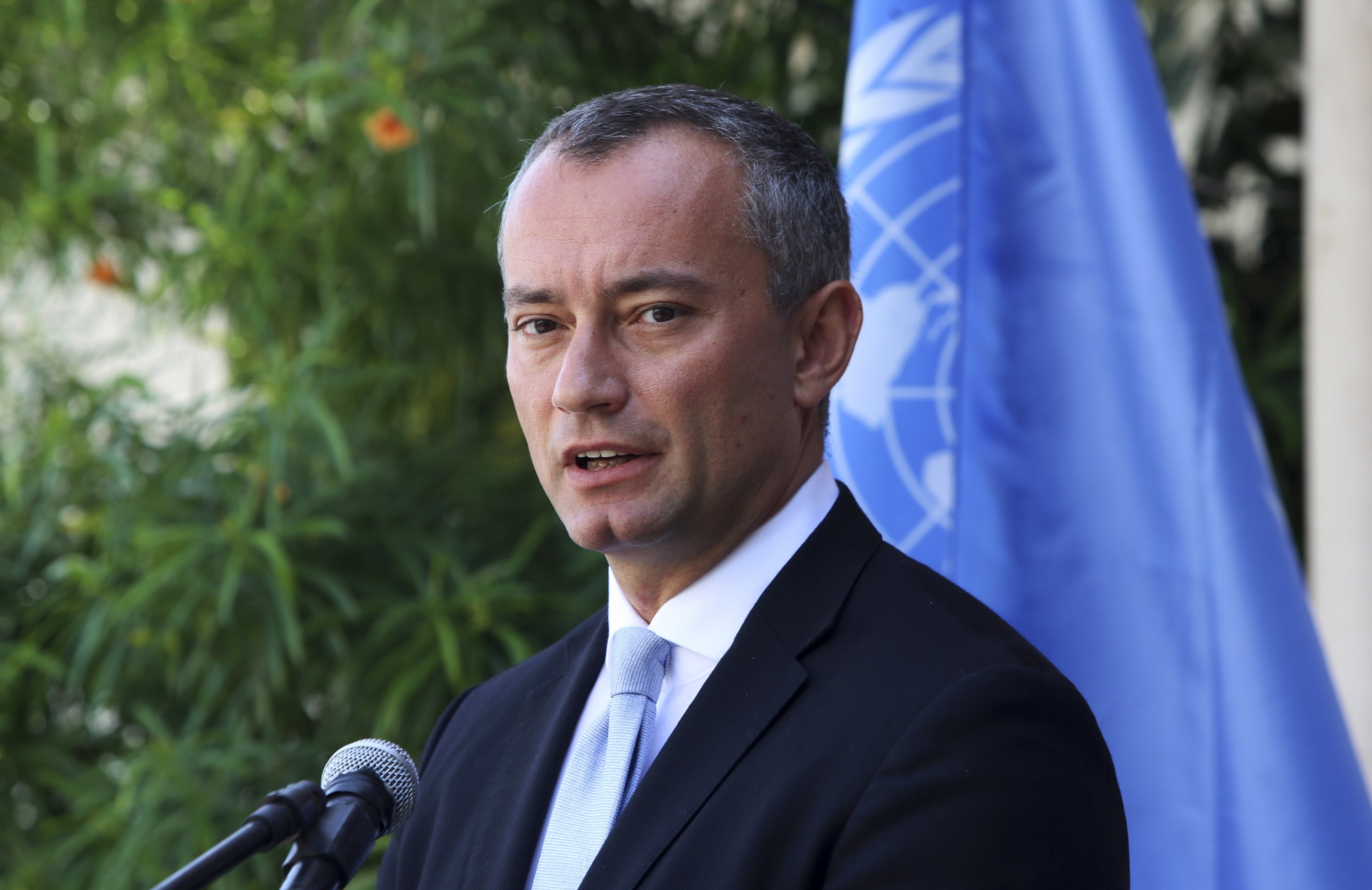
A former U.N. Mideast envoy has been chosen to direct U.S. President Donald Trump's Board of Peace to oversee the cease-fire in Gaza, Israel's prime minister said Thursday, as at least eight more deaths from Israeli strikes were reported there.
The appointment of Bulgarian diplomat Nickolay Mladenov marks an important step forward for Trump's Mideast peace plan, which has moved slowly since delivering an October cease-fire ending more than two years of Israel's genocidal military campaign against the Palestinian enclave.
Benjamin Netanyahu made the announcement after meeting Mladenov in west Jerusalem, identifying him as the "designated" director-general for the board, which is meant to oversee the implementation of the second and far more complicated phase of the cease-fire.
A senior U.S. official, speaking on condition of anonymity because the appointment has not been officially announced, confirmed Mladenov is the Trump administration's choice to be the board's day-to-day administrator on the ground.
Trump has said he will head the board. Other appointments are expected next week.
Under Trump's plan, the board is supposed to supervise a new Palestinian government, the disarmament of the Palestinian resistance group Hamas, the deployment of an international security force, additional pullbacks of Israeli troops and reconstruction. The U.S. has reported little progress on any of these fronts so far.
Mladenov is a former Bulgarian defense and foreign minister who served as the U.N. envoy to Iraq before being appointed as the U.N. Mideast peace envoy from 2015-2020. During that time, he had good working relations with Israel and frequently worked to ease tensions between Israel and Hamas.
The first phase of the cease-fire halted the war and saw an exchange of hostages held by Hamas in exchange for hundreds of Palestinians held by Israel. The deal has been marred by Israeli violations, as continued strikes in Gaza have killed over 400 Palestinians, according to local health officials.
On Thursday, Israeli strikes across the Gaza Strip killed at least eight people, according to Palestinian hospital officials and family members. Hamas called the deaths a "blatant violation of the cease-fire."
The victims included an 11-year-old girl who dreamed of becoming a doctor, a teenage girl and two boys killed in a tent camp and a man whose daughter wept over his body outside a hospital.
"Talk to me, dad!" she cried outside Nasser Hospital, where the body of Abdullah al-Kassas had been taken after a strike in eastern Khan Younis.
At least a dozen others were injured, hospital officials said.
Israel's military claimed it was not aware of any strike-related casualties in northern Gaza's Jabaliya area, where 11-year-old Hamsa Housou was killed, and did not immediately comment on the others reported Thursday.
Her uncle, Khamis Housou, told The Associated Press (AP) that the family had returned home on Oct. 11, a day after the cease-fire went into effect. He said their Falluja neighborhood has been subjected to daily shooting by Israeli troops despite being on the western side of the yellow cease-fire line.
He heard screams early Thursday as Israeli troops combed the area where shells and shrapnel hit. His niece, who he said had dreams of becoming a doctor, was pronounced dead at Shifa Hospital.
"They say that there is a cease-fire and that the war on Gaza has stopped. Is this only through the media, while every day there are explosions and fire belts?" he asked. "Shooting does not stop. Where is the cease-fire?"
On Thursday, Egyptian and European Union leaders meeting in Cairo urged the deployment of an international stabilization force in the Gaza Strip to oversee the October cease-fire.
"The situation is extremely severe," EU foreign policy chief Kaja Kallas said.
Israel is also also restricting the international NGOs from delivering aid to the enclave.
"There's no justification for the humanitarian situation in Gaza to have deteriorated to the current level," Kallas said.
The head of the U.N. agency for Palestinian refugees warned Thursday that Israeli pressure on the organization risks creating a "huge vacuum" in services.
Philippe Lazzarini, commissioner general of the United Nations Relief and Works Agency, or UNRWA, told reporters in Ankara that no other body has the capacity or "community trust" to provide health, education and social services there.
"If the agency cannot or has to stop to operate in Gaza or in the West Bank, this will create a huge vacuum," he said.
Lazzarini was in Türkiye for talks with officials on improving humanitarian access in Gaza.
In June, Türkiye and UNRWA signed an agreement for the agency to open an office in Ankara. Lazzarini said the office, which is expected to open "within weeks," would initially serve as a liaison and advocacy hub, but could later take on additional functions.