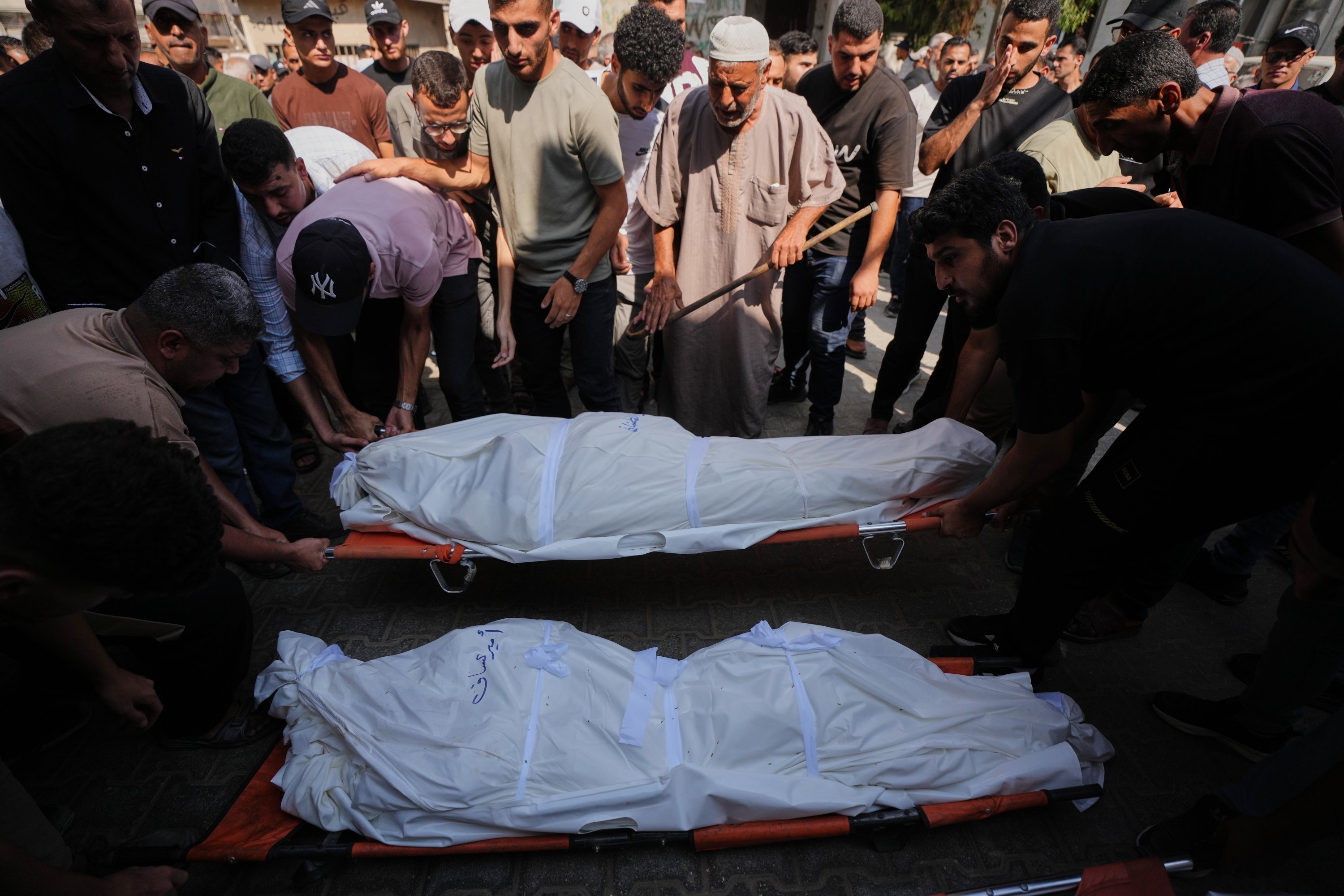
Palestinians marked the National Day for the Recovery of the Bodies of Palestinian and Arab Martyrs on Thursday as the number of Palestinian remains held by Israel reached unprecedented levels, underscoring a decadeslong struggle by families seeking the return of their loved ones.
The annual observance, held Aug. 27, highlights the plight of families whose relatives’ bodies are being kept in Israeli military morgues or buried in closed military cemeteries known as “graves of numbers.”
The issue has taken on new urgency since Israel launched its war on the Gaza Strip in October 2023.
Hundreds of unidentified bodies have been returned to Gaza, while thousands of Palestinians remain missing, leaving families uncertain about the fate of their relatives.
The Palestinian Cabinet designated Aug. 27 as a national occasion in 2008 to mobilize legal and popular efforts to establish the fate of missing Palestinians, recover their bodies and ensure they are returned to their families for burial.
The Palestinian National Campaign for the Retrieval of Martyrs’ Bodies and Disclosure of the Fate of the Missing, a nongovernmental organization, said Palestinian prisoners’ institutions have documented the names of 799 Palestinians whose bodies are being held by Israel.
The campaign said 256 of the bodies are buried in “graves of numbers,” while 99 belong to Palestinians who were prisoners. The list also includes 81 children under 18 and 10 women.
But recent Israeli reporting suggests the actual number could be significantly higher.
Haaretz reported Aug. 11, citing two Israeli security sources, that Israel is holding about 1,700 Palestinian bodies, most of them from Gaza, for possible use in future prisoner or hostage exchanges.
The discrepancy reflects the difficulty of establishing the full number of Palestinians whose remains are being held, particularly amid the destruction and mass displacement caused by the Gaza war.
“Graves of numbers” is the term Palestinians use for closed Israeli military cemeteries where Palestinian and Arab bodies have been buried without their names being publicly identified.
Instead, graves are marked with numbers corresponding to files containing information about the person buried there.
The practice in its modern form dates to the late 1960s and expanded after the 1967 war.
The cemeteries are generally located in restricted military zones, preventing families from visiting the graves or knowing precisely where their relatives are buried.
The cemeteries have historically held the remains of Palestinians and Arabs, including Lebanese nationals.
For Palestinian families, the graves represent more than the withholding of remains.
They are also a source of prolonged uncertainty, as relatives can spend years or decades without knowing exactly where a loved one is buried or being able to conduct a traditional funeral.
Israel has increasingly used the detention of Palestinian bodies as a tool in negotiations.
Since 2015, Israel has expanded its policy of retaining Palestinian remains. In 2017, its security Cabinet approved the continued detention of certain bodies for potential use in negotiations.
In September 2019, Israel’s Supreme Court ruled that military authorities could hold Palestinian bodies under the 1945 Emergency Regulations, including for the purpose of negotiations over the return of Israelis or their remains.
The security Cabinet broadened the circumstances for holding Palestinian bodies again in 2020.
Palestinian officials and rights groups have condemned the practice, arguing that the dead should not be used as leverage in political or security negotiations.
International humanitarian law requires parties to armed conflicts to respect the dead and their graves and to facilitate the return of remains to families whenever circumstances permit.
The International Committee of the Red Cross has documented customary international humanitarian law rules requiring respect for the remains of people who die during armed conflict and efforts to facilitate their return.
Article 34 of Additional Protocol I to the Geneva Conventions also calls for respect for the remains of people who died in connection with armed conflict or occupation and provides for their return when circumstances permit.
Israel’s war in Gaza has added a new and much larger dimension to the longstanding issue.
Israeli forces have transferred hundreds of bodies out of the enclave, while thousands of Palestinians remain missing amid widespread destruction and continued difficulties accessing areas where people were killed.
The National Campaign to Recover the Bodies said that, as of Feb. 4, 2026, Israel had returned 930 Palestinian bodies to Gaza, along with 66 boxes containing human remains.
The campaign said some of the remains were taken from cemeteries in Gaza and areas around the al-Shifa Medical Complex in Gaza City.
Identifying the remains has proved difficult because Palestinian authorities lack sufficient DNA-testing equipment and supplies. Teams have instead had to rely on traditional identification methods and information provided by families searching for missing relatives.
The National Campaign and Palestinian prisoners’ institutions said Wednesday that the number of detained bodies could rise as investigators obtain more information and identify additional victims. They said thousands of Palestinians remain missing in Gaza, while extensive destruction has made it difficult to reach areas where people may have been killed.
The crisis also extends beyond bodies removed from Gaza. Thousands of Palestinians are believed to remain buried beneath the rubble of destroyed buildings inside the enclave.
Zaher al-Wahidi, director of the Health Information Unit at Gaza’s Health Ministry, said Aug. 20 that about 7,400 bodies remained trapped beneath the rubble, with recovery teams unable to reach many of the sites.
The scale of the deaths has made identifying and recovering the missing an enormous challenge. Gaza’s Health Ministry says Israeli attacks have killed more than 73,400 Palestinians and injured more than 174,400 since October 2023.
Since a U.S.-brokered cease-fire took effect Oct. 10, 2025, Israeli attacks have killed 1,303 Palestinians and wounded 4,336, according to the ministry.