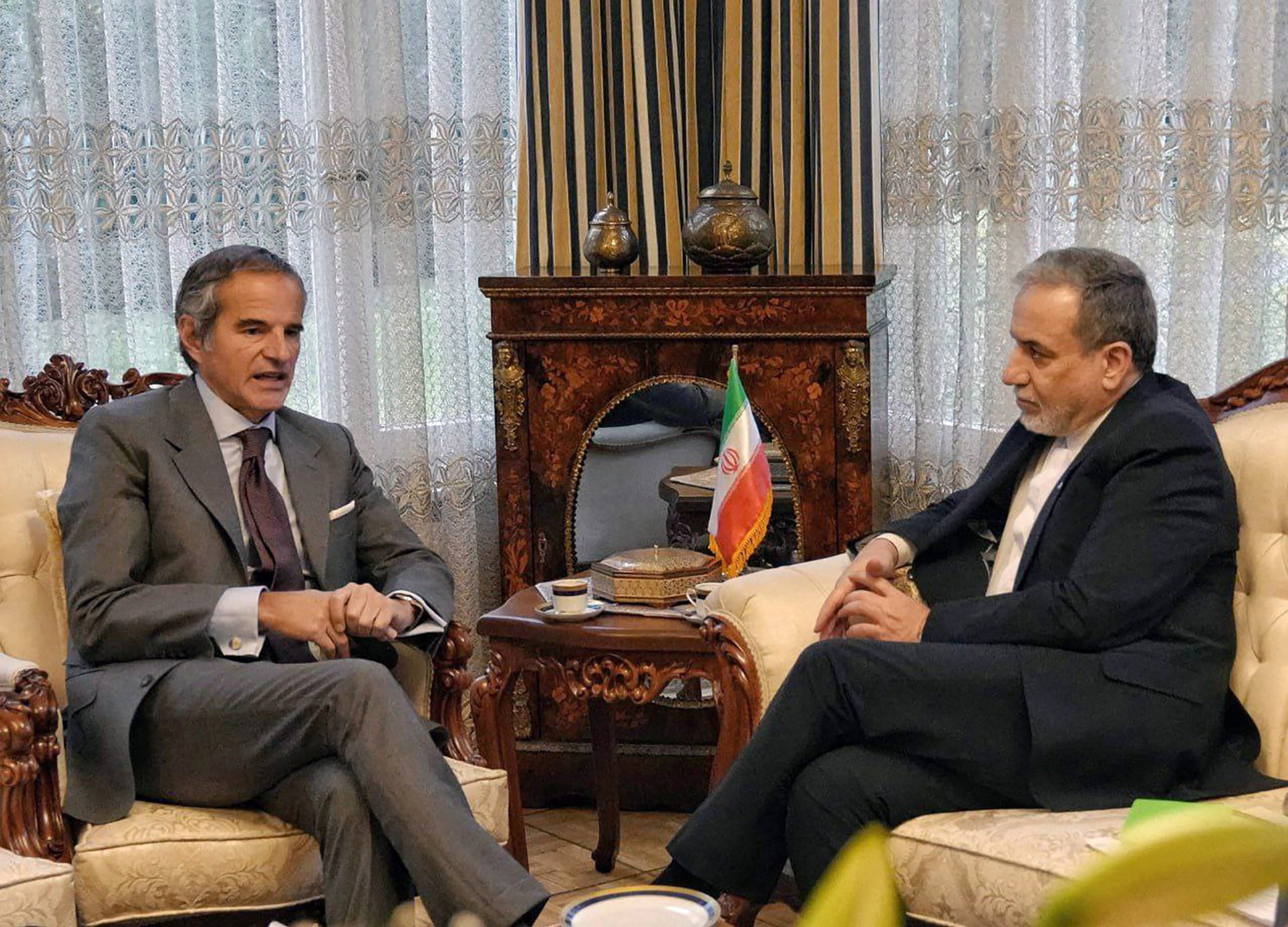
Iran’s top diplomat met Monday with the head of the U.N. nuclear watchdog ahead of a second round of negotiations with the United States over Tehran’s nuclear program.
Washington, which joined Israel in a wave of airstrikes on Iran in June, has ordered a second aircraft carrier strike group to the Middle East in the latest standoff with Tehran, in addition to other U.S. warships and aircraft that have already been deployed.
Adding to the tension, Iran began a military drill Monday in the Strait of Hormuz, a vital international waterway and oil export route from Gulf Arab states, who have been appealing for diplomacy to end the dispute.
The U.S. and Iran renewed negotiations earlier this month, hoping to tackle their dispute over Tehran's nuclear program, which Washington, other Western states and Israel all believe is aimed at building nuclear arms. Tehran denies this.
However, Washington has sought to expand the scope of talks to non-nuclear issues such as Iran's missile stockpile. Tehran says it is only willing to discuss curbs on its nuclear program in exchange for sanctions relief and won't accept zero uranium enrichment. It says its missile capabilities are off the table.
Speaking during a visit to Hungary on Monday, U.S. Secretary of State Marco Rubio said reaching a deal with Tehran would be hard.
"I think that there's an opportunity here to diplomatically reach an agreement that addresses the things we're concerned about. We'll be very open and welcoming to that. But I don't want to overstate it either. It's going to be hard. It's been very difficult for anyone to do real deals with Iran, because we're dealing with radical Shia clerics who are making theological decisions, not geopolitical ones."
Iran's Foreign Minister Abbas Aragchi said he was in Geneva to "achieve a fair and equitable deal."
"What is not on the table: submission before threats," Aragchi said on X.
Iran has repeatedly threatened to close the Strait of Hormuz in retaliation against any attack, which would choke a fifth of global oil flows and send crude prices sharply higher.
The waterway connects the biggest Gulf oil producers, such as Saudi Arabia, Iran, Iraq and the United Arab Emirates, with the Gulf of Oman and the Arabian Sea.
Meanwhile, Iran's Revolutionary Guards have conducted a drill named "Smart Control of the Strait of Hormuz," to test the readiness of the guards' naval units to protect the waterway, the semi-official Tasnim news agency said Monday.
"Intelligently utilizing the geopolitical advantages of the Islamic Republic in the Persian Gulf and the Sea of Oman are among the main objectives of this exercise," Tasnim said.
Iran's civil defense organization held a chemical defense drill in the Pars Special Economic Energy Zone on Monday to strengthen preparedness for potential chemical incidents in the energy hub located in southern Iran.
Deputy Foreign Minister Majid Takht-Ravanchi on Sunday signaled Iran's readiness to compromise on its nuclear program in return for sanctions relief, telling the BBC that the ball was "in America's court to prove that they want to do a deal."
Prior to the U.S. joining Israel in striking Iranian nuclear sites in June, Iran-U.S. nuclear talks had stalled over Washington's demand that Tehran forgo enrichment on its soil, which the U.S. views as a pathway to an Iranian nuclear weapon.
Iran says its nuclear program is solely for civilian purposes and is ready to assuage concerns regarding nuclear weapons by "building trust that enrichment is and will stay for peaceful purposes."
Iran's Foreign Ministry said Aragchi had discussed cooperation with the International Atomic Energy Agency, as well as Tehran's technical point of view regarding nuclear talks with the U.S., during his meeting with IAEA head Rafael Grossi.
The IAEA has been calling on Iran for months to say what happened to its stockpile of 440 kilograms (970 pounds) of highly enriched uranium following Israeli-U.S. strikes and let inspections fully resume, including in three key sites that were bombed in June last year: Natanz, Fordow and Isfahan.
Israeli Prime Minister Benjamin Netanyahu said Sunday he told U.S. President Donald Trump last week that any U.S. deal with Iran must include the dismantling of Iran's nuclear infrastructure, not just stopping the enrichment process.
Netanyahu said he is sceptical of a deal, but it must include enriched material leaving Iran. "There shall be no enrichment capability – not stopping the enrichment process, but dismantling the equipment and the infrastructure that allows you to enrich in the first place," he said.