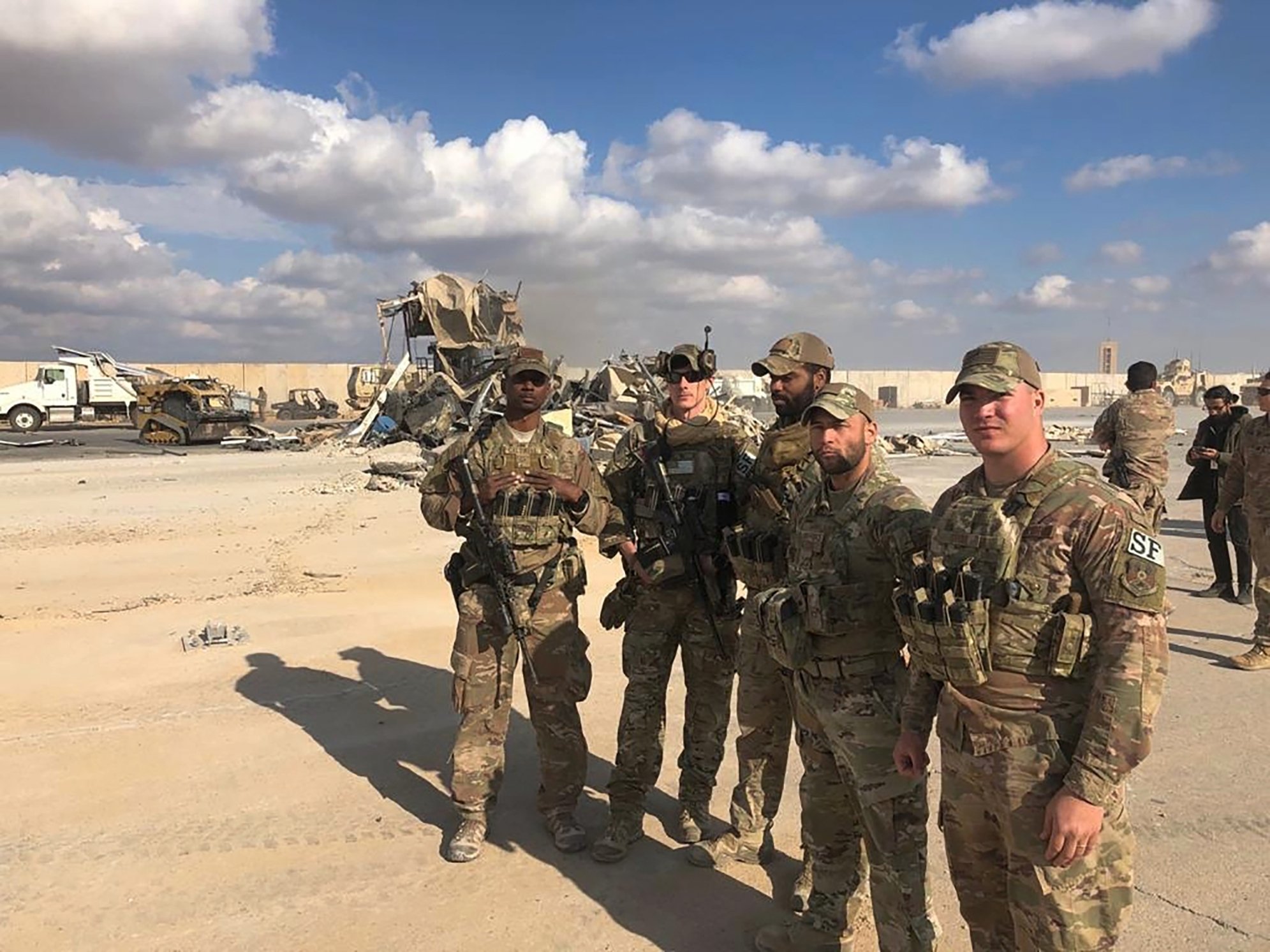
Iraq announced Wednesday it would assume control next week of a key military base from the U.S.-led coalition fighting Daesh terrorists, an issue that has long stirred political tensions in the country.
Deputy Commander of Iraq's Joint Operations Command, Lieutenant General Qais al-Muhammadawi, said the anti-Daesh coalition would hand over to the Iraqi security forces the Ain al-Asad military base in western Iraq and there would be bilateral pacts between Baghdad with several members of the alliance including the U.S., France and Britain.
"The Ain al-Asad base will witness next week a complete withdrawal and will be handed over to our Iraqi forces," al-Muhammadawi said at a press conference in Baghdad.
"This is an achievement pertaining to the Iraqi capabibilities, and Iraqi sovereignty as well as understanding with the U.S. and [other] countries of the alliance on turning the mission into bilaterial memorandums for exchanging expertise and information, and for training," he added without further details.
Iraq is considering signing security agreements with the US after the withdrawal of its forces towards Iraq's semi-autonomous northern region run by the Kurdistan Regional Government (KRG), the Saudi-owned al-Hadath television reported Wednesday, citing unidentified sources.
Over the past months, there have been repeated calls from Iraq's Iran-allied militias for the withdrawal of U.S. troops.
Located in the western province of al-Anbar, Ain al-Asad base was repeatedly targeted by attacks from Iraq's Iranian-aligned groups.
U.S. forces are still stationed near Baghdad Airport and at the Irbil air base in Iraq's KRG region. The U.S also maintains military presence in neighboring Syria and Jordan.
The U.S.-led alliance against Daesh was founded after the terrorist group overran large swathes of northern Iraq and Syria in 2014.
Iraq declared victory over Daesh in December 2017 and pushed for an end to the contested presence of the U.S.-led coalition, saying it was necessary for the country's stability.
Although Daesh is considered militarily defeated, an estimated 2,500 of its operatives are still active in both Syria and Iraq.
Iraq and the U.S. had earlier agreed to shift the U.S.-led coalition forces to a non-combat role.