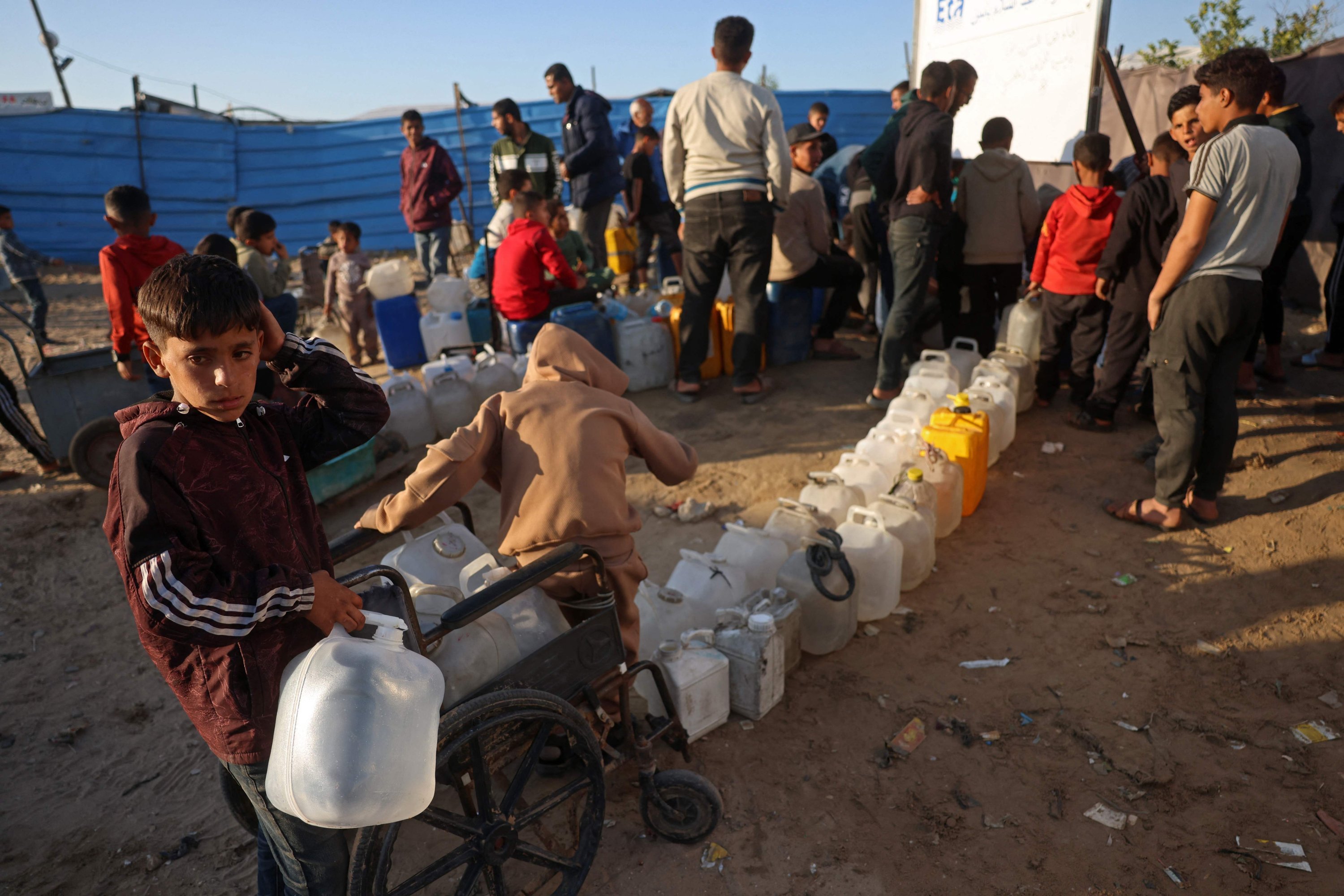
Aid organizations say they are still facing major obstacles operating in Gaza and other Palestinian territories, despite Israel’s Supreme Court suspending a ban that had restricted their work, a director at one of the charities said Monday.
Israel in December said it was banning 37 non-governmental organizations unless they provided detailed information on their Palestinian staff, in a move humanitarian organizations warned would further curtail already inadequate aid to Gaza.
Israel's Supreme Court in February froze that ban, theoretically allowing the NGOs to continue working in Gaza and the occupied West Bank until a final ruling.
But foreign "staff continued to be rejected, supplies continued to be rejected", said Alan Moseley, Danish Refugee Council director for the Palestinian territories.
He said almost no international NGO targeted by the Israeli ban had managed to transport aid into Gaza in recent months.
While commercial trucks were allowed to bring in basic supplies under a fragile cease-fire deal agreed in October, these are often far too expensive for Gazans after months of war, he said.
Some charities had managed to deliver aid via U.N. trucks still allowed in or had bought goods directly in Gaza to distribute them.
But this was "very difficult" and "very expensive", with some vital goods, including medical supplies, being very hard to find, he added.
Israel continued to block the entrance of aid worth "millions of dollars", Moseley said.
"There's tonnes of supplies sitting over the border, in Egypt and in Jordan, and there's a huge amount of energy put into trying to unblock these supplies," he added.
Israel has opposed so-called dual-use material and equipment, which it says could be used for military purposes.
"You hear that things can be used for making weapons or something else -- but we see wheelchairs, prosthetics, school supplies, children's clothing, everything can be blocked," the aid worker said.
'Obligations of an occupying power'
Moseley said Israel's Supreme Court, at a hearing on March 23, gave NGOs petitioning against the ban the opportunity to revoke their request or submit the requested Palestinian staff data.
"But we decided not to do that and we requested a full judgment by the court," he said.
The NGOs argued that they should be protecting their Palestinian staff's data, that they had already registered them with the Palestinian Authority, and that the Israeli ministry of diaspora affairs and combating antisemitism demanding the information "doesn't have jurisdiction".
They also stressed "the obligations of an occupying power to actually facilitate provision of humanitarian assistance, not to obstruct it", Moseley said.
Gaza is under a fragile cease-fire agreed last October, which followed two years of genocidal war that began on Oct. 7, 2023, causing widespread destruction that affected about 90% of Gaza's civilian infrastructure, with reconstruction costs estimated by the United Nations at around $70 billion.
The death toll from Israel’s war since October 2023 has reached 72,553 on Monday after two more Palestinians were killed by Israeli army fire in Gaza.