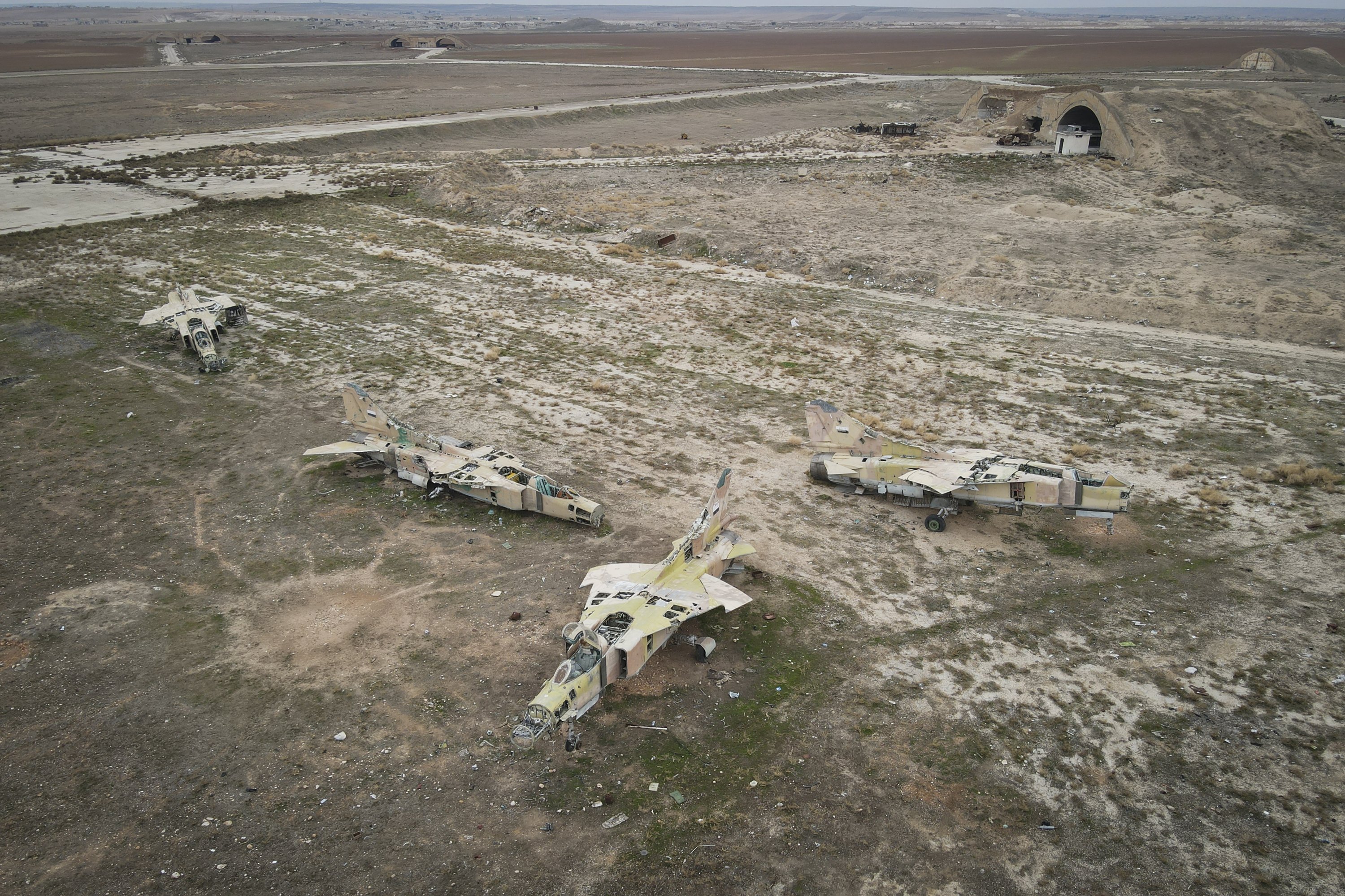
Israel carried out a series of airstrikes on northeastern Syria's Abu al-Duhur military air base Tuesday, according to Syrian state media and a war monitor.
The attack on the disused air base came after a recent visit to the site by a Turkish delegation.
Israel has been carrying out incursions into Syrian territory since the December 2024 overthrow of longtime ruler Bashar Assad, including sending troops into a U.N.-patrolled buffer zone that separated Israeli and Syrian forces in the Israeli-occupied Golan Heights since 1974.
It has also hit key military sites including several airfields, according to the U.K.-based war monitor, Syrian Observatory for Human Rights.
"Israeli occupation aircraft early this morning targeted the runway ... with eight strikes," Syrian state television quoted an unidentified military source as saying.
It added that "the attack resulted in material damage to the airport's infrastructure, without causing casualties."
The facility has been out of service since 2012 and is currently protected by Syrian Defense Ministry forces, a security source told Agence France-Presse (AFP), without reporting any casualties.
According to the Syrian Observatory for Human Rights, the strikes came after "a visit by a Turkish military delegation to the airfield in recent days as part of efforts to reactivate it."
Türkiye is a key ally of the new government in Damascus.
No side has claimed the strikes on the airfield and the Israeli military said "no comment" in response to an AFP inquiry about the strikes.
A U.S.-led international coalition against the Daesh terrorist group has previously carried out strikes on senior terrorist figures in the northwest.
Syria is now part of the coalition.
Israel has launched hundreds of strikes on Syria since the fall of Assad and Israeli officials have said they intend to keep forces in a "security zone" in southern Syria, where they seek a broader so-called "demilitarized zone."
Damascus has repeatedly condemned incursions in the country's south.
During a joint press conference with his French counterpart Emmanuel Macron in Damascus last month, Syrian President Ahmed al-Sharaa called for an "active French role" to halt Israeli escalations in his country.
Syrian Foreign Minister Asaad al-Shaibani also last month condemned "the continuation of Israeli military actions" and warned that "the unlawful occupation of our land beyond the 1974 line is a direct threat to the security of the region."
He demanded an "immediate and unconditional withdrawal."
But last week Israeli Defense Minister Israel Katz said that his country planned to keep troops in Syria.
Israel captured most of the Golan from Syria in the 1967 Arab-Israeli War and later annexed the areas under its control, in a move not recognized by most of the international community.
The incursions have been condemned by the United Nations chief as "violations of Syria's sovereignty and territorial integrity."
Despite tensions between the neighbors, Israel and Syria's new authorities have held several rounds of direct talks and have agreed to establish an intelligence-sharing mechanism.
Syrian President Ahmed al-Sharaa in June denied that his country sought to intervene militarily in Lebanon, where Israel is raising a separate war, after U.S. President Donald Trump suggested Damascus could get involved.
Hezbollah fought alongside Assad in the country's civil war, making al-Sharaa and the new authorities who toppled the former leader in 2024 deeply hostile to the group.
Syria's war shattered the country's infrastructure and pushed millions of people to flee internally and abroad.