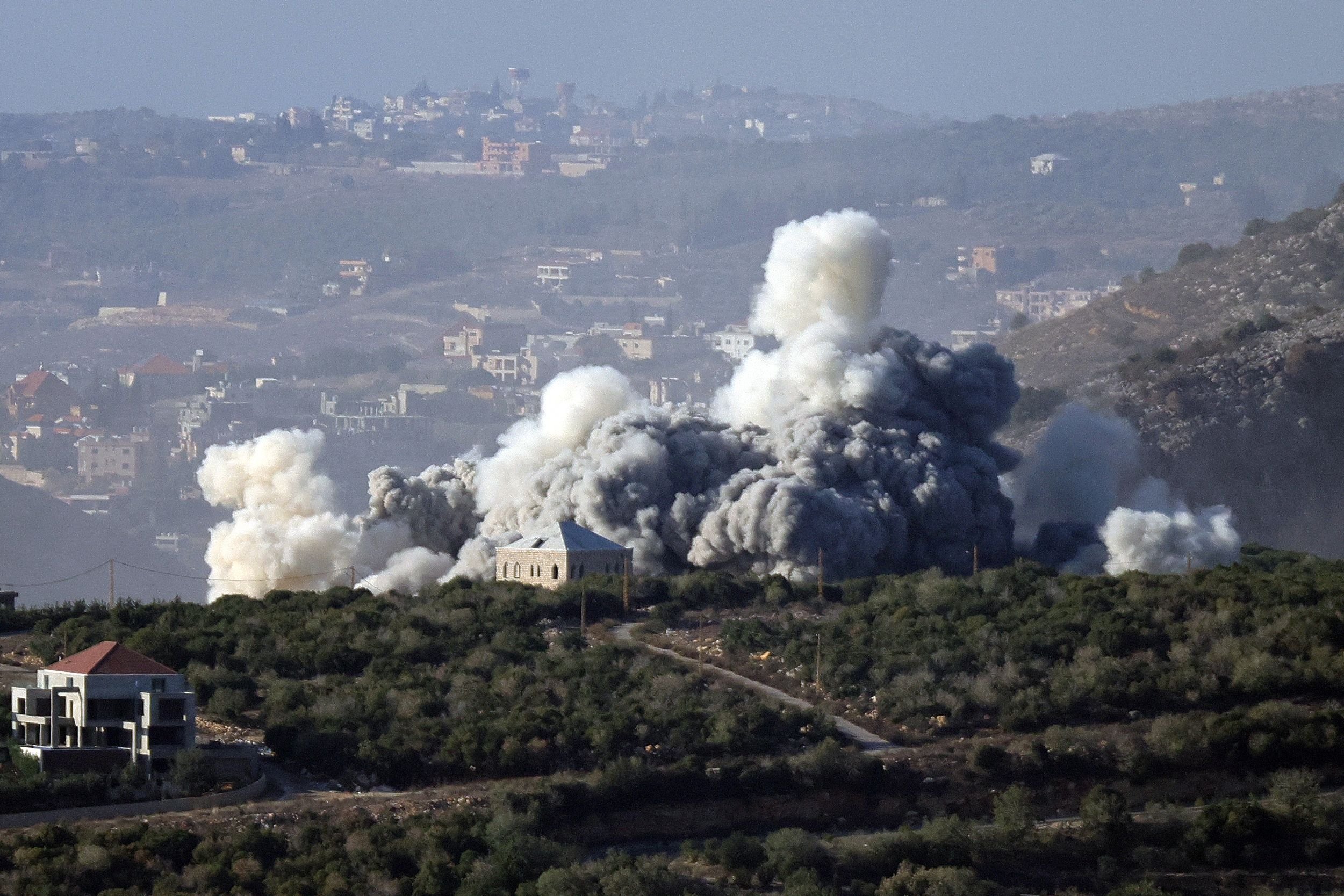
The Israeli military carried out a fresh round of strikes against Hezbollah in southern Lebanon on Thursday, marking exactly one year since the cease-fire with the group.
Lebanon’s state-run National News Agency reported that Israeli aircraft launched “a series of raids on Al-Mahmoudiya and Al-Jarmak,” just north of the Litani River.
The cease-fire, brokered Nov. 27, 2024, aimed to end more than a year of hostilities between the two sides.
But Israel has repeatedly conducted airstrikes in Lebanon despite the truce, citing the need to target Hezbollah members and infrastructure to prevent the group from rearming.
Lebanese Prime Minister Nawaf Salam said his country is facing “a one-sided war of attrition that is escalating.”
The Israeli military said it “struck and dismantled Hezbollah terror infrastructure in several areas in southern Lebanon” in a statement after Thursday’s strikes. It said it had also hit “several launch sites where Hezbollah weapons were stored,” “military posts” used by the group and a storage facility containing weapons.
Israel’s military said it “will continue to operate to remove any threat to the State of Israel.” It added that since the cease-fire, it has been trying to prevent Hezbollah from rebuilding by dismantling infrastructure, thwarting intelligence operations and diminishing its military capabilities.
The military said it has carried out around 1,200 “targeted activities” and “eliminated more than 370 terrorists” from Hezbollah, Hamas and other Palestinian groups during the cease-fire.
Under the cease-fire agreement, Hezbollah was to pull its forces north of the Litani River, about 30 kilometers (20 miles) north of the border with Israel and dismantle its military infrastructure there.
Under a government-approved plan, the Lebanese army is to dismantle Hezbollah’s military infrastructure south of the river by the end of the year before addressing the rest of the country.
The United States has increased pressure on the Lebanese government to disarm Hezbollah.
The Lebanese military has said it is carrying out its plan, but Washington and Israel have accused authorities of stalling the process.
Lebanese President Joseph Aoun “rejected the Israeli claims,” his office said Thursday, adding that the Lebanese army was “preventing armed displays, confiscating ammunition, inspecting tunnels, among other things.”
On Thursday, Aoun met with Jeanine Hennis-Plasschaert, the United Nations’ special coordinator for Lebanon, who said a year on from the cease-fire, “uncertainty remains.”
“For too many Lebanese, the conflict is ongoing – albeit at a lower intensity. And one does not need a crystal ball to understand that as long as the current status quo continues, the specter of future hostilities will continue to loom large,” she said.
Israeli Defense Minister Israel Katz warned Wednesday that there would be “no calm” in Lebanon if Israel’s security was not guaranteed.
An Israeli strike on Beirut’s southern suburbs on Sunday killed Haitham Ali Tabatabai, the most senior Hezbollah commander to be killed by Israel since the cease-fire entered into force.
The Lebanese prime minister slammed Hezbollah’s claims that its weapons deter Israeli aggression.
“These weapons did not protect either Hezbollah’s leaders or the Lebanese people and their property,” Salam said. “Are Hezbollah’s weapons currently capable of repelling the ongoing Israeli attacks? These weapons have provided neither deterrence nor protection, nor have they brought victory to Gaza.”