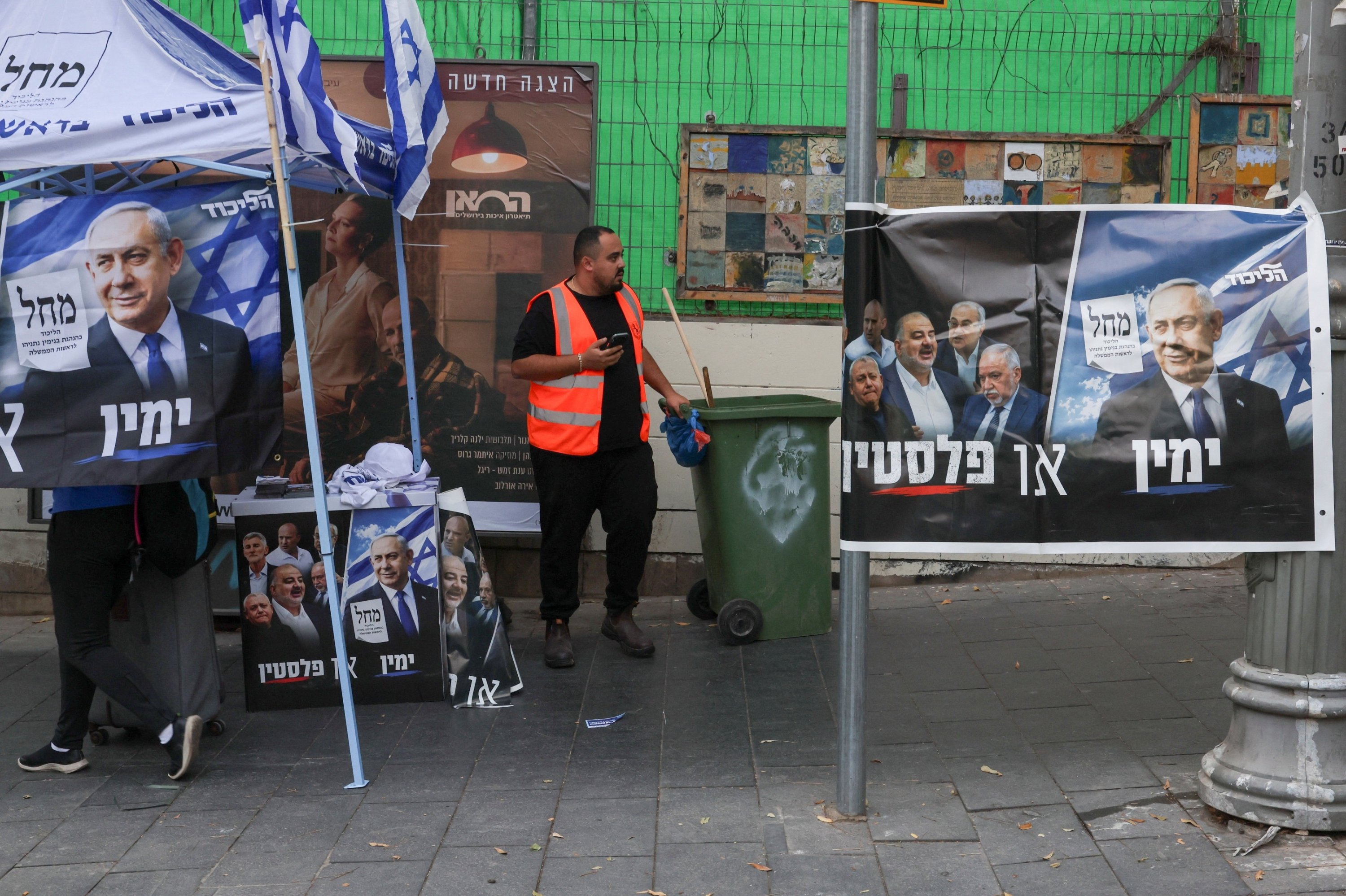
Israel faces four potential scenarios for government formation if neither Benjamin Netanyahu nor Gadi Eisenkot secures a majority in Tuesday’s general election, according to an Israeli politics expert.
Opinion polls suggest that neither Netanyahu’s Likud party nor Eisenkot’s Yashar party is expected to lead a bloc capable of securing the 61 seats needed for a majority in the 120-member Knesset, Israel’s parliament.
Israel uses a nationwide proportional representation system in which voters cast ballots for party lists rather than individual candidates. The prime minister is not directly elected but must be able to secure the confidence of at least 61 lawmakers.
As no single party typically wins a parliamentary majority, governments are generally formed through coalitions of parties with broadly compatible political positions.
Wadie Abu Nassar, an expert on Israeli politics, outlined four possible scenarios in comments to Anadolu Agency (AA).
“The first scenario is that Netanyahu or Eisenkot manages to form a regular government through a coalition with parties that win seats in the polls,” Abu Nassar said.
He described that outcome as difficult, given polling projections that neither Netanyahu’s bloc nor the opposition camp would secure the required majority.
“Still, this scenario cannot be completely ruled out, particularly amid reports that Eisenkot is trying to win over lawmakers from the Haredi parties to support a government he would form,” he added.
The second scenario would involve Eisenkot forming a minority government backed by Arab lawmakers who would support it in parliament without joining the governing coalition, Abu Nassar said.
Arab parties in Israel have said they could provide Eisenkot with a parliamentary “safety net” in exchange for guarantees addressing the concerns of Arab citizens.
The arrangement would aim to prevent the current government, which includes far-right ministers Itamar Ben-Gvir and Bezalel Smotrich, from remaining in office as a caretaker administration.
The Joint List, an alliance of three Arab parties led by Yousef Jabareen, and the United Arab List, headed by Mansour Abbas, have expressed willingness to support an Eisenkot-led government from outside the coalition.
Their demands include halting home demolitions, combating crime in Arab communities and opening a political horizon with the Palestinians.
Eisenkot has not taken a definitive position on the proposal, although he has previously ruled out including Arab parties in a coalition he seeks to form.
Polls suggest that 13 party lists could enter the Knesset, including two representing Arab citizens, who account for about 20% of Israel’s population of more than 10 million.
Opinion polls project that the Arab parties could win a combined 14 to 15 seats.
The third scenario would involve a national unity government bringing together Netanyahu, Eisenkot and other parties, Abu Nassar said.
“There are discussions in Israeli circles that if the elections reach a deadlock, meaning neither bloc obtains the required majority to form a government, a national unity government could be formed,” he said.
Abu Nassar said Israeli President Isaac Herzog has been pushing for such an arrangement to avoid another election. Reports also indicate that figures close to U.S. President Donald Trump favor the option.
Under the proposed arrangement, Likud and Yashar would join other parties in a government led by Netanyahu and Eisenkot, while Ben-Gvir’s Jewish Power party and Smotrich’s Religious Zionism party would be excluded, Abu Nassar said.
The main obstacle is opposition parties’ refusal to join a government with Netanyahu or one led by him, Abu Nassar said. Netanyahu, however, appears open to a unity government in which he and Eisenkot would rotate as prime minister, provided Netanyahu serves first.
“Opposition parties do not necessarily reject joining Likud in a unity government but object to Netanyahu personally,” Abu Nassar said.
Some Israeli political circles have raised the possibility of Herzog granting Netanyahu a pardon in his corruption cases in exchange for his withdrawal from political life, Abu Nassar added.
Netanyahu has said he would not leave politics even if he loses the election.
He faces charges of bribery, fraud and breach of trust in three separate cases, known as Cases 1000, 2000 and 4000. He denies wrongdoing.
Separately, the International Criminal Court (ICC) issued an arrest warrant for Netanyahu on Nov. 21, 2024, over alleged war crimes and crimes against humanity in Gaza.
More than 74,000 Palestinians have been killed by Israel’s genocidal military offensive in Gaza since October 2023, according to figures cited in the original report.
Ben-Gvir has also claimed that Netanyahu has avoided appearing in photographs with him because he is pursuing a possible unity government with Eisenkot.
The fourth scenario would involve neither Netanyahu nor the opposition succeeding in forming a government, leaving the current Cabinet in place as a caretaker administration until another election could be held several months later.
“In the fourth scenario, elections would be repeated after several months, and until then the current government would remain as a caretaker government until a new one is formed,” Abu Nassar said.
“This is the scenario Netanyahu would prefer and work toward if he fails to form a government,” he added.
Under Israeli law, Knesset elections are normally held every four years, although an election can be called earlier if the political system fails to produce a functioning government or other legal conditions for an early vote are met.
The election is widely seen as crucial to Netanyahu’s political future. The 76-year-old prime minister is standing trial in Iarael on charges including bribery, fraud and breach of trust. A conviction could result in imprisonment.
Netanyahu is also subject to an ICC arrest warrant issued in 2024 over alleged war crimes and crimes against humanity in Gaza during Israel’s genocidal military campaign since October 2023.