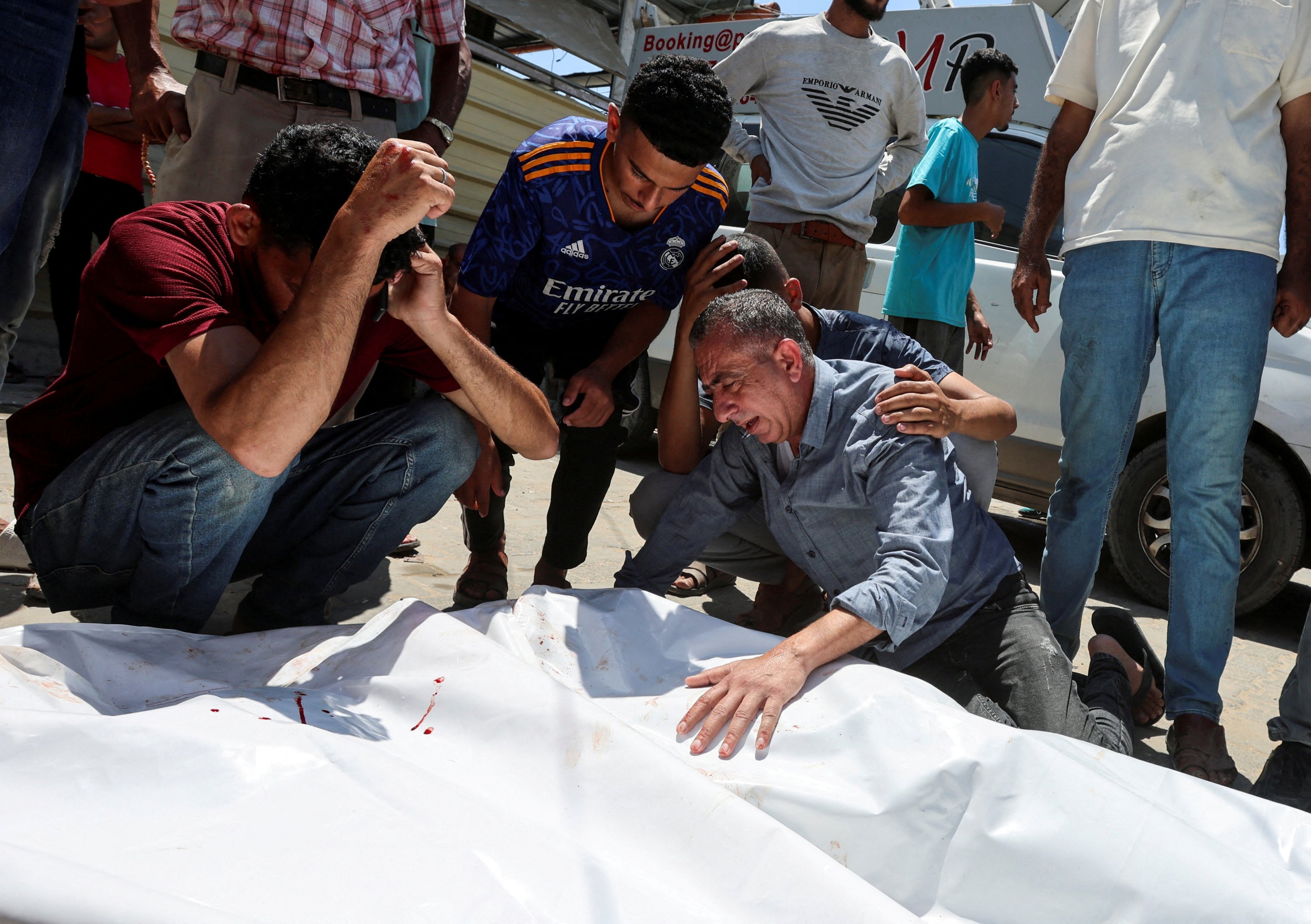
A simple street corner in central Gaza, where sacks of flour were being handed to desperate civilians, turned into a killing field Friday after an Israeli airstrike slammed into the crowd, killing 18 people, including seven members of a Palestinian police unit working to curb looted aid distribution.
The blast, which tore through Deir al-Balah’s aid distribution point, ripped bodies apart and spattered blood across alley walls.
Hospital officials said a child was among the dead. Dozens more were wounded. The victims had gathered not for battle or protest, but for food.
The Sahm unit, affiliated with Gaza’s Hamas-run Interior Ministry, had been distributing flour and other essentials seized from black market dealers and looters.
Witnesses said the unit was trying to restore order to a volatile aid scene where lawlessness, starvation, and profiteering have collided.
Video taken moments after the strike showed limp bodies, twisted limbs, torn flour bags and panic-stricken survivors screaming for help. Several of the dead wore police vests. The blood mixed with spilled flour, the ground caked in what was once survival.
The Israeli military did not comment on the strike. But the message, many in Gaza said, was unmistakable.
The attack is the latest grim chapter in a humanitarian disaster spiraling out of control.
Since Hamas' Oct. 7, 2023, incursion on southern Israel, food distribution has gone from organized to anarchic.
Israel cut off nearly all aid for more than two months.
Since mid-May, it has allowed only a fraction in, often citing security concerns.
But for ordinary Gazans, the result has been devastating: flour, rice and oil became commodities sold at extortionate prices – or seized violently by gangs and middlemen.
U.N. trucks have been stormed. Convoys stripped. Aid workers threatened. And with more than 2.2 million people trapped in the besieged strip, survival has often depended on luck or local connections.
That’s where Gaza’s powerful tribes have stepped in.
On Wednesday, the National Gathering of Palestinian Clans and Tribes, a centuries-old network of family alliances, declared it would take matters into its own hands – literally.
“We escorted a convoy to northern Gaza last night,” said tribal leader Abu Ahmad al-Gharbawi, his voice strained but resolute in a phone call with The Associated Press (AP). “No looters. No gangs. No merchants hiking prices. We are done starving.”
The move, while rooted in solidarity, was also born of survival. Tribal leaders say the collapse of civil order and the sidelining of U.N. agencies left Gaza’s families with no choice but to reclaim responsibility for protecting food.
Israeli officials, however, remained skeptical. Prime Minister Benjamin Netanyahu and Defense Minister Israel Katz released a joint statement Wednesday, accusing Hamas of continuing to divert aid, despite the tribal intervention.
The tribal council fired back, accusing Israel of using “baseless theft allegations” to justify military strikes on civilian aid zones. “The aid was fully secured by the people,” their statement read, “and we are committed to seeing it delivered to homes, not markets.”
Meanwhile, Israel and the U.S. have funneled support into an alternative system: the Gaza Humanitarian Foundation, a private American contractor distributing aid independently of the U.N.
For the past month, the foundation has handed out food boxes in Israeli-controlled zones in southern Gaza. But the conditions are brutal.
Thousands of Palestinians walk for hours through scorched military corridors, dodging gunfire and checkpoints to reach the sites.
Doctors Without Borders (MSF) condemned the effort Friday as “slaughter masquerading as humanitarian aid,” demanding it be shut down immediately.
“This system degrades Palestinians by design,” MSF said, “forcing them to choose between starvation or risking their lives for minimal supplies.”
Health officials say hundreds have been killed or wounded during these chaotic aid scrambles. Israel insists its forces only fire warning shots to disperse crowds – but survivors tell a different story.
“There are bodies every day,” said a volunteer medic near Khan Younis. “Not from fighting. From food lines.”
The United Nations, sidelined and under fire, still operates within Gaza – albeit barely.
The World Food Program (WFP) has largely suspended operations due to safety concerns, and the World Health Organization (WHO) said Thursday it was able to send its first medical convoy into Gaza since March 2: nine trucks carrying blood, plasma and surgical supplies to Nasser Hospital, the largest functioning hospital in southern Gaza.
But aid experts say when sufficient food is allowed in, looting and black markets vanish. “The solution isn’t security,” one WFP worker said anonymously. “It’s volume. Let the food flood in.”
On Thursday in Gaza City, fresh aid finally reached some. Flour was offloaded late the night before, and by sunrise, lines stretched for blocks.
“We’ve waited for months without flour,” said Hiba Khalil, a mother of seven. “Our children cried themselves to sleep with hunger. Today is the first time I feel relief.”
Nearby, Umm Alaa Mekdad, her hands clutching a plastic bag, spoke softly. “The gangs used to steal our shares. They didn’t care about the children crying at night.”
But even this fragile hope was short-lived.
That evening, Israeli warplanes launched another barrage across the Gaza Strip.
Health officials said 28 people were killed in strikes that pounded Gaza City and the south.
Twenty of the dead were taken to Shifa Hospital, already overrun and running low on supplies. Eight more arrived at Nasser Hospital.