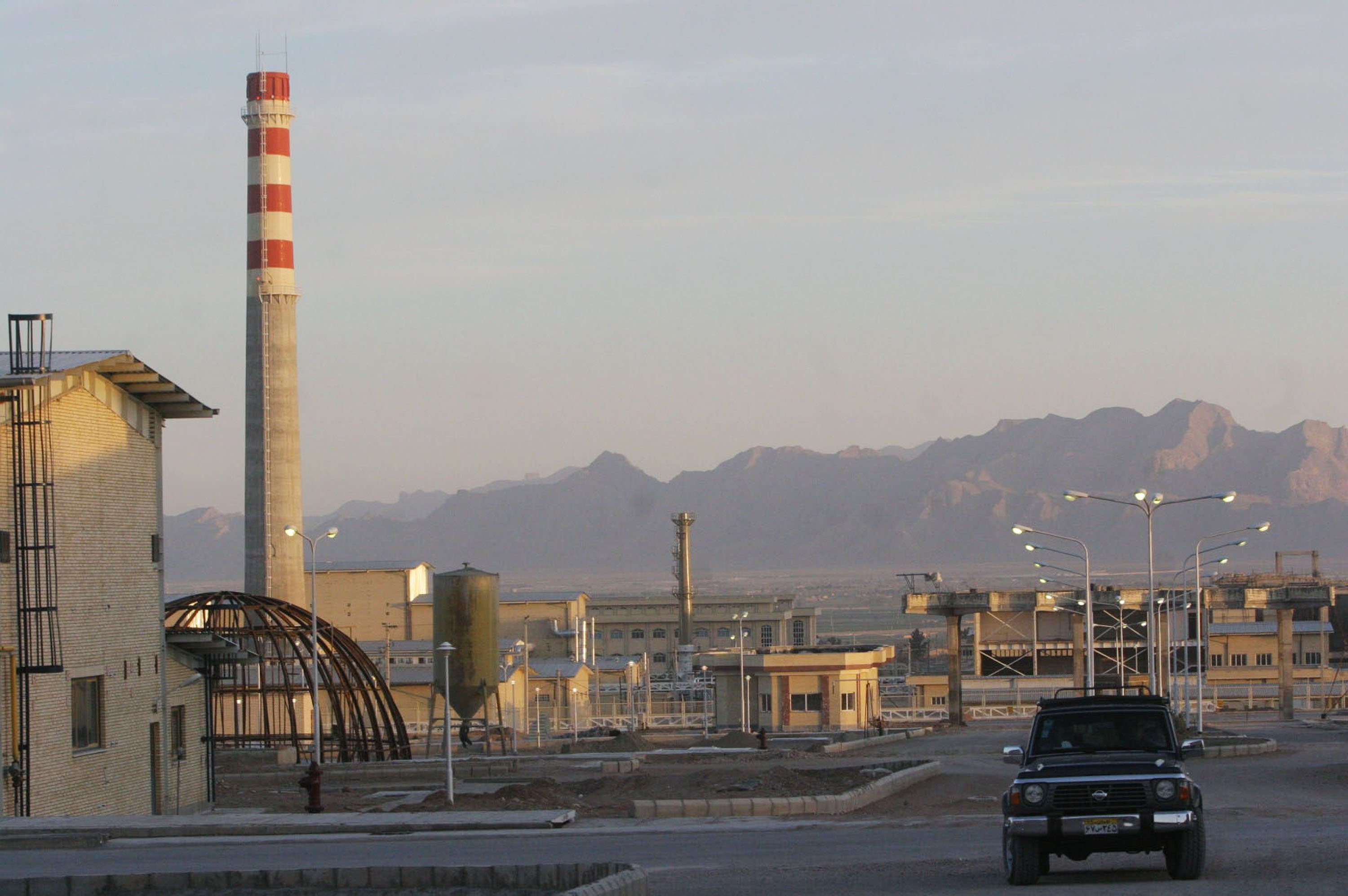
U.S. intelligence assessments indicate that Iran’s estimated timeline to build a nuclear weapon remains unchanged from last summer, when analysts concluded a U.S.-Israeli attack had pushed it back to as long as a year, Reuters reported, citing three sources.
The assessments of Tehran's nuclear program remain broadly unchanged even after two months of a war that U.S. President Donald Trump claimed to have launched in part to stop the Islamic Republic from developing a nuclear bomb.
The latest U.S. and Israeli attacks that began on Feb. 28 have focused on conventional military targets, but Israel has hit several significant nuclear facilities.
The unchanged timeline suggests that significantly impeding Tehran's nuclear program may require destroying or removing Iran's remaining stockpile of highly enriched uranium, or HEU.
The war has stalled since the U.S. and Iran agreed on an April 7 truce to pursue peace. Tensions remain high as both sides appear deeply divided and as Iran has choked traffic through the Strait of Hormuz, blocking some 20% of world oil supplies and igniting a global energy crisis.
Secretary of Defense Pete Hegseth has said publicly that the U.S. aims to ensure Iran does not obtain a nuclear weapon via ongoing negotiations with Tehran.
U.S. intelligence agencies had concluded before June's 12-day war that Iran likely could produce enough bomb-grade uranium for a weapon and build a bomb in around three to six months, said two of the sources, all of whom requested anonymity to discuss U.S. intelligence.
Following the June strikes by the U.S. that hit the Natanz, Fordow and Isfahan nuclear complexes, U.S. intelligence estimates pushed that timeline back to about nine months to a year, said the two sources and a person familiar with the assessments.
The attacks destroyed or badly damaged the three enrichment plants known to have been operating at the time. But the U.N. nuclear watchdog has been unable to verify the whereabouts of some 440 kilograms of uranium enriched to 60%.
It believes that about half was stored in an underground tunnel complex at the Isfahan Nuclear Research Center, but it has been unable to confirm that since inspections were suspended.
The International Atomic Energy Agency assesses that the total HEU stockpile would be enough for 10 bombs if further enriched.
"While Operation Midnight Hammer obliterated Iran’s nuclear facilities, Operation Epic Fury built on this success by decimating Iran’s defense industrial base that they once leveraged as a protective shield around their pursuit of a nuclear weapon," said White House spokeswoman Olivia Wales, referring to the June operation and the latest war that began in February.
"President Trump has long been clear that Iran can never have a nuclear weapon – and he does not bluff."
The Office of the Director of National Intelligence did not respond to a request for comment.
U.S. officials, including Trump, repeatedly cite the need to eliminate Iran's nuclear program as a key objective of the war.
"Iran can never be allowed to obtain a nuclear weapon. That is the goal of this operation," Vice President JD Vance wrote on X on March 2.
The unchanging estimate of how long it would take Iran to build such a weapon reflects in part the focus of the latest U.S. and Israeli military campaign, the sources said.
While Israel has struck nuclear-related targets, including a uranium-processing facility in late March, U.S. attacks have concentrated on conventional military capabilities, Iran's leadership and its military-industrial base.
The unchanged estimates may also stem from a lack of major nuclear targets that can be readily and safely destroyed following June's military action, according to some analysts.
Eric Brewer, a former senior U.S. intelligence analyst who led assessments of Iran's nuclear program, said it was not surprising that the assessments have not changed because recent U.S. strikes have not prioritized nuclear-related targets.
"Iran still possesses all of its nuclear material, as far as we know," said Brewer, vice president of the nuclear materials study program at the Nuclear Threat Initiative arms control think tank. "That material is probably located in deeply buried underground sites where U.S. munitions can't penetrate."
In recent weeks, U.S. officials have contemplated dangerous operations that would significantly impede Iran's nuclear efforts. Those options include ground raids to retrieve the HEU believed to be stored in the tunnel complex at the Isfahan site.
Iran has repeatedly denied seeking nuclear weapons. U.S. intelligence agencies and the IAEA say Tehran halted a warhead development effort in 2003, though some experts and Israel contend that it secretly preserved key parts of the program.
Precisely evaluating Iran's nuclear capacity is difficult, even for the world's leading intelligence services, say experts.
Several U.S. intelligence agencies have independently studied Iran's nuclear program and while the sources described a broad consensus regarding Iran's capacity to build a nuclear weapon, outlier assessments do occur.
Iran's nuclear ambitions may have been set back further than the intelligence estimates suggest.
Some officials, including U.S. Secretary of State Marco Rubio, have argued that U.S. strikes on Iranian air defenses have reduced the nuclear threat by diminishing Iran's ability to defend its nuclear sites should it decide to rush toward weaponization in the future.
There is also the impact of Israel's assassinations of Iran's leading nuclear scientists.
David Albright, a former U.N. nuclear inspector who runs the Institute for Science and International Security, said the killings have added significant uncertainty to Tehran's ability to build a bomb that would function as intended.
"I think everyone agrees knowledge can't be bombed, but know-how certainly can be destroyed," he said.