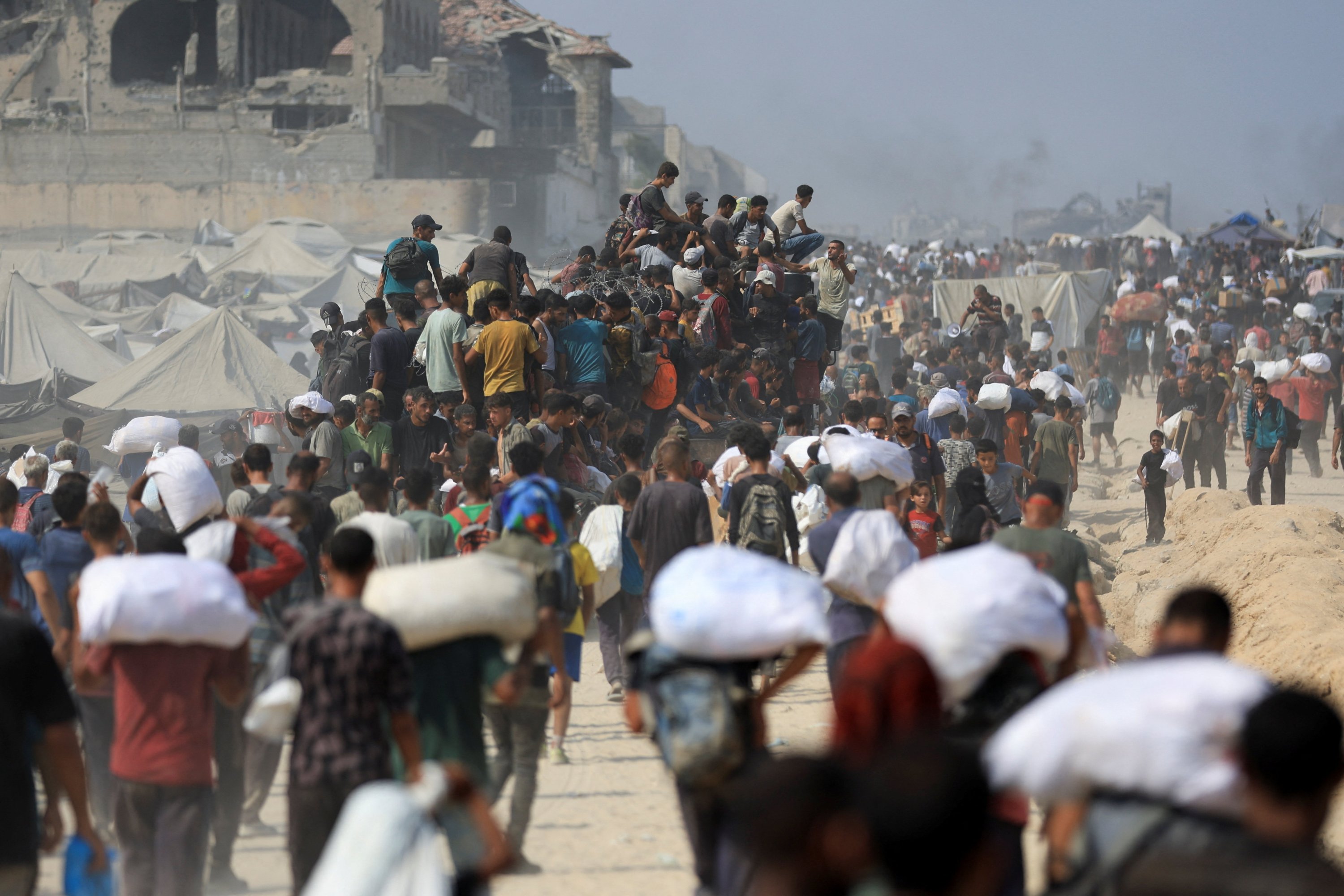
More than 100 nonprofit organizations warned Thursday that Israel's regulations for aid groups operating in Gaza and the occupied West Bank would hinder critical relief efforts and replace independent groups with ones aligned to Israel's political and military agenda.
At the same time, hospital officials reported more deaths from Israeli airstrikes and an increasing toll from malnutrition.
The mounting backlash over aid restrictions and the worsening humanitarian crisis in Gaza have been cited by several countries as a factor in their moves toward recognizing Palestinian statehood. Yet on Thursday, Israel advanced plans for a new settlement expansion in the occupied West Bank, with one far-right government minister describing the move as a way to "bury the idea of a Palestinian state."
The nonprofit groups, including Oxfam, Doctors Without Borders and CARE, were responding to registration rules announced by Israel in March that require organizations to hand over full lists of their donors and Palestinian staff for vetting. They contend doing so could endanger their staff and give Israel broad grounds to block aid if groups are deemed to be "delegitimizing" the country or supporting boycotts or divestment.
The aid groups stressed on Thursday that most of them have not been able to deliver "a single truck" of life-saving assistance since Israel implemented a blockade in March.
The aid that the groups provide supplements assistance from the United Nations, airdrops organized by foreign governments and the Gaza Humanitarian Foundation – the new Israel and U.S.-backed contractor, which has been the primary distributor of aid in Gaza since May.
Despite those channels, the amount of aid reaching Gaza remains far below what the U.N. and relief groups previously delivered.
U.N. agencies and a small number of aid groups have resumed delivering assistance, but say the number of trucks allowed in remains far from sufficient.
During the two-month cease-fire, aid groups demanded that Israel allow entry for 600 trucks per day.
Israel has pressed U.N. agencies to accept military escorts to deliver goods into Gaza, a demand they've largely rejected, citing their commitment to neutrality.
The standoff has been the source of competing claims: Israel maintains it allows aid into Gaza that adheres to its rules, while aid groups that have long operated in the enclave decry the amount of life-saving supplies stuck at border crossings.
U.N. spokesperson Stephane Dujarric said U.S. envoy Steve Witkoff had met with U.N. humanitarian officials in New York about the "need to, speedily, scale up aid into Gaza."
Hospitals throughout Gaza on Thursday reported casualties from Israeli strikes.
An Israeli strike on Gaza City killed one person and wounded three others, an official at Shifa Hospital said. A separate strike killed five people in Gaza City on Thursday morning, according to al-Ahli hospital, which received the casualties.
The casualties add to more than 61,700 Palestinians, mostly women and children, who have been killed since Israel launched its military campaign after Palestinian resistance group Hamas' surprise attack on Oct. 7, 2023, which killed around 1,200 people.
Local health officials on Thursday also reported four additional malnutrition-related deaths in Gaza, raising the total to 239, a toll that includes 106 children.
In the occupied West Bank, Israel's far-right Finance Minister Bezalel Smotrich on Thursday announced the construction of a new settlement expansion that Palestinians and rights groups worry will scuttle plans for a future Palestinian state by effectively cutting the West Bank into two separate parts.
Smotrich said doing so "buries the idea of a Palestinian state, because there is nothing to recognize and no one to recognize."
"Anyone in the world who tries today to recognize a Palestinian state will receive an answer from us on the ground," he said, referencing the many countries moving toward recognition.
Many states and rights groups swiftly condemned the plan. Peace Now called it "deadly for the future of Israel and for any chance of achieving a peaceful two-state solution."
As European countries amplify their criticisms of Israel and the humanitarian crisis in Gaza, some are expanding evacuations.
Italy's foreign affairs ministry said it received 114 Palestinian evacuees from Gaza on Wednesday, including 31 children suffering from either severe injuries and amputations or serious congenital diseases.
Since the beginning of the war, Italy has evacuated more than 900 Palestinians from Gaza, including those who have arrived as part of a family reunification program.