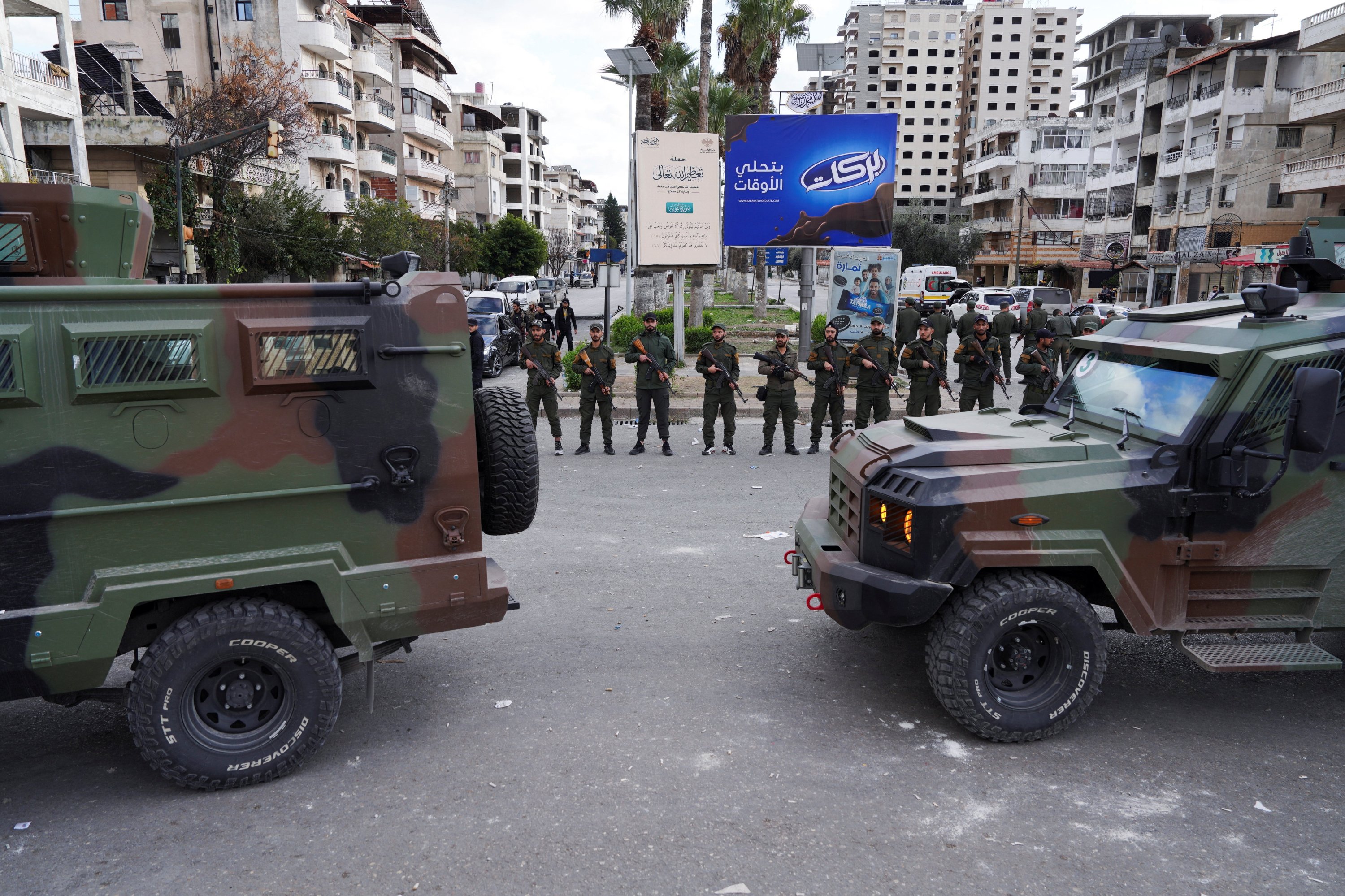
Calm returned to Syrian coastal cities Monday following protests by separatists and Assad remnants the day before, with local authorities reporting a significant security presence to prevent further unrest.
On Sunday, protests had erupted in several provinces, including Latakia, which is largely populated by members of the Alawite community to which former dictator Bashar Assad belonged to. Similar demonstrations were reported in the provinces of Tartus, Homs and Hama.
In Latakia, a source in the governorate told Deutsche Presse-Agentur (dpa) that "the city is calm today across all areas, with public security forces and Ministry of Defense units deployed to avoid incidents that could harm civilians or damage property."
Syrian authorities, however, blamed supporters of the country's now-deposed ruler, Assad, for attacking security forces and civilians during the unrest in Latakia, resulting in three deaths, according to Syria's state news agency SANA.
The protests were in response to a call from Alawite separatist leader Ghazal Ghazal, who has previously been known for his support of the regime and for advocating a military solution against the Syrian revolution.
Sheikh Mohammad Ali from Latakia blamed Ghazal for the unrest in Latakia and other coastal cities, accusing him of endangering Alawite communities.
"He wants to send the Alawite youth into fire, as Assad did, killing and injuring hundreds of thousands of Alawites before fleeing with his family," Ali told dpa.
In Tartus, public security and Defense Ministry forces were deployed across the governorate after imposing a curfew following attacks on security personnel by former regime loyalists riding motorcycles.
Yasser Othman, a local employee, said, "the province is calm today after former regime elements attacked security forces and protesters. These individuals have become mercenaries for Iran and Hezbollah after Assad abandoned them."
The Latakia Health Directorate reported that the Sunday violence left four people dead and 108 injured.
The heavy security deployment appears to have restored relative calm, though tensions remain high in Syria's coastal regions.
Since Assad's ouster in December last year, Syria, an ethnically diverse country, has been roiled by several instances of deadly violence.
Interim President Ahmed al-Sharaa, however, has pledged to protect minorities.
Meanwhile, Syrian authorities announced Sunday the arrest of a member of a “terrorist cell” in the northwestern province of Latakia.
The Interior Ministry said an individual identified as Basel Issa Ali Jamahiri was apprehended in the village of Duweir Ba'bada in the Jableh countryside on charges of belonging to the Saraya al-Jawad cell, which is affiliated with former special forces commander Suheil al-Hassan.
Al-Hassan is suspected of having committed war crimes against members of the Syrian revolution.
The ministry added that several weapons and ammunition hidden in various locations were confiscated during the operation.
Suheil al-Hassan, a former commander in the ousted Assad regime’s army, is widely known as one of the figures most closely associated with repression against Syrians during the years of the revolution between 2011 and 2024. He is also accused of playing a prominent role in the regime’s policy of violently suppressing popular protests, including the use of barrel bombs.
The ministry said the arrest was part of a broader security operation carried out by the Internal Security Command in Latakia province Wednesday.
On the same day, Syrian authorities announced the seizure of improvised explosive devices and various weapons during an operation targeting the Saraya al-Jawad cell, which resulted in the arrest of one member and the neutralization of three others.