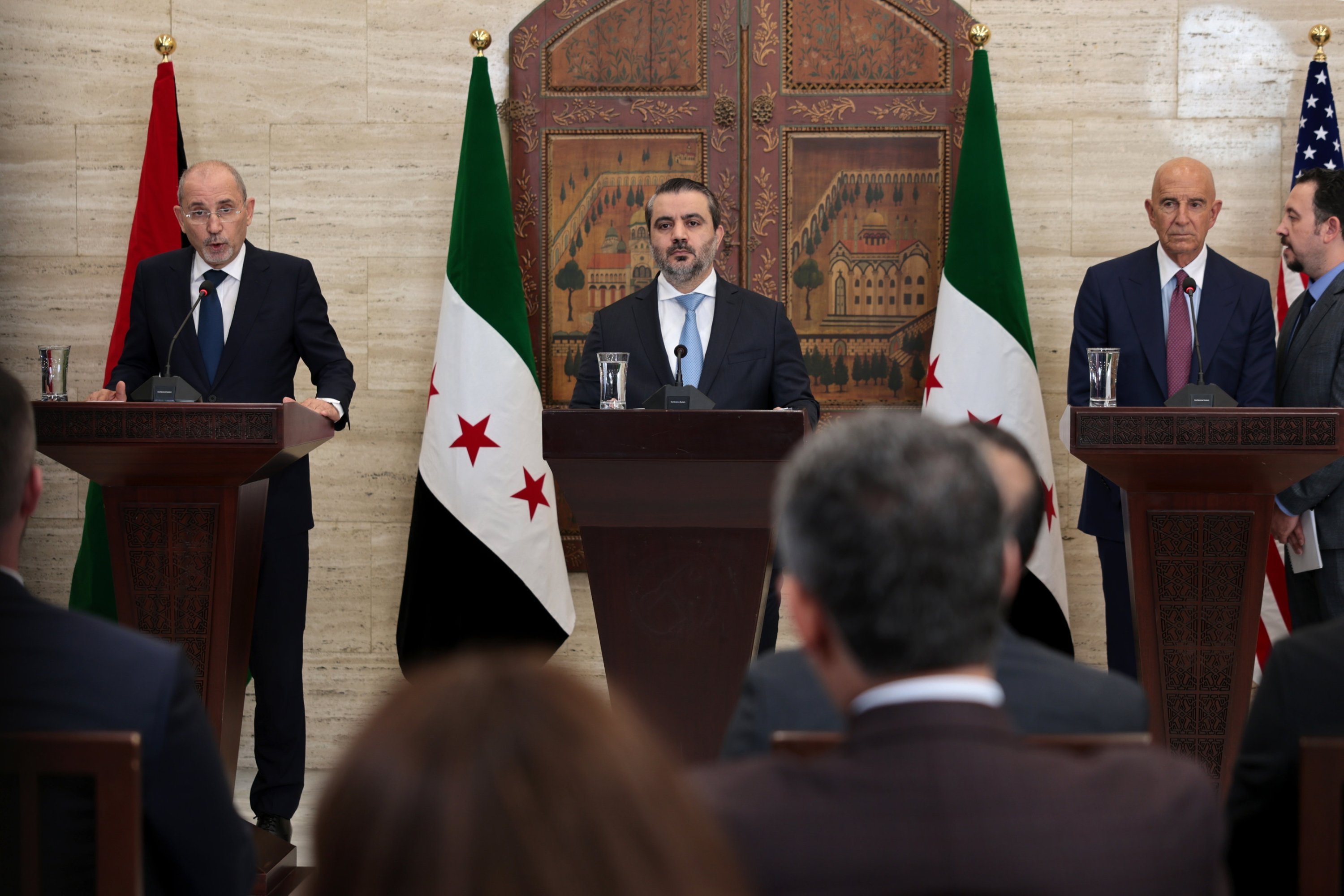
Syria announced Tuesday that it is cooperating with the United States to establish joint “security understandings” with Israel, which has called for the demilitarization of southern Syria.
The announcement was part of a U.S.- and Jordan-backed roadmap for restoring stability in the south following sectarian violence, which was exploited by Israel to attack the country, and a Syrian military official told AFP that heavy weapons had been withdrawn from the area.
The foreign ministry said that Washington, "in consultation with the Syrian government, will work to reach security understandings with Israel concerning southern Syria that address the legitimate security concerns of both Syria and Israel."
The week of bloodshed in Druze-majority Sweida province erupted on July 13 with clashes between Druze fighters and the Bedouin but rapidly escalated, drawing in government forces and tribal fighters from other parts of Syria.
Israel, which has its own Druze community, used the incident as a pretext to carry out air strikes on government targets, claiming it was acting to defend the minority group.
"Syrian forces have withdrawn their heavy weapons from southern Syria," the military official told AFP on condition of anonymity, adding the process began around two months ago, after the violence.
A diplomatic source in Damascus told AFP, also on condition of anonymity, that the withdrawal covered the country's south up to about 10 kilometers (six miles) outside the capital.
Israeli Prime Minister Benjamin Netanyahu had said in August that his country was engaged in talks to establish a demilitarized zone in southern Syria.
The two countries have technically been at war since 1948.
After anti-regime-led forces toppled longtime dictator Bashar Assad in December, Israel deployed troops to a U.N.-patrolled buffer zone on the Golan Heights that has separated the countries' forces since an armistice that followed the 1973 Arab-Israeli war.
Israel has also repeatedly bombed Syria since Assad's fall.
Last week, President Ahmed al-Sharaa said Syria was negotiating with Israel to reach a security agreement that would see Israel leave areas it had occupied in recent months.
Syrian and Israeli officials have met on several occasions, and the diplomatic source said a new meeting would be held in Azerbaijan's capital, Baku, on Friday.
Since a cease-fire ended the sectarian bloodshed in July, the situation in Suwayda has remained unstable, with the city controlled by local Druze forces and the rest of the province by government troops.
Foreign Minister Asaad al-Shaibani announced on Tuesday a plan backed by Jordan and the United States to restore calm in the area.
"The Syrian government has laid out a clear roadmap for action... that supports justice and builds trust," Shaibani said in a press conference, adding that the plan involves holding accountable those who attacked civilians, compensating the people affected and "launching a process of internal reconciliation."
Jordanian Foreign Minister Ayman Safadi said a "joint Syrian-Jordanian-American mechanism" would ensure the plan's implementation, while U.S. envoy Tom Barrack, who was also present, called the steps "historic."
Syrian authorities have said their forces intervened after the violence broke out to stop the clashes, but witnesses, Druze factions and the Syrian Observatory for Human Rights have accused them of siding with the Bedouin and committing abuses against the Druze.
Hikmat al-Hijri, one of Syria's leading Druze spiritual leaders, had called for Israel's help during the bloodshed, and last month demanded the creation of a separate region for the minority in southern Syria.
Last month, Syrian state media said Shaibani and Israeli Strategic Affairs Minister Ron Dermer had met in Paris to discuss de-escalation and the situation in Sweida.
Earlier on Tuesday, Syrian authorities announced the creation of a new internal security chief position for Suwayda city, naming a member of the Druze community to the post.
The new chief, Suleiman Abdel Baqi, leads a local armed group that is seen favourably by the new authorities.