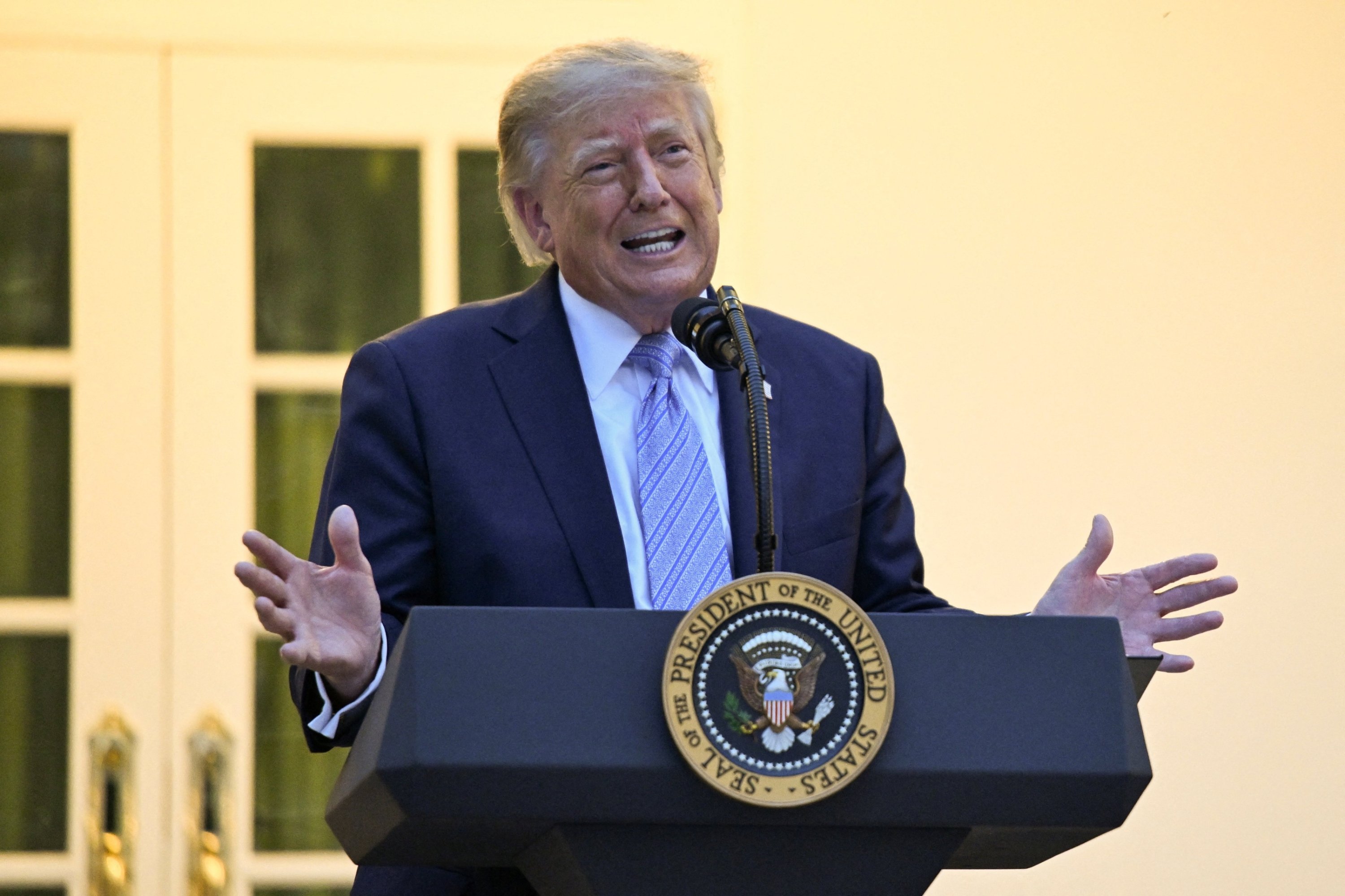
President Donald Trump returns to the United Nations next week facing a Middle East conflict that has proved far more complicated and prolonged than he predicted, with Iran still resisting U.S. pressure and its Houthi allies threatening another critical global shipping route.
When Trump addressed the U.N. a year ago, he portrayed the U.S. bombing of Iran's nuclear facilities as a decisive success, saying American strikes had "totally obliterated everything" and claiming he had helped bring peace between Israel and Iran.
Six months into the latest U.S.-Iran war, those declarations face a much more skeptical international audience.
Iran has been weakened militarily and economically, but it has continued to challenge Washington, restricting shipping through the Strait of Hormuz while its Iran-aligned Houthi allies in Yemen have rapidly expanded their control along the Red Sea coast. The Houthi advance toward the Bab el-Mandeb Strait has created a second threat to a vital global shipping corridor and pushed energy prices higher.
The developments have left Trump confronting a difficult strategic choice. Washington wants to keep both waterways open and reassure Gulf allies, but the U.S. military is already heavily committed to the Iran conflict and Trump has shown little appetite for opening another major front in Yemen.
The Houthi gains have also exposed vulnerabilities among U.S. partners. Saudi Arabia has requested greater American military support as the group attacks Saudi cities and energy infrastructure, but Washington has so far emphasized intelligence and targeting assistance rather than direct U.S. strikes.
"The US clearly has (military) capacity challenges but even so the cost of inaction here is likely to intensify tensions among Gulf allies," said Jonathan Panikoff, a former deputy national intelligence officer on the Middle East.
Trump entered the conflict after campaigning on avoiding prolonged foreign military engagements. He has since repeatedly suggested that the war could end soon, while offering shifting objectives and timelines.
On Wednesday, he again said he hoped the conflict was nearing its end.
"Well, hopefully we are towards the end of the war," Trump told reporters.
But the war that began Feb. 28, when the U.S. and Israel attacked Iran, has entered its seventh month. Iran responded with strikes against Israel and Gulf countries hosting U.S. military bases, while negotiations aimed at ending the fighting have repeatedly stalled.
The conflict has also placed pressure on U.S. military resources, including missile stockpiles, while creating economic consequences that have spread well beyond the battlefield.
Oil prices have remained above $100 a barrel amid disruptions to regional energy infrastructure and shipping. Traffic through the Strait of Hormuz has fallen sharply, while the Bab el-Mandeb is also facing growing disruption because of the Houthi advance.
For Trump, the economic fallout carries an additional political dimension. Higher energy costs are emerging as an issue ahead of November's midterm elections, when Republicans will defend their control of Congress.
"We are seeing what happens when a president launches a war of choice without anticipating the unintended consequences," said Aaron David Miller, a former Middle East adviser to both Republican and Democratic administrations.
Iran's nuclear program was central to Trump's justification for military action, but questions remain over the extent to which the strikes achieved the administration's stated objectives.
During his U.N. speech last year, Trump recalled the U.S. deployment of B-2 bombers and the use of 30,000-pound bombs against Iranian nuclear facilities. He described the strikes as having demolished Iran's uranium-enrichment capacity.
Experts subsequently assessed that the attacks had severely damaged the program but had not eliminated it.
Trump has continued to argue that the campaign successfully weakened Iran's nuclear capabilities. The administration has also intensified sanctions and economic pressure on Tehran.
Iran, meanwhile, has maintained that its nuclear program is peaceful and has denied seeking nuclear weapons.
The disagreement over the nuclear issue remains one of the central obstacles to diplomacy. Negotiations earlier this year produced competing accounts over inspections, Iran's frozen assets and the future of its nuclear activities.
The United Nations has also added fresh scrutiny of the war. A U.N. fact-finding mission said Thursday that there were reasonable grounds to believe the U.S. was responsible for strikes on a school and a sports facility in Iran in February that constituted war crimes. The mission separately accused Iranian authorities of crimes against humanity during a crackdown on anti-government protests.
The findings are expected to further complicate Trump's appearance before world leaders.
Trump's approach has also raised concerns among Gulf states that rely heavily on U.S. security guarantees.
Those concerns have grown because the U.S. entered the war without consulting several allies and has since resisted Saudi requests for direct intervention against the Houthis.
Saudi Arabia is particularly vulnerable because the Strait of Hormuz has been heavily disrupted, increasing the importance of alternative routes through the Red Sea. The Houthi advance toward the Bab el-Mandeb now threatens that option as well.
The crisis has also strained Washington's relationships with European and Asian allies, many of which have resisted Trump's calls for greater involvement in a conflict they did not help initiate.
At the same time, the humanitarian consequences in Yemen are mounting. More than 100,000 people have been internally displaced by the renewed fighting, while thousands more have fled by sea to Djibouti, according to the U.N. refugee agency.
The Houthi offensive has complicated Trump's search for an exit strategy.
A major U.S. intervention in Yemen could further stretch American forces and expose U.S. personnel and bases to retaliation. But allowing the Houthis to gain control over the Bab el-Mandeb would give Iran-aligned forces leverage over another major international shipping route.
U.S. officials met Houthi representatives in Oman last weekend in an apparent effort to contain the situation. The Houthis indicated they were targeting Saudi shipping but did not intend to attack American vessels, according to people familiar with the discussions.
Meanwhile, Washington continues to pursue economic pressure against Tehran.
The Trump administration has described its campaign as an effort to cripple Iran's economy and force concessions, while Iranian officials have rejected the pressure and continued to resist U.S. demands.
Trump will also encounter Iranian officials at the U.N. gathering. The U.S. has agreed to allow Iranian President Masoud Pezeshkian and Foreign Minister Abbas Araqchi to attend the General Assembly despite the ongoing conflict, although the delegation will face restrictions while in New York.