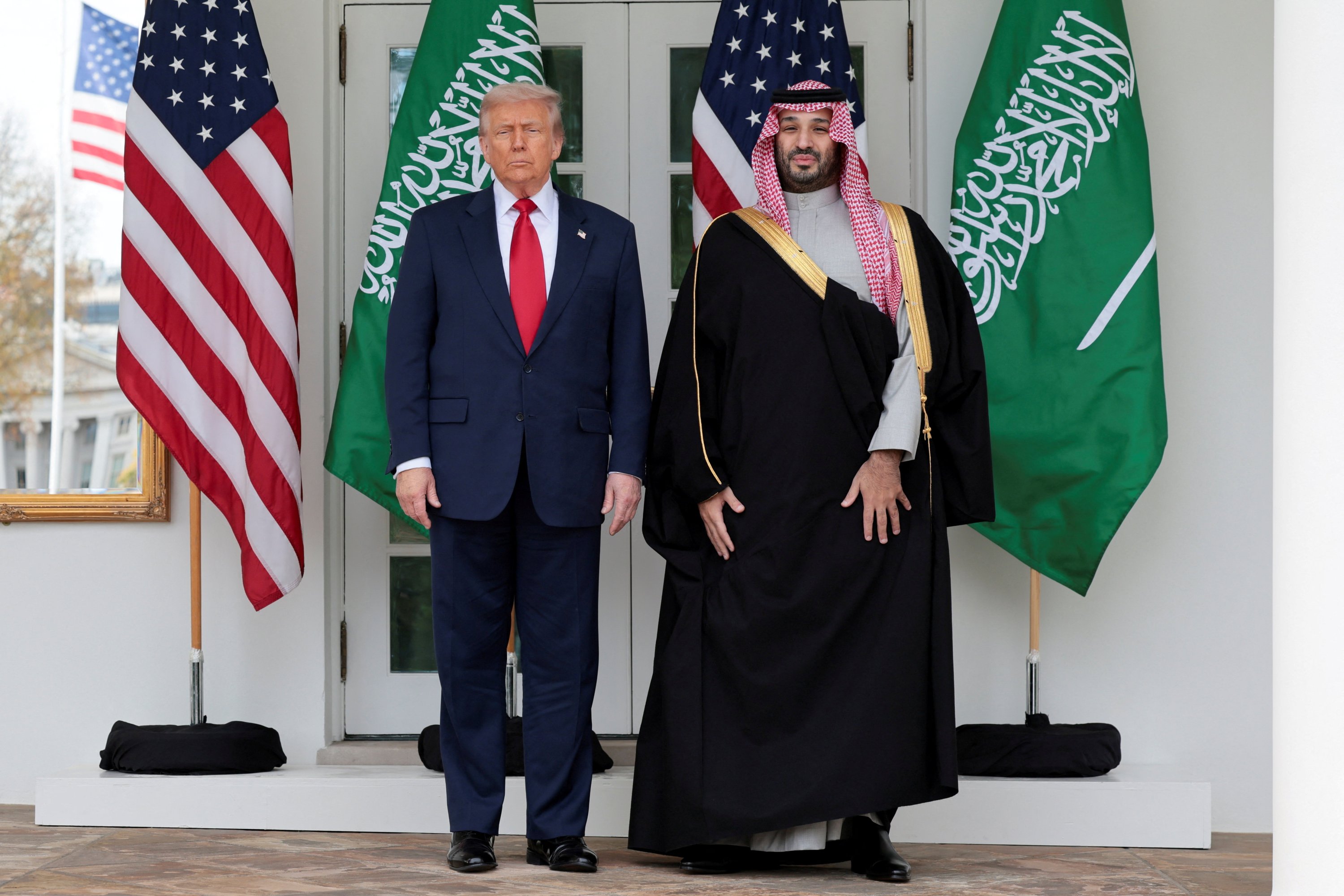
President Donald Trump on Tuesday designated Saudi Arabia as a "major, non-NATO ally," as both sides announced agreements on arms sales, civil nuclear cooperation, artificial intelligence and critical minerals.
"We're taking our military cooperation to even greater heights by formally designating Saudi Arabia as a major, non-NATO ally, which is something that is very important to them," Trump said at a dinner with the Saudi Crown Prince.
The meeting underscored a key relationship – between the world's biggest economy and the top oil exporter – that Trump has made a high priority in his second term.
The warm welcome for bin Salman in Washington marks a high point for U.S.-Saudi ties. Trump's predecessor Joe Biden traveled to the kingdom and met with the Saudi prince but he stopped short of hosting him at the White House.
Trump said he received a "positive response" about the prospects for Saudi Arabia normalizing ties with Israel. But the crown prince made clear that while he wanted to join the Abraham Accords, he was sticking to his condition that Israel must provide a path to Palestinian statehood, which it has refused to do.
During a formal black-tie dinner at the White House later Tuesday, Trump said he was "taking our military cooperation to even greater heights" by designating Saudi Arabia a major non-NATO Ally, a status that provides a U.S. partner with military and economic privileges but does not entail security commitments. U.S. strikes on Iranian nuclear facilities in June had made Saudi Arabia safer, Trump added.
A White House fact sheet said the two sides signed a Strategic Defense Agreement, which "fortifies deterrence across the Middle East," makes it easier for U.S. defense firms to operate in the country and secures "new burden-sharing funds from Saudi Arabia to defray U.S. costs." The agreement appeared to fall short of the congressionally ratified NATO-style treaty Saudi Arabia initially sought.
The White House announced Trump had approved future deliveries of F-35 fighter jets and the Saudis had agreed to purchase 300 American tanks. The sale of the stealth fighter jets to the kingdom, which has requested to buy 48 of the advanced aircraft, would mark the first U.S. sale of the advanced fighter jets to Riyadh, a significant policy shift. The deal could alter the military balance in the Middle East and test Washington's definition of maintaining what the U.S. has termed Israel's "qualitative military edge." Until now, Israel has been the only country in the Middle East to have the F-35.
The two countries also signed a joint declaration on the completion of negotiations on civil nuclear energy cooperation, which the White House said would build the legal foundation for a long-term nuclear energy partnership.
Bin Salman has been seeking a deal to unlock access to U.S. nuclear technology and help Saudi Arabia level up with the UAE and traditional regional foe Iran. But progress on such a nuclear pact has been difficult because the Saudis have resisted a U.S. stipulation that would rule out enriching uranium or reprocessing spent fuel - both potential paths to a bomb.
At the start of his visit, the crown prince was greeted with a lavish display of pomp and ceremony presided over by Trump on the South Lawn, complete with a military honor guard, a cannon salute and a flyover by U.S. warplanes.
Sitting next to Trump, bin Salman promised to increase his country's U.S. investment to $1 trillion from a $600 billion pledge he made when Trump visited Saudi Arabia in May. But he offered no details or timetable.
The two sides also signed a memorandum of understanding on artificial intelligence and a framework for collaboration on critical minerals, the White House said.
A $1 trillion investment in the U.S. would be difficult for Saudi Arabia to pull together given its heavy spending on an already-ambitious series of massive projects at home, including futuristic megacities that have gone over budget.
Spearheading an ambitious Vision 2030 plan to diversify the Saudi economy and lessen its dependence on oil, bin Salman is expected to tout his efforts at an investment conference to be attended by a slew of corporate executives on Wednesday at the John F. Kennedy Center for the Performing Arts.
In the Oval Office, Trump vehemently denied any conflict of interest with his family's Saudi investment interests.
"I have nothing to do with the family business. I have left, and I've devoted 100% of my energy. What my family does is fine. They do business all over," he said.
The White House has repeatedly said that upon taking office, Trump ended his involvement in his businesses after placing them in a trust managed by his children. Still, as beneficiary of the trust that controls the Trump Organization, the president will have the money the family is now making at his disposal when he leaves office.