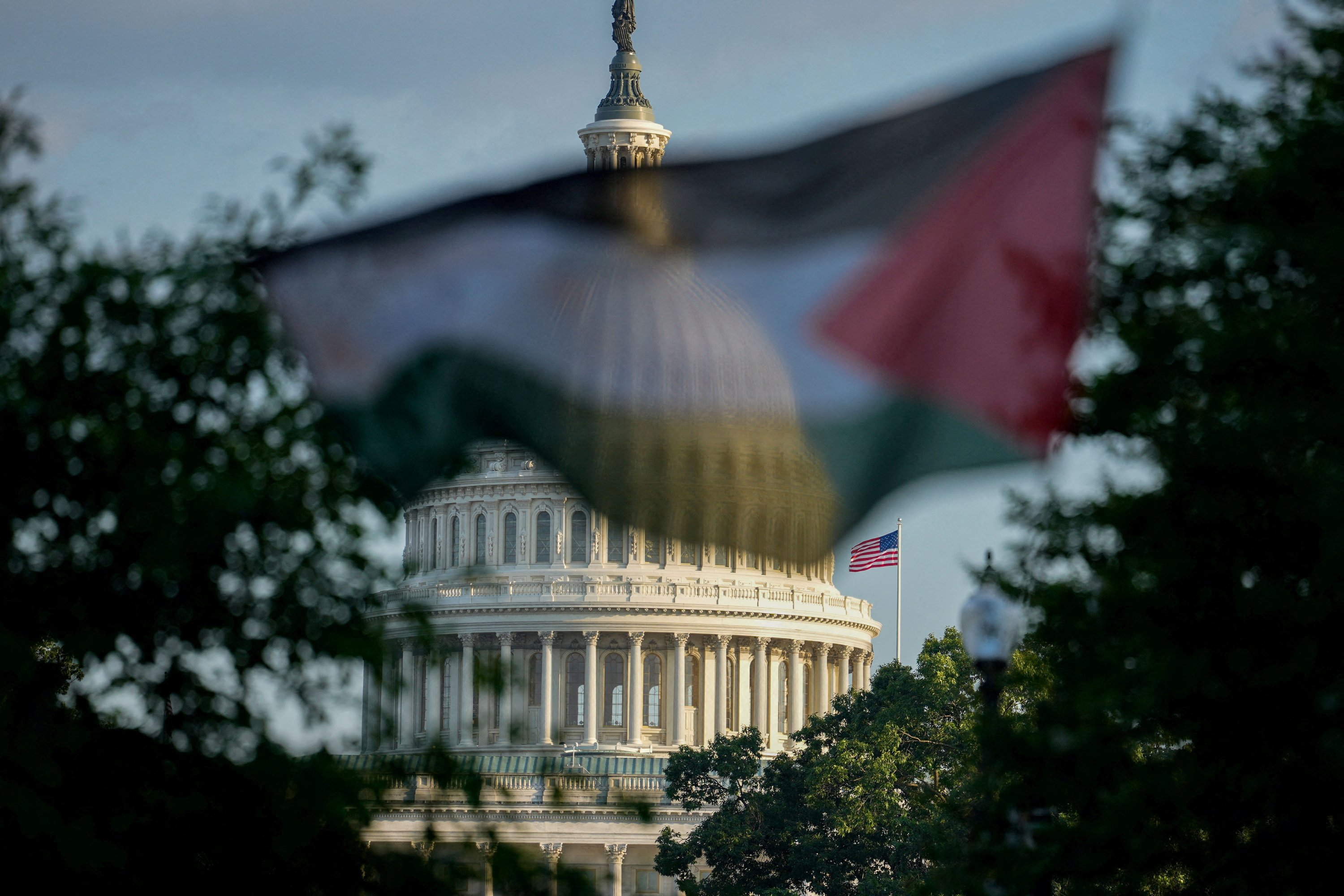
The U.S. on Thursday announced sanctions on officials from the Palestinian Authority (PA) and the Palestine Liberation Organization (PLO), claiming they are obstructing peace efforts with Israel, even as other Western powers advanced toward recognizing Palestinian statehood.
The State Department said it would deny visas for travel to the U.S. by those it was targeting, although it did not name any specific individuals.
"It is in our national security interests to impose consequences and hold the PLO and PA accountable for not complying with their commitments and undermining the prospects for peace," the State Department said in a statement.
It claimed the two Palestinian organizations had "taken actions to internationalize" their conflict with Israel, including through the International Criminal Court, and said both had continued "to support terrorism."
The PA and PLO serve as representatives for the Palestinian people and have long pushed for recognition of a Palestinian state by international organizations and foreign nations.
Authorities in Palestine called U.S.' move "blatant support for Israel's occupation" and its ongoing war in the enclave of Gaza.
Wassel Abu Yousef, a member of the PLO's executive committee, told Anadolu Agency (AA) that the sanctions come "as the U.S. partners in Israel's genocidal war on Gaza."
He accused Washington of "backing Israel's crimes and its settlers," saying the sanctions were meant to "support the occupation and its war of extermination, and to erase the Palestinian cause after the New York conference and the wave of countries announcing plans to recognize Palestine, which has risen to the top of the international agenda."
Abu Yousef added that the measures also sought "to undermine Palestinian representation," stressing that "the decision is nothing but further support for the occupation."
The State Department made its announcement just a day after Canada said it planned to recognize the State of Palestine at a meeting of the United Nations in September, ratcheting up pressure on Israel as starvation spreads in Gaza.
France said last week it would back Palestinian statehood and Britain said it would do the same at September's U.N. General Assembly meeting if Israel's atrocities in Gaza had not stopped by then.
The moves have come as international concern and criticism have grown as starvation and famine are taking place in Gaza and Palestinians are not getting food due to Israeli blockade.
The leading international authority on hunger crises this week said Israel's military offensive and blockade have led to the "worst-case scenario of famine" in the territory.
Since returning to office in January, U.S. President Donald Trump has been vague on his position on a two-state solution to the conflict between Israel and Palestine.
Israel has denounced the moves by France, Britain and Canada.
Israeli Foreign Minister Gideon Saar, in a post on social media platform X, thanked the U.S. for its "moral clarity" in sanctioning the Palestinian officials,
Saar said the action "also exposes the moral distortion of certain countries that ran to recognize a virtual Palestinian state while turning a blind eye to its support for terror and incitement."
It was not immediately clear how the U.S. visa ban would affect Palestinian diplomats.
Under the 1947 U.N. "headquarters agreement," the U.S. is generally required to allow access for foreign diplomats to the U.N. in New York. But Washington has said it can deny visas for security, terrorism and foreign policy reasons.
The U.S. sanctions follow an international conference this week at the U.N., hosted by France and Saudi Arabia, that aimed to work toward a two-state solution. Israel and the U.S. boycotted the event.
Since Oct. 7, 2023, Israel's offensive has killed more than 60,000 people in Gaza, mostly civilians, according to local health officials, reduced much of the enclave to ruins and displaced nearly the entire population.