As Israel's onslaught on Gaza continues, the positions of major players in the international arena are closely scrutinized. Positions oscillate between the West's continuous blank cheque for Israel, Russia's lip service to Palestinian rights and China's enduring neutrality.
Throughout this crisis, China has maintained a notably muted presence. Its statements echo classic condemnations, with calls for restraint on both sides, a mere paraphrasing of the U.N. Charter and a conviction that the two-state solution is the way forward. Still, this standard approach did not please the Israeli leaders, who aimed to use the Oct. 7 events as their 9/11, hoping to see a harsher condemnation of Hamas. The latter is not labeled as a terrorist organization by China.
Beyond such misplaced expectations, China's subdued tone is rather the norm than the exception. Beijing's foreign policy playbook is based on a strict commitment to non-interference.
Nevertheless, the Israeli leadership hoped to test the limits of Beijing's conventional foreign policy. China has a long-standing pro-Palestinian stance. During the 1960s and 1970s, Beijing supported the Palestinian Liberation Organization (PLO) diplomatically and politically.
More recently, Beijing also voted in favor of a U.N. General Assembly resolution calling for a humanitarian truce to the war in Gaza. But these moves represent the maximum the Chinese leaders can do, and it is highly unlikely to witness more assertive postures.
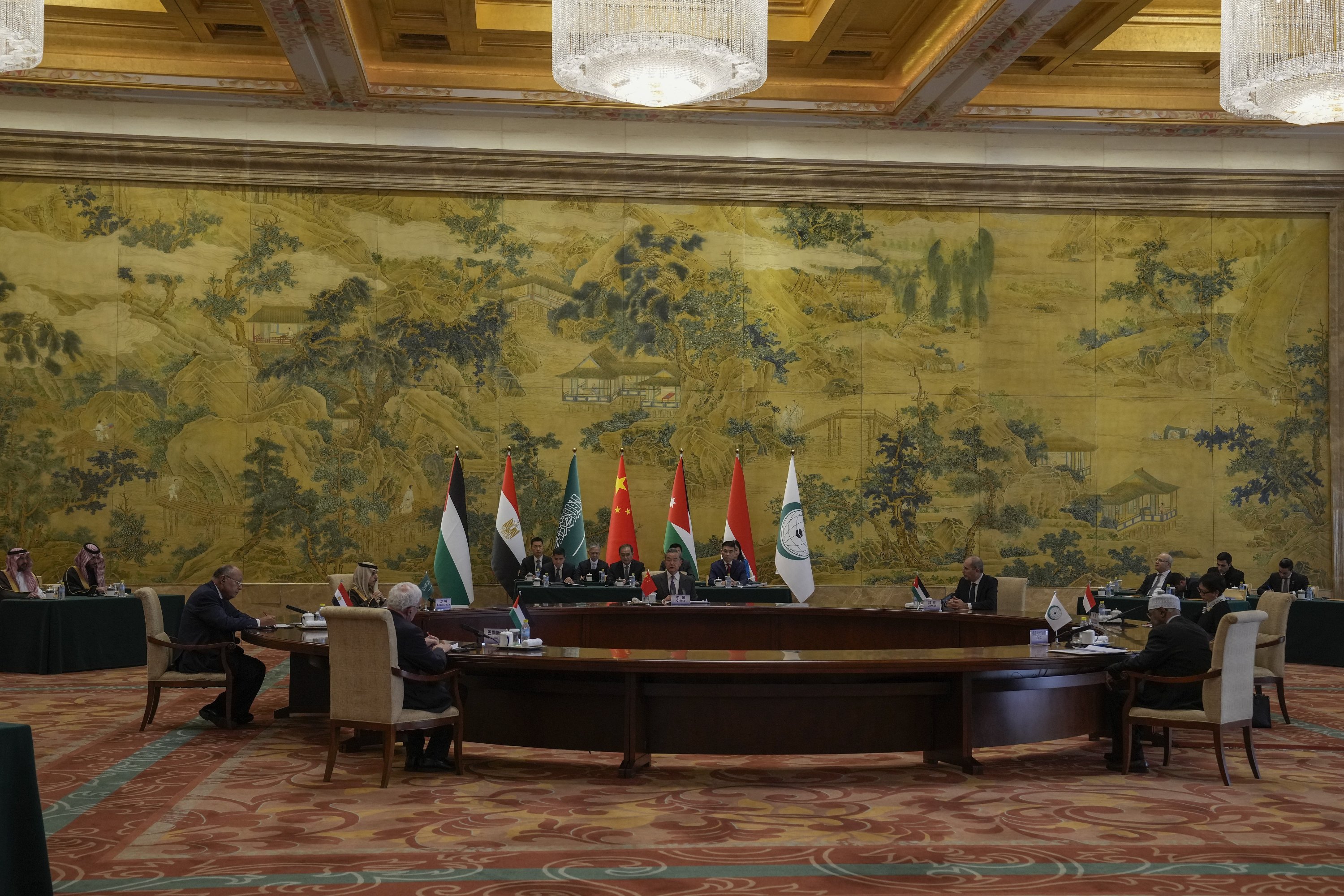
China has interests on both sides. On the one hand, supporting Palestine rhetorically boosts Beijing's image as a force standing for global justice. Projecting a positive image in the Global South has always been a priority. Such rhetoric can be seen in the Global Security Initiative paper and the supportive messages conveyed by President Xi Jinping during Mahmoud Abbas' visit to Beijing. This messaging is also coherent with China's statements during the annual COP meetings, G-7 conferences and the U.N. voting meetings: The most powerful developing nation is a peer among other developing countries.
China's approach to the current war on Gaza is, therefore, part of a larger framework, which also explains why Beijing consistently calls for cooperation with the U.N. and other key stakeholders to seek a resolution. Such diplomacy is a cornerstone of China's foreign policy and diplomatic lexicon.
On the other hand, Israel carries a big weight in China's considerations. China is the second largest trade partner of Israel, and Israel is a major investment hub for China, even if it is a non-Belt and Road Initiative (BRI) country. Additionally, Chinese investments in Israel are strategically significant, as with Haifa Port construction projects. Washington often warned against Chinese state-run enterprises operating strategic projects in Israel.
To truly grasp China's stance, one must remember China's extraordinary economic ascent over the past two decades, which has firmly anchored its name in the world's economic landscape. In many ways, a profit-centric economic view of the world forms the core of China's global perspective.
While the debate rages on whether China has geopolitical aspirations beyond the economic realm, as seen with the China-Pakistan Economic Corridor (CPEC), one thing remains certain – China's stance toward Israel is unlikely to deviate toward further marginalization currently, given its strict adherence to this economy-centric mindset.
There is also a less-known yet intriguing facet of the China-Israel relationship – one that occasionally raises eyebrows in Washington. For instance, there has been a buzzing interest in Chinese enterprises in Israel's burgeoning startup landscape, with a distinct interest in strategic assets.
Moreover, Beijing also regularly acquires cutting-edge Israeli weaponry, such as loitering munitions (LMs) and state-of-the-art surveillance technology, which have pivotal importance for the PLA. These business deals are mostly concealed from the public eye. In this context, Israel's double-faced role, whereby Tel Aviv benefits from the largess of Washington yet offers high-tech goodies to Beijing, transcends mere economic exchanges of "soft" commodities for dollars; it embodies the guile of Israeli foreign policy, keen to gain importance and leverage in the eyes of an emerging super-power. Therefore, such shadowy dealings paint a complex and dynamic portrait of the China-Israel relationship.
The escalation of the Israeli-Palestine conflict has led some to speculate about China's significance in the evolving "multipolar" international system or even liken it to a new America in the Middle East. However, the reality is quite different. China has no desire or interest in taking sides in this war.
For China, the factors of image-building and economic gains coexist, at least for now, as the global power balance remains partially unipolar in favor of the U.S. enjoying the superpower status. China does not have the latitude to choose a side in this war and arm it directly. Such scenarios are reminiscent of the Cold War era.
Even if China were to emerge as a peer competitor to the U.S., there is no guarantee that it would automatically throw its weight behind Palestine, much like the Soviet Union did during the 1967 Arab-Israeli War and the 1973 Yom Kippur War. This hesitation stems from the fact that the character of the Palestinian resistance today is notably different from its past when the PLO predominantly led it and espoused a more leftist tone.
So, are there other alternatives for China to maintain its economic gains and preserve its image? Arguably, it all depends on the direction China and the U.S. take. If these two powers wish to give the international community the impression that they can coexist, there may be a chance to end this genocidal war and pave the way for a two-state solution.
However, this would require the U.S. to deviate from its unconditional support for Israel, a move inconceivable at this stage. This situation would also need China to show the leadership and capability to go beyond mere condemnation statements or bizarre acts like erasing Israel from Alibaba and Baidu maps. It is also conditional on Western countries willing to stand up against the IDF's documented war crimes and pressure Israel to agree to a cease-fire.
In summary, China appears content with the existing status quo. It portrays itself as a vocal actor capable of opposing injustice in the eyes of the global South, albeit causing some disappointment for Israel but with no harm done to the lucrative economic partnership. Therefore, for the foreseeable future, the Chinese position will not evolve beyond a pro-Palestinian positive neutrality.