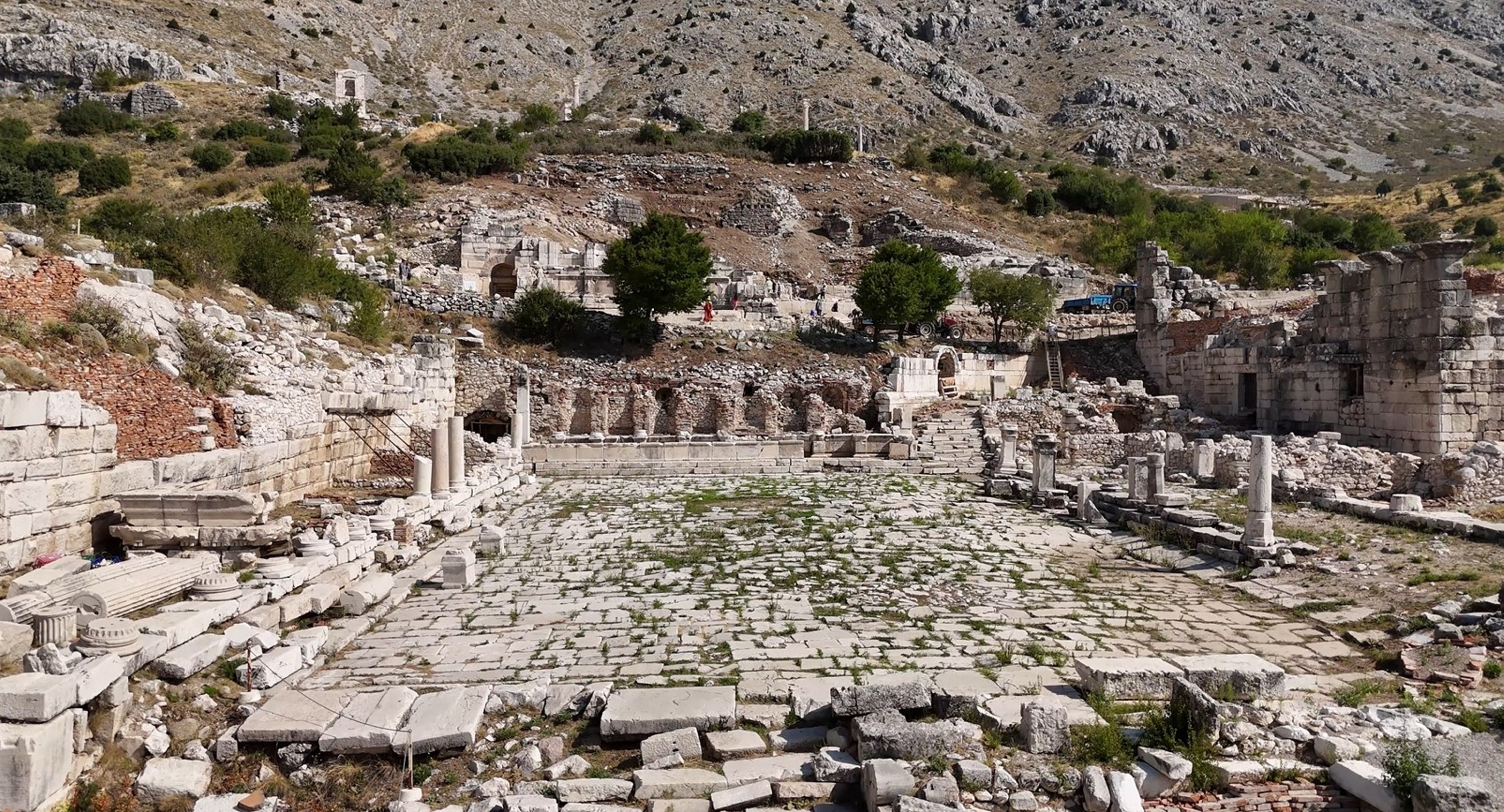
In the heart of Burdur province in southern Türkiye, nestled in the rugged highlands of Ağlasun, the ancient city of Sagalassos continues to reveal its magnificence. For the past 20 years, a determined archaeological effort has been peeling back the layers of time, unearthing one of Anatolia’s most splendid Roman cities.
The Sagalassos Archaeological Research Project, supported by Aygaz since 2005, is celebrating its 20th year. To mark the occasion, Aygaz General Manager Melih Poyraz and a delegation visited the site and the excavation house. During the visit, the group received information on the restoration of the Agora Gymnasium, Southeast Avenue and the Street Fountain.
The ancient city, listed on UNESCO’s World Heritage Tentative List, recently revealed several important finds, including a sphinx figure of the god Tutu and two life-sized marble statues, one representing the moon god Men and the other Hermes.
In his speech at the excavation site, Melih Poyraz stated that through their support, they have witnessed the uncovering of the ancient city for over 20 years. He noted that the Antonine Fountain marks a significant turning point for both the country and the field of archaeology. Poyraz also mentioned that the Upper Agora is among the best-preserved ancient squares in the Mediterranean region.
Poyraz emphasized that the excavations are conducted through broad cooperation. Since 2024, the project has been managed by a consortium of established institutions, including Koç, Bilkent, KU Leuven and Vrije Universiteit Brussel. He added that the project involves not only financial support but also substantial expertise and effort from these institutions and scholars.
Discussing the company’s commitment, Poyraz said Aygaz will celebrate its 65th anniversary next year and highlighted the importance of long-term sponsorships in social responsibility projects.
Professor Peter Talloen, head of the Sagalassos excavations, described Sagalassos as one of the best-preserved ancient cities. He recalled a devastating earthquake in the seventh century A.D. that buried the city under soil, which arrived at the present day like a large puzzle. He noted that, unlike other sites near modern settlements, Sagalassos has been protected from looting and remains largely as it was left.
As part of the excavation program planned until 2029, restoration works are planned for the Agora Gymnasium, Southeast Avenue and the Street Fountain. In 2024, preliminary restoration was completed on the west portico of the Gymnasium and excavations at the Street Fountain documented collapsed architectural elements. After these works, visitors will be able to use the original ancient routes to access the Upper Agora.
A five-year program for conservation and anastylosis is underway. This includes research, documentation and opening to the public of the urban structures around the Street Fountain and access roads to the Upper Agora. The program aims to restore the Agora Gymnasium and the Southeast Avenue with the Street Fountain.
In 2025, excavation will continue on the eastern part of the newly discovered colonnaded street near the Street Fountain. This work will document the collapsed architectural parts in place and uncover another section of the Southeast Agora Avenue.
Additionally, efforts are ongoing to use a sixth-century A.D. pavement as an authentic entrance path for visitors arriving from the lower city. This will provide a resting point before visitors reach the Agora via the Street Fountain. There are also plans to restore water flow to the fountain, aiming to return it to its original function.
The visit also included professor Jeroen Poblome from KU Leuven’s Archaeology Department and professor Inge Uytterhoeven, dean of the Faculty of Humanities and Letters at Koç University.