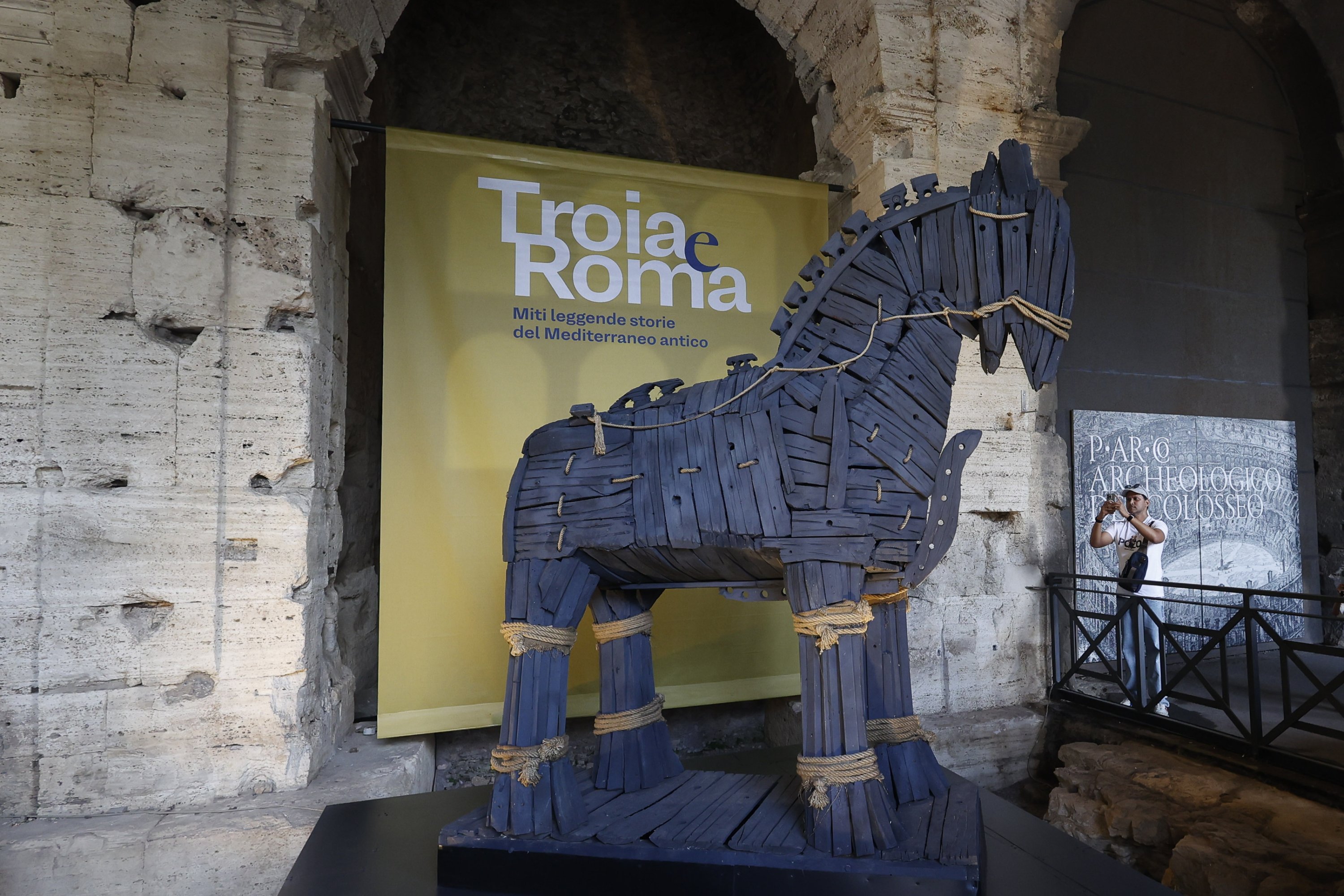
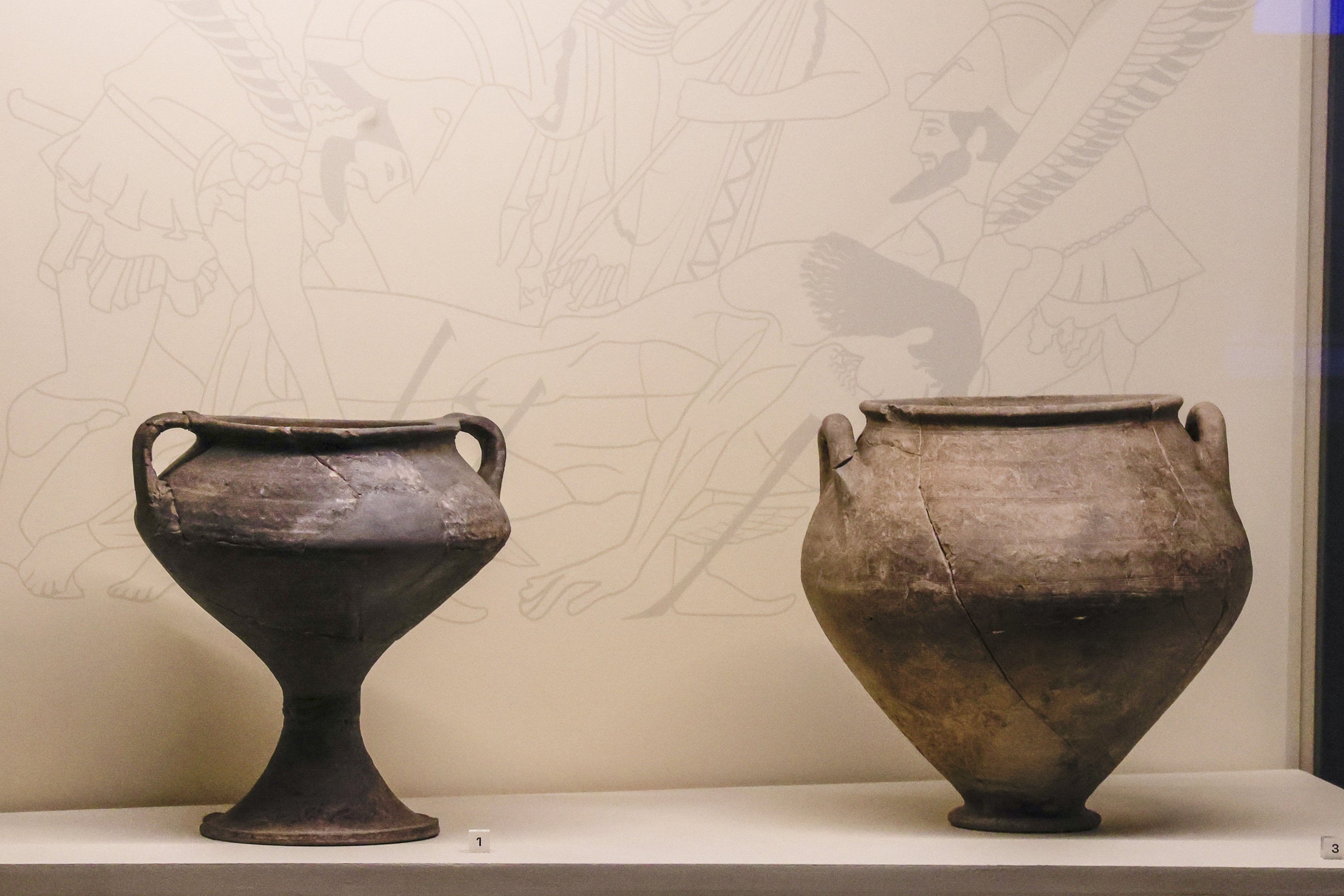
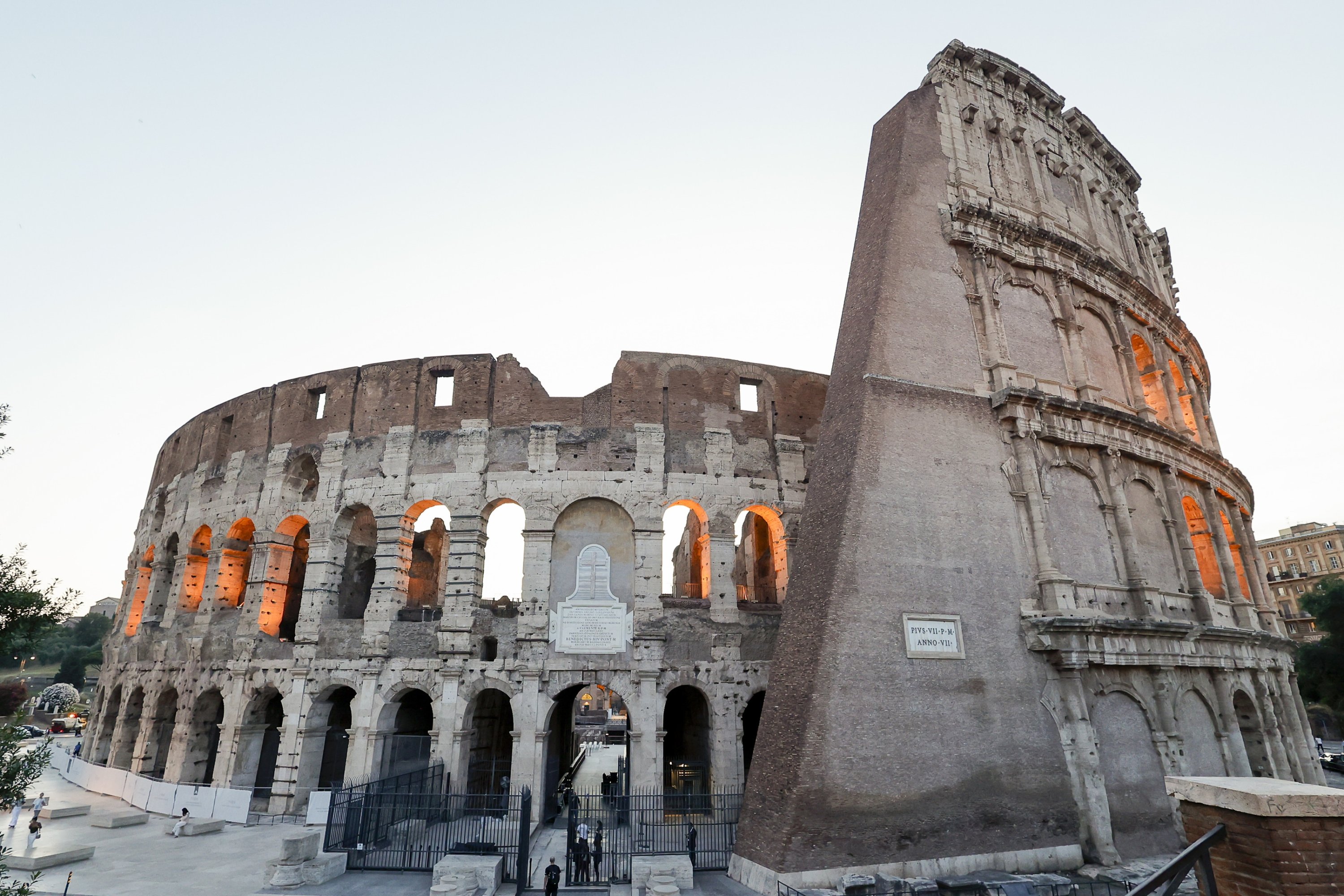
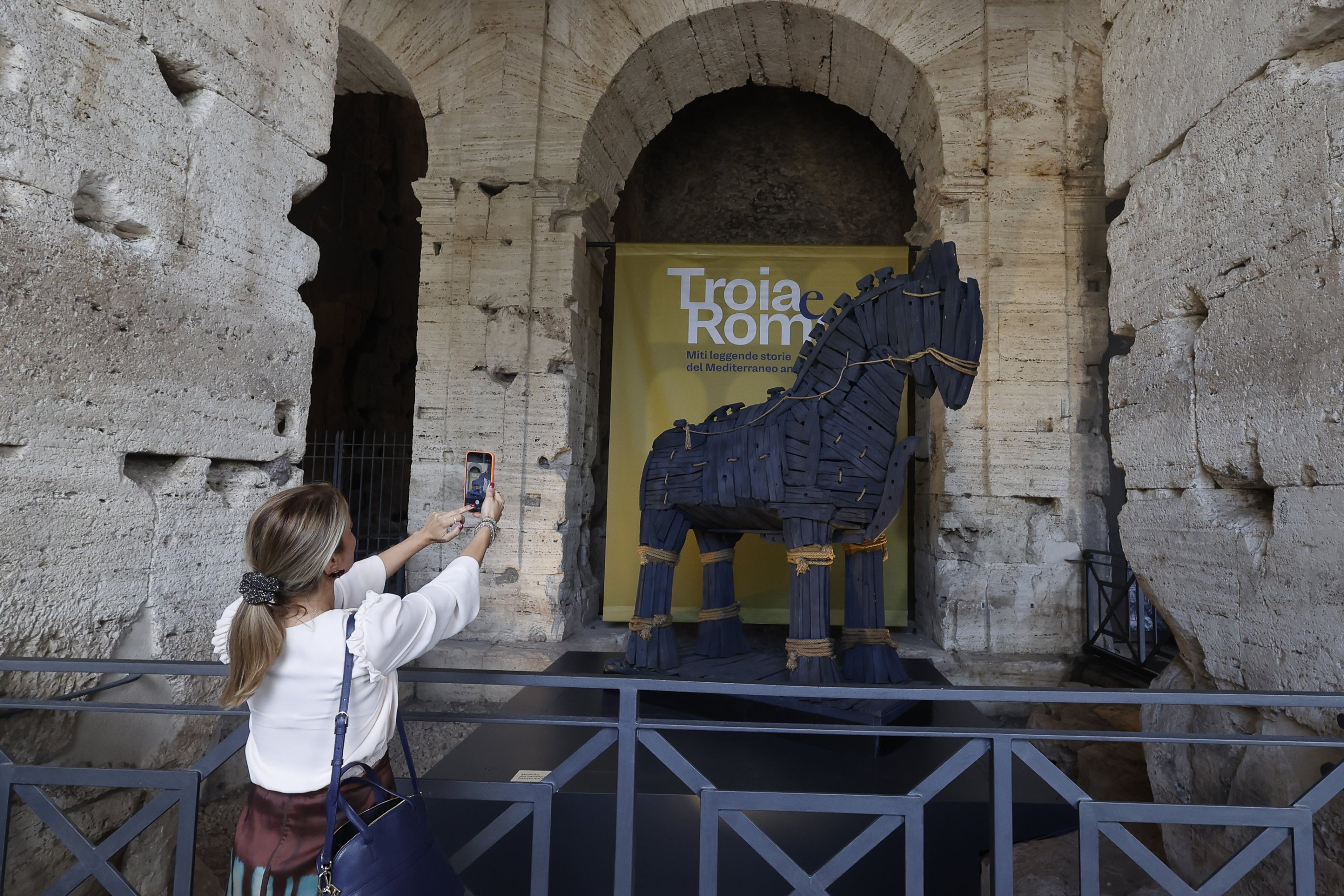
The world-famous Colosseum in Rome has opened a new exhibition titled “Troy and Rome: Myths, Legends and Stories of the Ancient Mediterranean,” bringing together more than 200 artifacts from Türkiye in a major cultural collaboration between the two countries.
The exhibition was organized with the support of Türkiye’s Ministry of Culture and Tourism, the Ministry of Foreign Affairs, the Turkish Embassy in Rome, the Embassy’s Cultural and Promotion Office, Italy’s Ministry of Culture, the Directorate of the Colosseum Archaeological Park and Turkish Airlines (THY).
The opening ceremony was held by Minister of Culture and Tourism Mehmet Nuri Ersoy and Italy’s Minister of Culture Alessandro Giuli.
The ceremony drew a wide range of officials, including Deputy Minister of Culture and Tourism Gökhan Yazgı, Türkiye’s Ambassador to Rome Elif Çomoğlu Ülgen, Türkiye’s Ambassador to the Vatican Fahrettin Altun, Çanakkale Governor Ömer Toraman and several members of Parliament and cultural heritage officials. Italian cultural authorities and Colosseum leadership were also present, including Alfonsina Russo of the Italian Ministry of Culture and Simone Quilici, director of the Colosseum Archaeological Park.
Speaking at the opening, Ersoy described the Colosseum as one of humanity’s most magnificent structures and said it continues to host Turkish-Italian cultural cooperation.
He said the exhibition connects the cultural heritage of Anatolia with Rome through both myth and historical reality.
“Within these ancient walls, a bridge is being built from Rome to Troy, taking visitors on a journey through time and space,” Ersoy said. “We present Troy and Rome together in a holistic narrative, addressing both mythological and historical dimensions.”
Ersoy noted that the exhibition features 221 works selected from 19 museums across Türkiye, including the Troy Museum in Çanakkale.
He emphasized that Troy is a foundational narrative in both Roman and European cultural memory, adding that the Trojan War has inspired centuries of artists, writers, poets, sculptors and painters.
Ersoy also said the exhibition reflects a broader Mediterranean cultural dialogue, describing it as a continuation of historical ties between the two shores of the sea.
“This exhibition is a strong cultural encounter inviting us to reconsider the shared memory and heritage of civilizations across the Mediterranean,” he said.
He also referenced a previous exhibition at the Colosseum, “Göbeklitepe: The Enigma of a Sacred Place,” held between October 2024 and April 2025, which attracted more than 6 million visitors.
Italian Culture Minister Alessandro Giuli called the exhibition a major cultural milestone and one of the most important days in contemporary cultural history for Italy and the international community.
Giuli shared a personal story about visiting Troy in Çanakkale in his youth, saying he collected soil from the site and brought it back to Rome.
“That Troy soil, that Anatolian soil, that Turkish soil is at my home, in a box, next to photographs of my ancestors,” he said.
He described the exhibition as a reflection of a millennium-long connection between Mediterranean civilizations and emphasized the continuing relevance of that historical relationship.
Giuli also pointed to the myth of Aeneas as a symbolic link between Troy and Rome, saying it connects the histories of Anatolia and Italy.
He added that Türkiye today plays a significant global role in promoting dialogue and cultural exchange, describing it as a stabilizing and creative force in international affairs.
Simone Quilici, director of the Colosseum Archaeological Park, said the exhibition represents a cornerstone of cultural cooperation between Italy and Türkiye.
Following the ceremony, officials toured the exhibition and attended a reception held in the Colosseum’s third level, an area typically closed to the public except for special events.
“Troy and Rome: Myths, Legends, and Stories of the Ancient Mediterranean” will remain open to visitors at the Colosseum through Oct. 18.
The Colosseum previously hosted another major Türkiye-themed exhibition, “Göbeklitepe: The Mystery of a Sacred Site,” which ran from October 2024 to April 2025 and was visited by more than 6 million people.