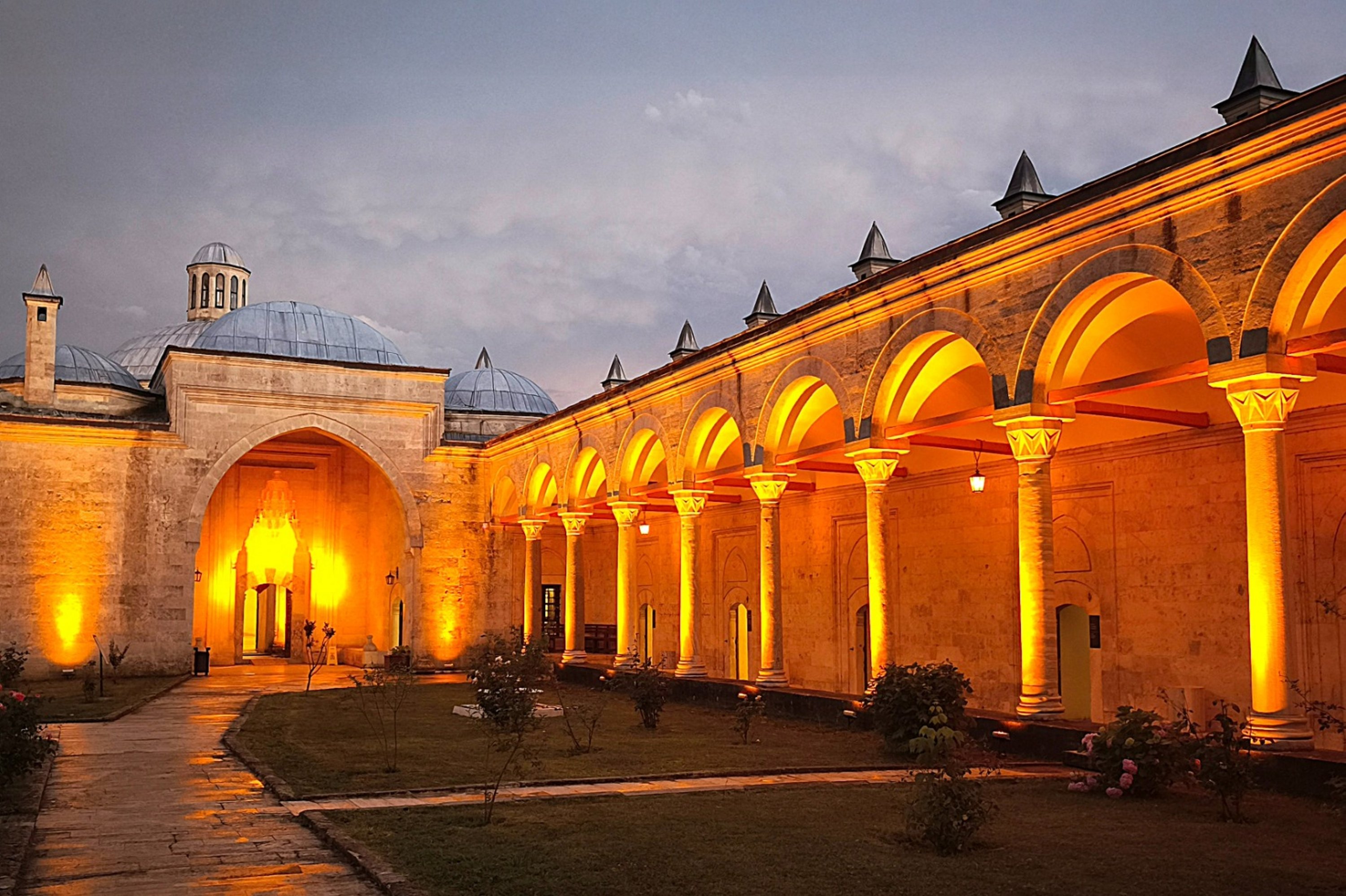
With the "Nighttime Museum" concept, the Sultan Bayezid II Complex Health Museum – open at night throughout the summer – is expected to see increased visitor activity.
The museum, which showcases medical education and treatment methods from the Ottoman era, will remain open until 10:30 p.m. on Thursdays, Fridays and Saturdays during the summer, as part of the Ministry of Culture and Tourism’s "Nighttime Museum" initiative.
Commissioned by Sultan Bayezid II in 1488 and originally used as a medical school and hospital, the complex now functions as both the "Health Museum" and "Charitable Institution" under the administration of Trakya University (TU).
Meeting with members of the press in the museum garden, TU Rector Mustafa Hatipler stated that the museum – where Ottoman medical education, the culture of the charitable institution (imaret) and patient treatments are presented – is one of the city’s most visited attractions.
Hatipler emphasized that Edirne stands out for its rich history and culture, saying: “Some cities speak during the day, others at night. Edirne is a city that speaks at night, and one of its most important night-speaking elements is the Bayezid II Complex Health Museum.”
He noted that necessary lighting and other preparations for nighttime visits have been completed.
Hatipler also expressed that opening the museum at night is expected to boost visitor numbers:
“We especially want the people of Edirne to experience this place at night. It will be open until 10:30 p.m. three days a week. This is a first for Edirne and is not a common practice in Türkiye. It will be a great initiative. We invite everyone to our museum.”
Starting today, the museum will be open for nighttime visits.
The foundation of the complex was laid by Sultan Bayezid II in 1484 as he departed on the Akkerman campaign, and it was completed in 1488.
During the Ottoman era, the complex served as a medical school, hospital and soup kitchen. After the 1800s, it became dedicated primarily to mental health treatments.
The complex ceased operations and sustained damage during the Balkan Wars in the late Ottoman period. It was revived through a restoration process that began in 1986, after Trakya University assumed responsibility for it in 1978.
Now on UNESCO's Tentative List of World Heritage Sites, the Health Museum within the complex – recipient of the European Museum Award in 2004 and the Best Presentation Award from the European Cultural Heritage Union in 2007 – attracts visitors from around the world.