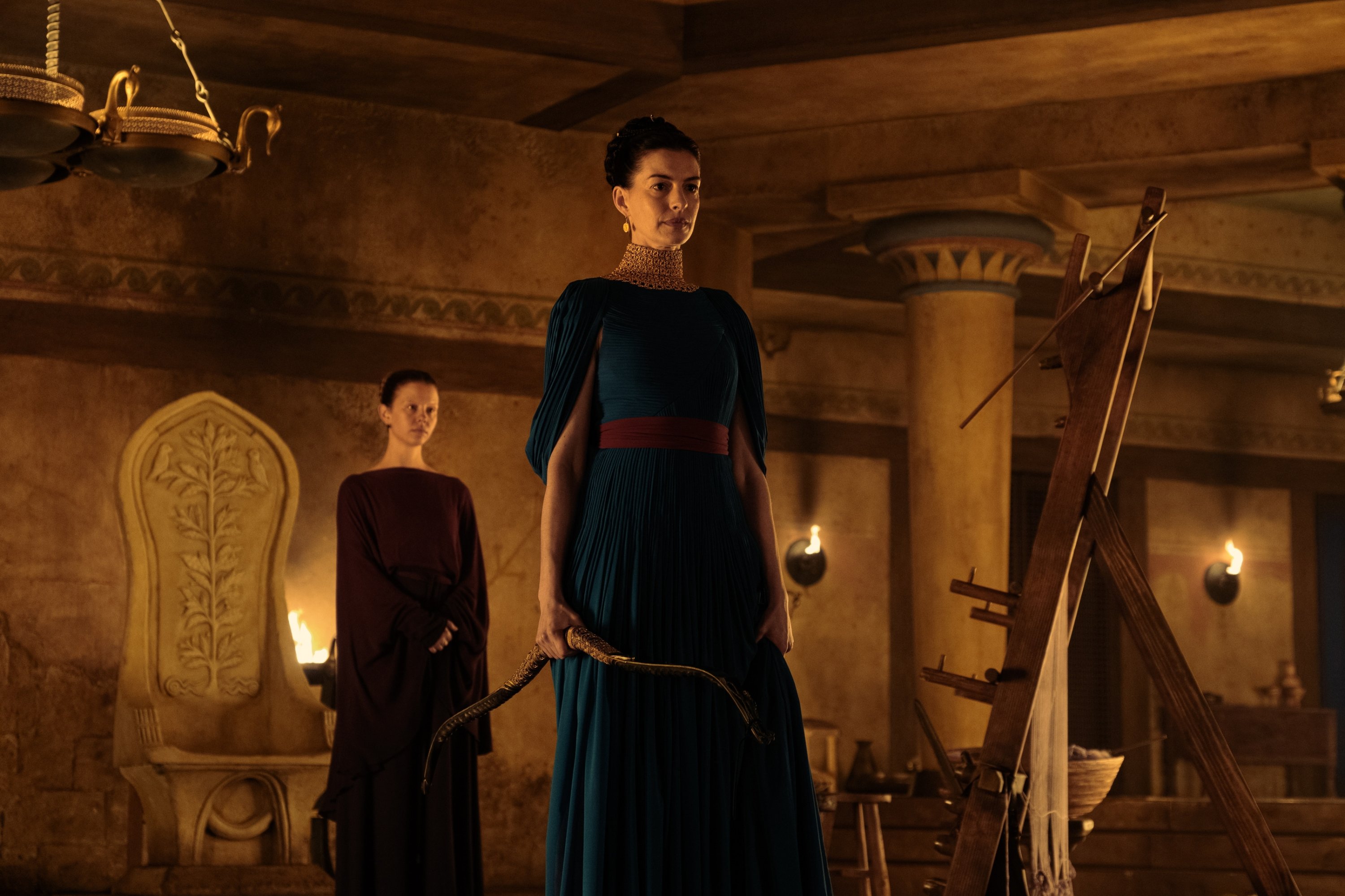
Every adaptation of the "Odyssey" is a negotiation between antiquity and the present, and in Christopher Nolan's version the Greek past is dramatized to mirror the American present. A lot has been said about the "fidelity" of this blockbuster, but what is the adapter to be faithful to? The plot? The characterization? Or the very act of telling the story? Despite Nolan’s (mis)use of the character of Odysseus as the PTSD-ridden American soldier throughout the film, as a narratologist my heart was won instantly when I saw a rhapsode, a poem singer, strike his staff on the ground and declare the first word of the epic "A man!". This reminds us how both the story of Odysseus’s return, and the story of the destruction of Troy was passed down the generations: first orally, then written down by Homer, then translated into several languages and then transferred to the screen. "The Odyssey," apart from being one of the earliest epics, is a text that contemplates its own production, and has a couple of poets in the story reciting the story of Odysseus. In Nolan’s adaptation we see one of them, and Penelope stops him at one point because she is tired of hearing the exploits of a man she’s been waiting for for 27 years.
While the Odyssey has famously invented "in medias res," that is we find our hero in the middle of his journey from Troy to Ithaca, the text of epic starts in the seat of gods, where Athena is trying to convince Zeus to release Odysseus from Calypso’s captivity. They have a long conversation about how Troy has been destroyed, how men never stay within the bounds of hospitality and how they always blame the gods for their own actions. And although Nolan does not adapt this section in the film, much of his adaptation seems to have been inspired by this conversation. Hospitality as Zeus’ law is at the center of Nolan’s moral universe for the epic from the beginning, and I am won over again because hospitality is the lens through which I teach the text to undergraduates.
Among the gods there is even a discussion of other warriors who have made it home after the Trojan War, of how homecomings are not necessarily happy. Famously with Agamemnon, who, upon his return, gets murdered by his wife, because he has sacrificed their daughter to the gods for good wind to get to Troy to plunder it. Or was the war to get his brother’s wife Helen back? Was it to save the brown woman or the oil? One can ever tell the reason for these imperial wars, so Nolan does have one character state plainly that Helen was just a pretext to loot.
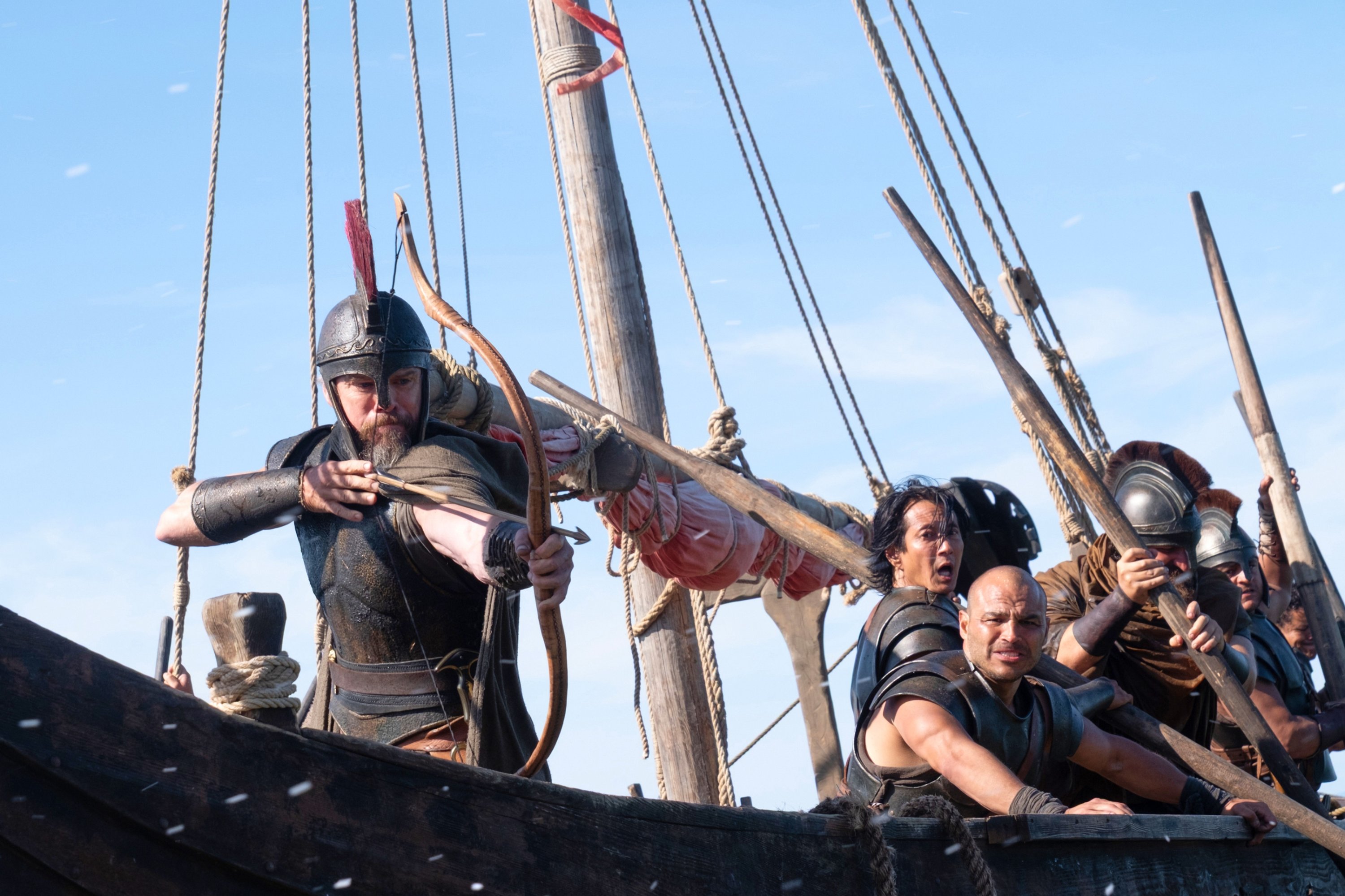
For an epic with so many main and side characters – "where is Achilles in this adaptation?", many have asked – and backstories, I am very happy Nolan decided to include the Agamemnon one, because it gives a chance for Lupita Nyong’o to play both Helen and Clytemnestra, to make racists cry twice harder. (For another screen adaptation of Agamemnon’s story, see "The Killing of a Sacred Deer" by the Greek director Yorgos Lanthimos). We should not have to condescend to address the "question" of whether black people existed in the Greek Empire, which they so obviously did, the Greek Empire having extended to Africa, but there we are. The inclusion of the Agamemnon story – who, by the way, appears both in flashbacks to "The Iliad" and the "Underworld" section in a Darth Vader-like mask and voice – serves Nolan’s dramatic tension as to whether it is good for our hero to return home, or to stay on Calypso’s island.
That is where, on Calypso’s island, we find Matt Damon, who has molded Odysseus into his own, remorseful American soldier image. Nolan’s interpretation of Odysseus as this forlorn Afghanistan/Iraq veteran is the center-point of the criticism aimed at this adaptation (Emily Wilson’s now (in)famous review in the LRB is titled "An Uncomplicated Man"), but Nolan being U.S.-centric, and a teller of his adopted country’s crimes through a forgiving lens, is no news to me. I have watched "Oppenheimer." What interests me here is how Nolan plays with the elements of narration and makes them his own. Famously, American conservatives’ first reaction to the film was that Nolan had taken a classical story and spoilt it with his non-linear narrative tricks, reminding us that being conservative in the U.S. means that you have not read any of the texts you claim to champion.
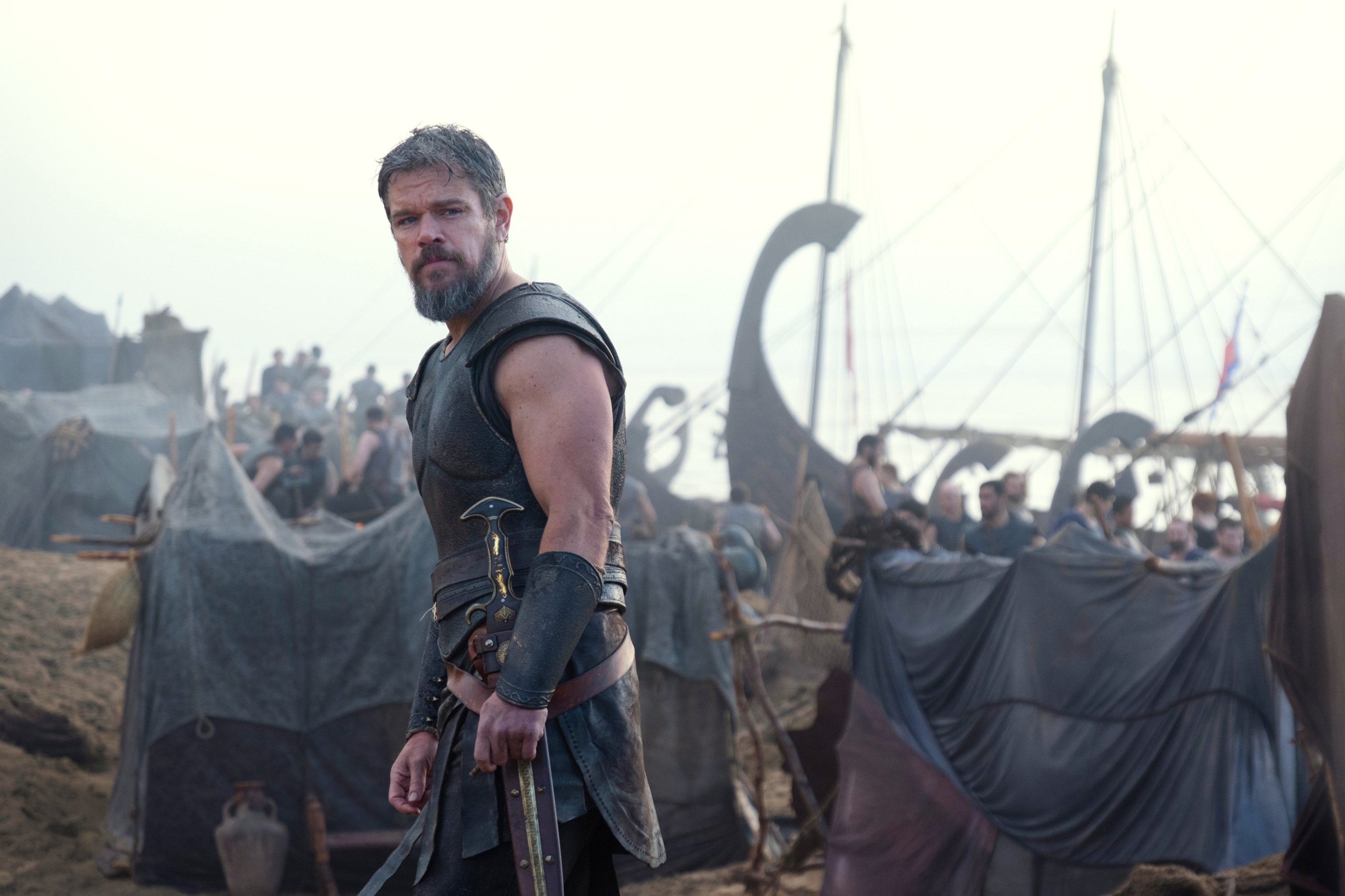
What the Calypso island episode does is it conflates the Calypso and Nausicaa encounters in the text. When it comes to showing the storytelling scenes that are already in the text of the Odyssey in his film, Nolan misses a trick by omitting the Nausicaa episode. It is the story on yet another island, where Odysseus finds himself invited to a palace where, just like in Ithaca, a poet is reciting the story of Troy. Odysseus takes this as his cue and tells his own story. In the text, this is where, after having heard the gods’ conversation and seen him released from Calypso’s island, the audience hears the fantastical stories of the Cyclops, Scylla and Charybdis (excellently immersive scenes in Nolan’s direction), "Circe" and the "Underworld," in Odysseus’s own words. All this, in the film, Nolan has Odysseus recount to Calypso, who, played by Charlize Theron, looks like a new-age guru helping you get in touch with your past through Ayahuasca (in the film, it is the lotus flower that helps him remember).
There is nothing of the playful, trickster quality of Odysseus in the text in Damon. He mopes about Calypso’s island, has flashbacks to the siege and destruction of Troy, looking guiltily at the fires engulfing the city, all enabled by his trick of the wooden horse. We see Athena’s statue’s head being cut off: Odysseus and his soldiers have disobeyed the rule of hospitality and desecrated the temples, acts that are condemned by any civilization known to man, acts that are common practices of the American and Israeli armies.
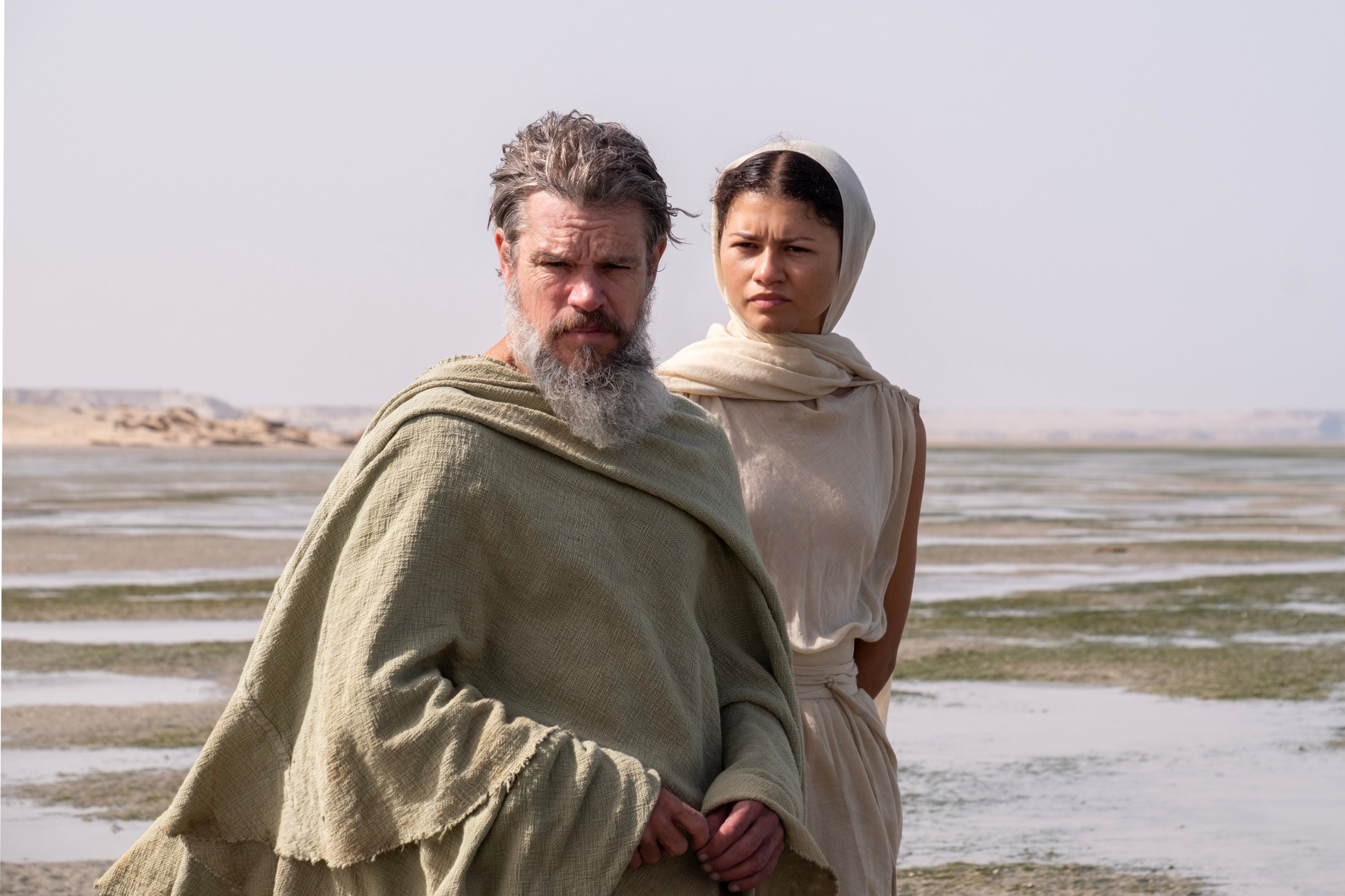
It is Zendaya who has been accompanying Odysseus on his moments of important decision to pass judgement on his behavior, and for the most part of the film I had assumed that this was Athena. In one of his flashbacks to the desecration of the Athenian temple, however, we see the agonized face of Zendaya, dressed like a priestess, being held back by soldiers who are very likely to violate and murder her. This suggests she is the ghost of a mortal, and this reinforces the moral Nolan is pushing in the film: that gods probably don’t walk among us, and that we should treat strangers with hospitality not because they may be gods in disguise but because they are humans like us.
That the Greeks have strayed from both god’s law and human decency and have themselves become the barbarians becomes most apparent when Odysseus’s English-speaking army invades an island and a desolate islander tells them, in Greek, that they have been fearing the "sea people." This is an ingenious addition by Nolan that plays with our perception of time even more. The language confusion suggests that Odysseus’s Greeks have strayed so far from civilization that they cannot understand Greek anymore. Allegorically, Americans themselves are the destroyers of Western culture, which, we are led to believe, all started with the Greeks and the Greek language.
At the end of the film – the text ends with Odysseus settling in Ithaca – having laid waste to the Mediterranean and become the leader of "the sea peopl"’ that caused the Greeks to lose their culture of writing, Odysseus, with Penelope, heads "West," where, he tells us, he’ll found civilization anew. The two sail into the sunset looking like two pilgrims, with the compass needle pointing to Ithaca, NY. This, then, is Nolan’s boldest act of adaptation: recasting America's founding myth as the last chapter in Homer's epic.