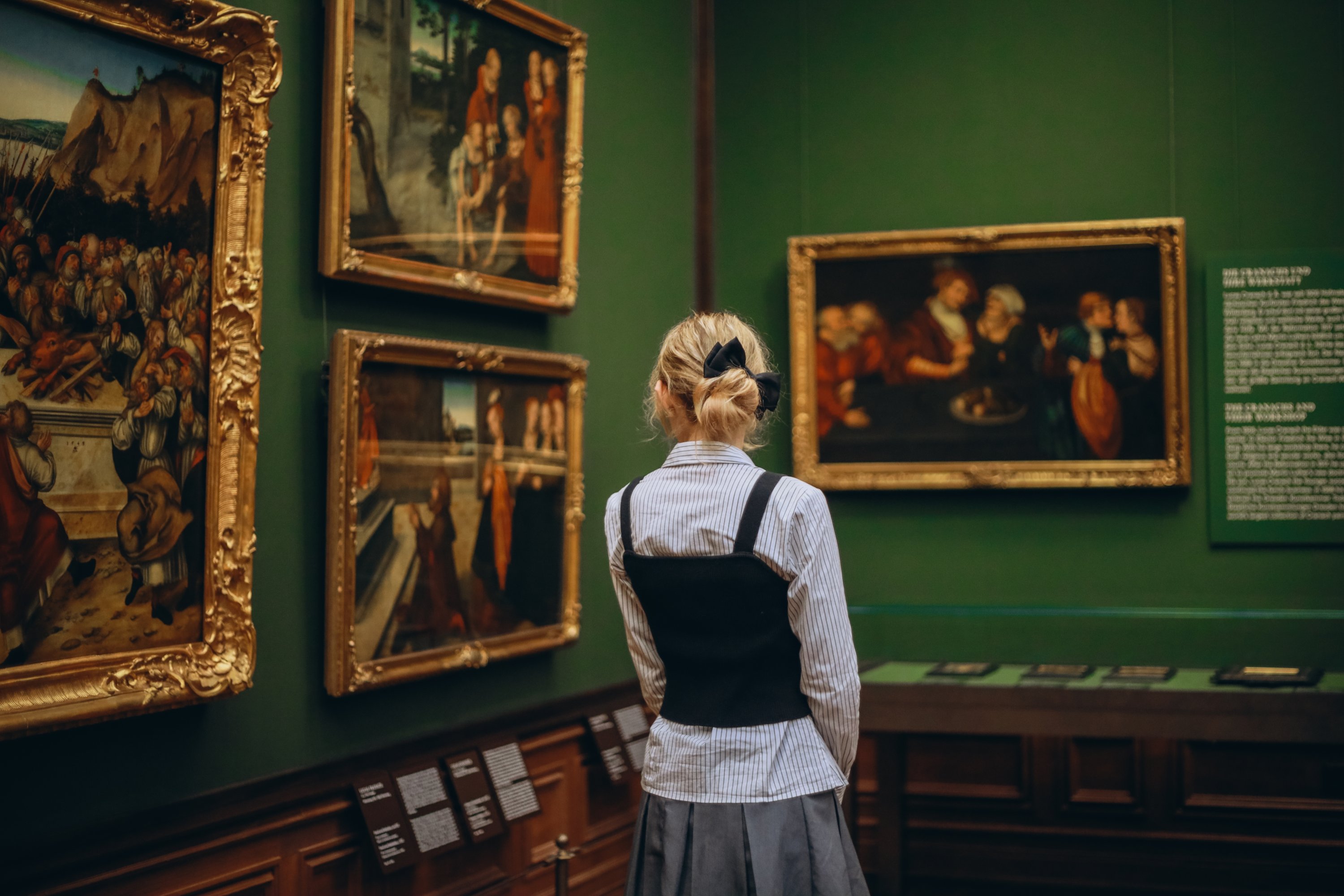
Some books arrive at precisely the right historical moment; others create that moment themselves. Linda Nochlin’s "Why Have There Been No Great Women Artists?" belongs decisively to the latter category. More than 50 years after its original publication in 1971, it continues to unsettle readers, not because its arguments have aged well, but because many of the structures it exposed have survived with astonishing resilience.
The brilliance of the book lies in the fact that Nochlin refuses to answer the title literally. She dismantles the question before attempting to respond to it. Her argument is elegantly simple yet intellectually devastating. The problem is not that women have failed to produce great art, but that history has been designed to recognize greatness according to standards that systematically excluded women long before they ever entered the studio.
This shift transforms the conversation completely. Instead of searching museums for forgotten female Michelangelos or Picassos, Nochlin asks us to examine the institutions that made Michelangelo and Picasso possible in the first place. That distinction changes everything. For centuries, becoming an artist required far more than talent. It required access to education, anatomy classes, apprenticeships, patrons, academies, financial independence, public commissions, professional networks and, perhaps most importantly, the social permission to devote one’s life entirely to artistic production. Women were denied nearly all of these. One cannot expect masterpieces to emerge from opportunities that never existed.
Nochlin therefore rejects what she calls the mythology of artistic genius, the romantic belief that extraordinary artists simply appear, untouched by history or circumstance. Genius, she argues, has always been cultivated inside institutions. The myth of the solitary genius conveniently ignores the architecture supporting him. It is precisely this argument that has made the essay immortal. Rather than celebrating exceptional women who somehow overcame discrimination, Nochlin investigates why discrimination itself remained invisible for so long. This methodological shift has influenced not only feminist art history but virtually every contemporary discussion surrounding museums, collections, archives and cultural representation.
Reading the book today, however, produces a curious emotional experience. One oscillates between admiration and discomfort. Admiration for the intellectual clarity with which Nochlin exposes hidden assumptions. Discomfort because many of those assumptions continue to shape today’s art world in subtler forms.
No major museum today would openly claim that women are incapable of producing great art. Such a statement would be unthinkable. Yet institutional inequality has become more sophisticated rather than disappearing altogether. Auction records remain overwhelmingly dominated by male artists. Blue chip galleries continue to represent proportionally fewer women. Museum acquisitions still reveal historical imbalances. The language surrounding “masterpieces” often reproduces inherited hierarchies rather than questioning them. Representation has improved dramatically. Power has improved far less. Perhaps this explains why the book continues to resonate across generations. It is no longer merely about women. It has become a framework for understanding exclusion itself. Nochlin teaches readers how institutions manufacture legitimacy. Once that mechanism becomes visible, it becomes impossible not to notice similar patterns elsewhere – whether concerning race, geography, class, colonial histories, or artists working outside dominant cultural centers. The essay therefore belongs not only to feminist scholarship but to critical thinking more broadly.
As someone working simultaneously as an artist and an arts columnist, I found myself reading the book from two complementary perspectives. The artist inside me responded emotionally while the journalist responded analytically.
The emotional response emerged from recognizing how familiar many of Nochlin’s observations remain. The expectation that women continuously justify their seriousness, negotiate visibility differently, or balance artistic ambition with social expectations has certainly evolved since 1971. Yet, traces of those expectations still linger beneath the polished surface of contemporary institutions. The analytical response, meanwhile, focused on something perhaps even more significant.
Nochlin demonstrates that art history is not a neutral archive. It is an edited narrative.
Every museum wall, every university syllabus, every auction catalogue, every permanent collection tells a story, not merely about art but about the values of the society assembling those stories.
One of the most rewarding aspects of the book is its refusal to replace one mythology with another. Nochlin does not argue that every overlooked woman artist deserves automatic canonization, nor does she suggest that historical quality should be abandoned in favor of political correctness. Instead, she insists that our criteria themselves deserve scrutiny.
How do we define greatness?
Who established those definitions?
Whose experiences shaped them?
Which forms of artistic labor became visible?
Which remained invisible?
These questions remain remarkably contemporary.
Indeed, they may be even more relevant in an age increasingly preoccupied with diversity metrics and institutional representation. Statistics alone cannot transform culture.
Adding more women to museum exhibitions without questioning the narratives surrounding them risks producing cosmetic inclusion rather than structural change. Nochlin anticipated this danger decades ago. She understood that genuine transformation requires rewriting historical frameworks rather than merely expanding existing lists.
The Turkish publication also carries particular resonance: Türkiye possesses an unusually rich history of influential women artists compared with many neighboring regions. From Mihri Müşfik Hanım to Fahrelnissa Zeid, from Hale Asaf to Semiha Berksoy, Turkish modernism contains remarkable female figures whose contributions continue to receive increasing scholarly attention. Yet even here, the mechanisms Nochlin describes remain recognizable. Male artists often occupy the symbolic center of national narratives, while women are introduced as notable exceptions. Exceptionalism itself becomes another form of marginalization.
The language changes. The hierarchy survives.
Reading the book within today’s Turkish artistic landscape therefore encourages productive reflection.
Our museums have expanded, galleries have multiplied, and biennials have become internationally connected.
Nevertheless, one must still ask whether institutional structures have changed as profoundly as appearances suggest. Visibility is not identical to equality. Participation is not identical to influence. Recognition is not identical to power. Nochlin reminds us never to confuse these concepts.
Another remarkable strength of the essay lies in its accessibility.
Despite its enormous academic influence, the writing avoids unnecessary theoretical jargon.
Its arguments unfold with logical precision, historical examples and refreshing intellectual confidence.
One senses that Nochlin writes not to impress specialists but to persuade readers. That may explain why the essay remains assigned in universities worldwide while simultaneously attracting general audiences interested in culture. It possesses the rare quality of changing how one looks at museums.
After reading the book, paintings themselves appear different, not because the artworks have changed, but because the institutional frame surrounding them has become newly visible. One begins noticing who is represented.
Who is missing?
Who commissioned the work?
Who funded the academy?
Who entered the collection?
Who remained in storage?
Art history quietly transforms into social history.
This altered perception may be the book’s greatest achievement.
No review would be complete without acknowledging that some aspects inevitably reflect the intellectual climate of the early 1970s. Contemporary feminist scholarship has expanded considerably, incorporating intersectionality, postcolonial critique and broader analyses of identity and power that extend beyond Nochlin’s original framework. Yet these developments do not diminish the essay’s significance. On the contrary, they demonstrate their extraordinary generative power.
The book opened a door through which subsequent generations continued walking. Very few essays achieve such lasting influence. In retrospect, Nochlin did not simply ask why there had been no great women artists. She questioned why we had accepted the question itself for so long. That subtle inversion remains intellectually exhilarating.
The essay transforms what initially appears to be a discussion about women into a profound examination of institutions, education, privilege, historical memory, and cultural authority. Its true subject is not gender alone. Its true subject is how history gets written.
As an artist, I found myself reflecting not only on those who were excluded from history but also on those who may still be standing outside its gates today. The next “great artist” may already exist somewhere beyond the networks that currently define visibility. If Nochlin teaches us anything enduring, it is that talent alone has never guaranteed recognition. Institutions matter. Opportunities matter. Narratives matter. And history is never as objective as it pretends to be.
More than half a century after its publication, "Why Have There Been No Great Women Artists?" continues to perform the highest function of serious criticism. It does not merely provide answers; it permanently changes the questions we ask. That is perhaps the rarest achievement any work of art history can claim and the reason this slim volume remains one of the most essential books anyone interested in art, culture or society can read today.
Last but not least, Nochlin’s essay was never an argument about women; it was an argument about power. It exposed the uncomfortable reality that artistic value is not merely discovered but produced through institutions, education, markets, criticism and collective memory. What we call the canon is less a neutral archive than a record of accumulated cultural authority.
If the 21st century wishes to move beyond symbolic inclusion, it must do more than diversify museum walls. It must interrogate the intellectual frameworks through which artistic significance is constructed. Until then, every celebration of progress risks becoming another chapter in a history that has merely learned to disguise its exclusions.
The question that should guide us today is therefore not, “Why are there still no great women artists?” but rather, “Who still possesses the power to decide what greatness means?” Because whoever answers that question will also rewrite the history of art.