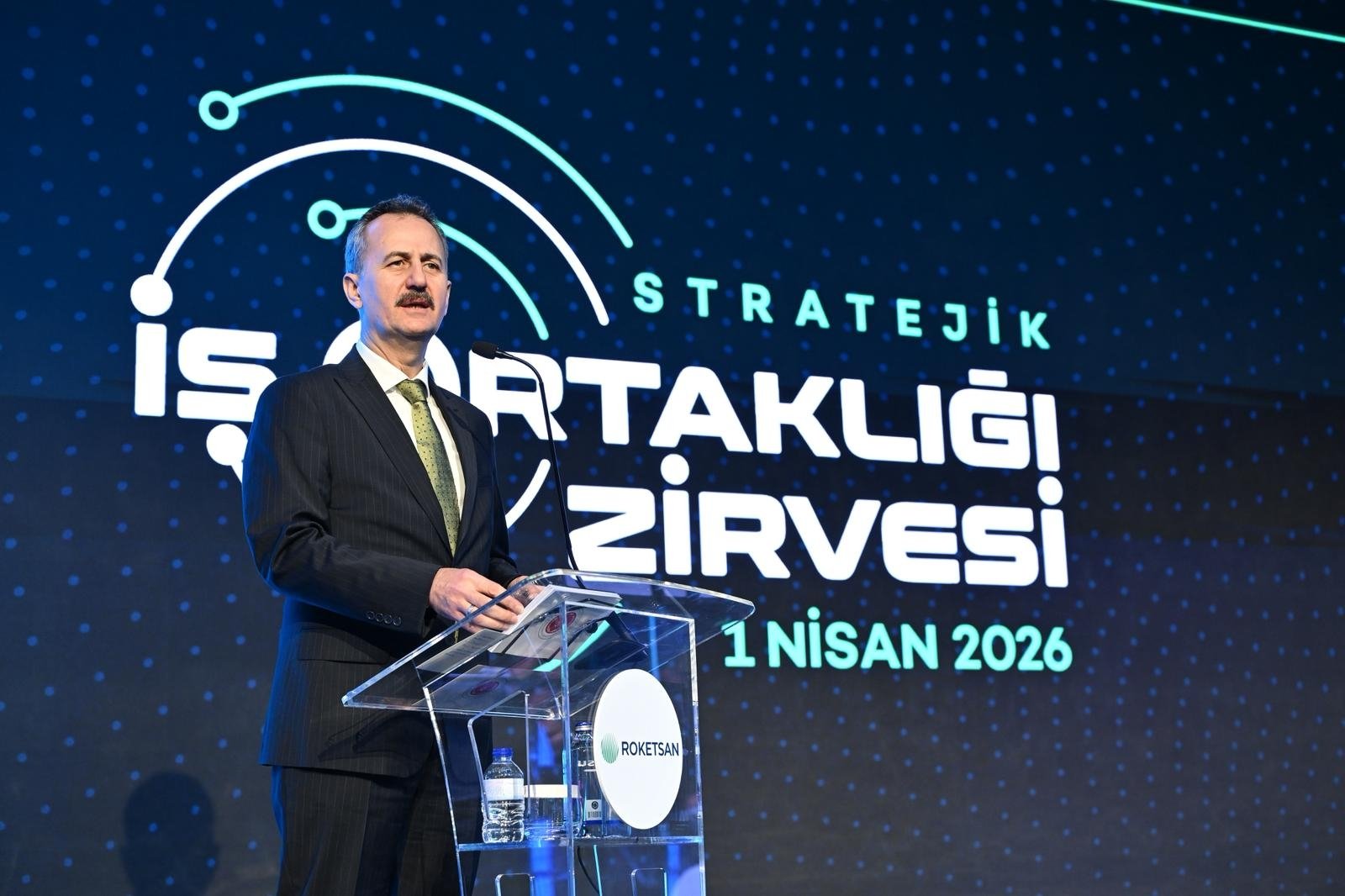
Turkish defense officials and industry executives gathered Wednesday at the 3rd Strategic Partnership Summit hosted by Turkish missile company Roketsan in Ankara.
The officials underlined that strengthening domestic production, supply-chain resilience and space-based capabilities has become increasingly critical to national security, as wars and geopolitical tensions reshape the nature of modern conflict and put new pressure on the global defense industry.
During the event, the head of the Presidency of Defense Industries (SSB), Haluk Görgün, and Roketsan CEO Murat Ikinci remarked that Türkiye’s defense sector must be able to sustain production, adapt quickly to battlefield needs and reduce dependence on foreign suppliers.
Speaking at the event, Görgün said countries now bring not only their military platforms and munitions to the battlefield, but also their logistics capacity and industrial ecosystems.
“For this reason, the defense industry has become a strategic field of power that directly reflects a nation’s warfighting capacity, resilience and continuity,” Görgün said.
He said recent conflicts have shown that warfare is undergoing a fundamental transformation, with land, air, sea, cyber and space domains increasingly integrated into a single operational environment.
According to Görgün, space-based systems are gaining importance by accelerating decision-making and improving coordination between units through communications, surveillance, positioning and time synchronization capabilities.
Görgün also noted modern conflicts increasingly favor munitions and platforms that can be produced quickly, replaced easily and deployed at lower cost. That, he said, has elevated the importance of serial production, continuity in manufacturing, stock planning, storage infrastructure and logistics architecture.
“Today’s defense industry architecture is shaped by real-time feedback from the field,” he stressed, adding that Türkiye’s gains in the sector stem from the strong link it has built between operational requirements and industrial production.
He described the strengthening of domestic and national capabilities as vital to national security and said Roketsan’s resilience through its supplier ecosystem had become an example for the wider sector.
Ikinci, speaking at the same summit, said Roketsan had reached a domestic sourcing level of 92%, helping insulate the company from global supply-chain shocks that have disrupted defense and civilian industries alike.
“We are affected by disruptions in the global supply chain,” Ikinci said. “But because we operate with a domestic value-added ratio above 90%, we are less affected than some other stakeholders or competitors.”
He said the company was continuing to invest heavily in alternative supply sources and local production to build a fully independent defense industrial base.
“The supply chain has taken a very serious blow right now,” Ikinci said. “There is difficulty across all industries in the world. But even in this environment, our ability to continue production is a major advantage for us.”
He said Türkiye’s broader defense ecosystem now meets much of the country’s military requirements domestically, describing the country as a stabilizing force in a volatile region.
He stated that Turkish authorities had launched a series of initiatives aimed at making companies more visible, effective and sustainable, including measures to increase the role of small and medium-sized enterprises, support financial stability, ease access to funding and assist firms in export agreements and contracts.
Moreover, Ikinci also drew attention to Roketsan reinvesting its revenue into infrastructure and serial production capacity, and he signaled that more announcements on expansion plans would be made public soon.
“Roketsan is investing all the money it earns into its infrastructure to increase serial production capacity,” he said.
He said the capacity increases would be seen across a wide range of missile systems, including the Tayfun ballistic missile, the SOM cruise missile, the Atmaca anti-ship missile, and the Siper and Hisar air defense systems.
Asked about the Siper-2 air defense missile, Ikinci said development work was continuing and that the system was expected to move toward serial production. He stated that Siper-2, designed by the Scientific and Technological Research Council of Türkiye’s defense research arm, TÜBITAK SAGE, would be among the most advanced missiles in the Siper family, with Roketsan expected to take part in production as an industrial partner.
He added that Turkish efforts to strengthen air defense capabilities were not limited to Siper and included all elements of the Steel Dome air defense concept, as well as the Hisar and Sungur families and other next-generation missile programs.
Ikinci said existing systems would continue to gain new sensors and added capabilities, and that new members would join the Siper family in the future.
Alongside Görgün and Ikinci, the event was attended by Roketsan Chairman Faruk Yiğit and a broad group of sector representatives, suppliers and experts.
The event continued with panel discussions featuring Olcay Elmalı Meço, director at Roketsan in charge of advanced materials and manufacturing technologies developments; Irfan Durmuş, director of the Rare Earth Elements Application and Research Center (MUNTEAM); Celal Erbay of the National Intelligence Academy; Saruhan Saklar of Türkiye’s General Directorate of Mineral Research and Exploration; Murat Eskici, Roketsan’s supply chain director; Aziz Meydan, chairperson of the board of HMS Machining company; Şenay Idil, general manager of Alp Aviation; and Ali Rıza Alptekin, head of the Defense and Aviation Group at Kale Group.