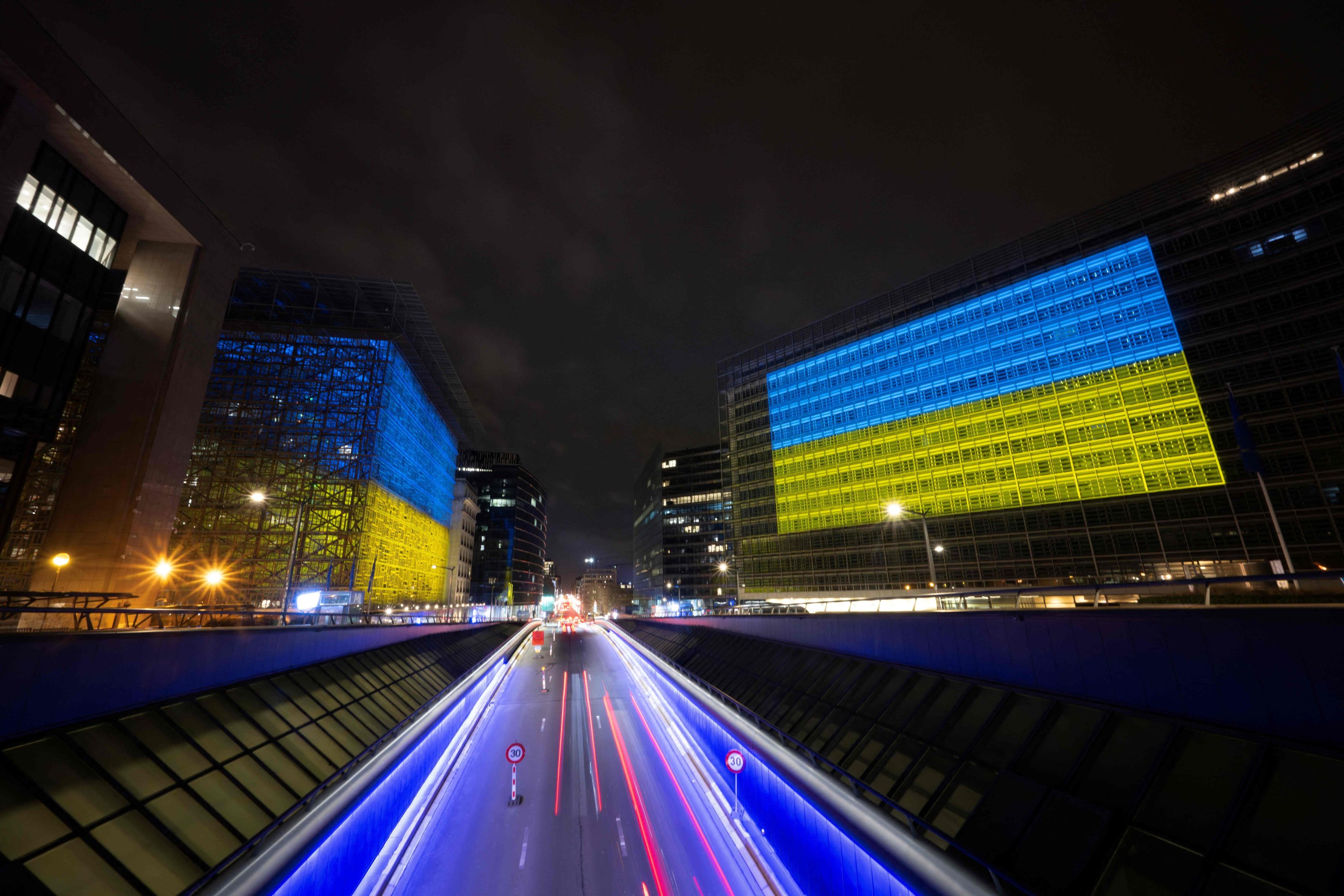
European Union countries have failed to reach a consensus and agree on a 20th package of sanctions against Russia, mainly due to objections from Hungary's side as the war in Ukraine entered its fifth year on Tuesday.
According to information obtained by Deutsche Presse-Agentur (dpa) by EU diplomats, Hungary, in particular, continued to block the planned tightening of sanctions against Russia.
During a Monday meeting of EU foreign ministers in Brussels, Hungary also reaffirmed its opposition to a multibillion-euro loan for Ukraine. Instead, only a 100 million euro ($117.8 million) emergency package for Ukraine's energy infrastructure, which EU officials say can be approved without Hungary's backing, is now expected to be announced.
"This is a setback and a message we did not want to send today," said the EU's top diplomat, Kaja Kallas.
The EU had planned to use the anniversary to send a signal of support to Ukrainians and reaffirm that the bloc would stand by them in their defense against Russian aggression.
EU leaders had also aimed to show Russian President Vladimir Putin that he cannot count on fading European solidarity and should come to the negotiating table.
Hungarian Foreign Minister Peter Szijjarto on Monday said that his country would only agree to the measures to help Ukraine if Kyiv allows the resumption of Russian oil supplies through the Druzhba pipeline.
Szijjarto accused Kyiv of deliberately blocking the use of the pipeline, which runs through Ukraine, for political reasons.
Ukraine says that Russian bombing led to the flow of oil being stopped at the end of January.
Budapest's position was supported by Slovakia. Like Hungary, Slovakia still purchases large quantities of Russian crude oil and says that it cannot guarantee its energy security without the supplies.
"I am astonished by Hungary's position," said German Foreign Minister Johann Wadephul as he arrived at the foreign ministers' meeting.
"I do not believe it is right for Hungary to betray its own struggle for freedom and European sovereignty," Wadephul said, alluding to the Soviet Union's decades-long rule of Hungary following World War II.
Ministers had been expected to formally sign off on the 90 billion euro EU loan and the bloc's 20th package of sanctions on Russia.
On Tuesday, a group of senior EU officials was due to travel to Ukraine to mark the anniversary of the Russian invasion on Feb. 24, 2022.
European Council President Antonio Costa, who is among them, said in a letter to Hungarian Prime Minister Viktor Orban that he would "raise this matter directly" with Ukrainian President Volodymyr Zelenskyy.
"A decision taken by the European Council must be respected. When leaders reach a consensus, they are bound by their decision. Any breach of this commitment constitutes a violation of the principle of sincere cooperation," Costa wrote.
Even prior to the meeting, Orban had said that Budapest would block both measures unless the Druzhba pipeline supplies resume.
"I think we shouldn't tie together things that are not connected to each other at all," said Kallas.
The 90 billion euro loan was initially agreed by EU leaders, including Orban, in December and then approved by the European Parliament, but still needs to be formally signed off by EU ministers.
The funding is intended to meet Ukraine's financial and military needs until the end of 2027, enabling it to further resist Moscow's larger military might.
The EU's 20th package of sanctions is to include a ban on maritime services related to exports of Russian crude oil.
In addition, the European Commission has proposed additional financial restrictions to further constrain Russia's ability to carry out international payments to fund economic activities.
There are fears in Brussels that Orban is instrumentalizing the conflict for his current election campaign.
Last week, Orban claimed without any evidence that Ukraine was interested in him losing Hungary's parliamentary elections scheduled for April 12.