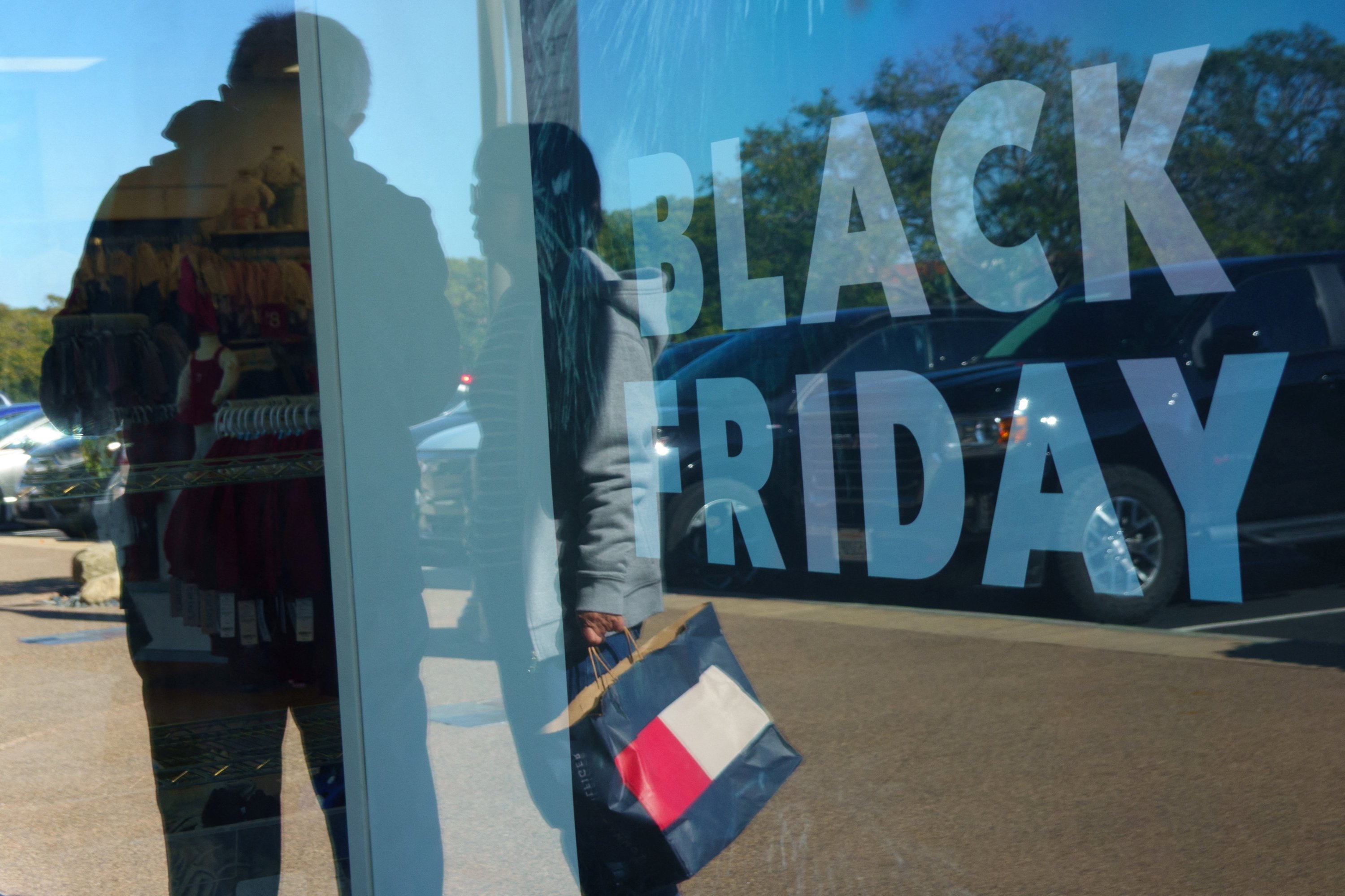
Black Friday, the post-Thanksgiving shopping frenzy that attracts throngs of bargain hunters to stores, faces a paradox this year, as record crowds are expected, but consumers' appetite to spend has dropped sharply.
The day, traditionally marked by pre-dawn lines outside retailers and "doorbuster" deals on electronics and appliances, emerged as a cultural phenomenon around the late 1980s, when shoppers began racing to stores with Christmas lists even before the Thanksgiving turkey had been digested.
This year's event on Nov. 28 is poised to attract more foot traffic than ever, according to estimates from the U.S. National Retail Federation (NRF). Yet underlying economic indicators suggest those crowds will be far less willing to convert browsing into purchases.
The disconnect presents a challenge for retailers who depend on the holiday season to drive a third of their annual profitability. Nearly two-thirds of consumers surveyed by the NRF plan to wait for Thanksgiving weekend deals, up from 59% in 2024, while average spending is projected to fall to $890 per person from last year's $902.
The forecast slowdown underscores the effect of mounting pressures of inflation and weak job growth.
"What we're seeing is that certainly consumers are more cautious," Massimo Basei, chief commercial officer of Danish jewellery giant Pandora, told Reuters, predicting fierce competition.
U.S. retail sales increased less than expected in September in part due to elevated prices. President Donald Trump's tariffs have contributed to this trend, adding roughly 4.9 percentage points to retail prices, according to the non-profit Tax Foundation.
In Europe, the crucial shopping day was marked by strikes at Amazon warehouses in Germany, with separate protests also planned outside Zara stores in Spain.
With unemployment near a four-year high, shoppers have also become more selective. U.S. consumer confidence sagged to a seven-month low in November, according to economic research group The Conference Board, with fewer households planning to buy motor vehicles, houses and other big-ticket items over the next six months, or to make vacation plans.
Retailers are targeting cautious shoppers with smaller, affordable luxury items instead – wallets instead of suitcases, customizable handbags, and low-cost add-ons like Crocs' Jibbitz charms, said Nikki Baird, vice president of strategy at software firm Aptos, which counts apparel and accessory companies as clients.
Spending is concentrated among affluent households. The richest 10% of Americans – those earning at least $250,000 annually – accounted for about 48% of all consumer spending in the second quarter of 2025, a steady increase from around 35% of spending in the mid-1990s, according to Moody's Analytics.
"Increasingly, the headline spending is being driven by a narrower subset of consumers," said Michael Pearce, deputy chief U.S. economist at Oxford Economics.
Yet even some high-income shoppers are showing restraint. Sricharan Sridhar, who is based in Tempe, Arizona, and earns more than $100,000 annually, said that despite promotional pricing, big-ticket items were still out of his budget.
Clothing, shoes and accessories lead consumers' online Black Friday shopping lists, followed by children's toys and books, then gaming and movies, according to CivicScience, which analyzes data from multiple consumer surveys.
As shoppers hunt for value, many are turning to artificial intelligence. Half of consumers, and 71% of Gen Z shoppers, plan to use AI this Black Friday, according to a Bank of America survey of 2,010 U.S. shoppers. Most will rely on it to compare prices and deals, while others use it to generate gift ideas, track budgets, and even craft personalized messages or cards, the survey found.
Online shopping has, in any case, diluted Black Friday's significance, with promotions geared toward the event spread across weeks.
"Black Friday is an obsolete concept and has now become just a point in time," said Andy Tsay, professor at Santa Clara University's Leavey School of Business.