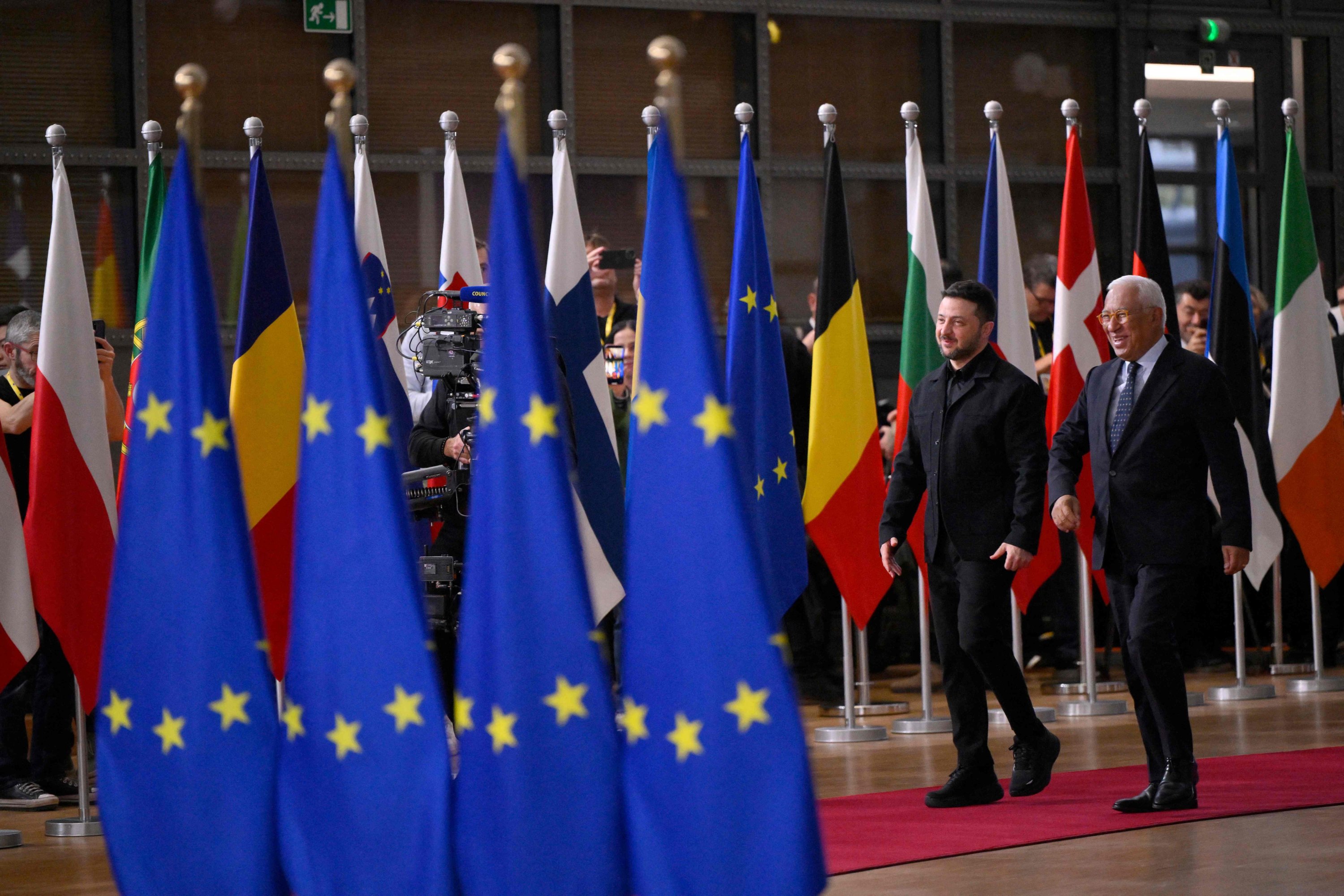
European Union leaders on Thursday ordered the bloc's executive branch to come up with options for meeting Ukraine's pressing economic and military needs over the next two years, but did not agree to use frozen Russian assets to fill the gap.
Belgium, which holds the bulk of Russia's frozen assets, refused to approve a plan to use the funds as collateral for a massive loan for Ukraine and indicated it would require more assurances before doing so. The leaders will consider the European Commission's proposals at their next meeting in December.
In a statement published during a summit in Brussels, the leaders committed "to address Ukraine's pressing financial needs for 2026-2027, including for its military and defense efforts."
Ukrainian President Volodymyr Zelenskyy had said that it was important to get the money soon. "We need it in 2026, and better to have it at the beginning of the year, but I don't know if it's possible," he told reporters on the sidelines of the meeting.
In their only written reference to the billions held in Belgium, the leaders said: "Subject to EU law, Russia’s assets should remain immobilized until Russia ceases its war of aggression against Ukraine and compensates it for the damage caused by its war."
Ukraine's budget and military needs for 2026 and 2027 are estimated to total around $153 billion.
The biggest tranche of Russia's frozen assets – about $225 billion worth – is held in Belgium, and the government is wary of using the money without firm guarantees from other EU countries.
"If we want to give them to Ukraine, we have to do it all together," Belgian Prime Minister Bart De Wever told reporters at the summit before the statement was published. "If not, Russian retaliation might only hit Belgium."
"We are a small country, and retaliation can be very hard. They might confiscate all kinds of monies of Western banks in Russia, confiscate the European-owned companies in Russia," he said.
The commission has described the plan as a "reparation loan." In essence, EU countries would guarantee a loan to Ukraine of around $165 billion of European money, not taken from the assets themselves. Kyiv would only refund the EU once Russia pays significant war reparations to Ukraine for the massive destruction it has caused.
Should Moscow refuse, its assets would remain frozen.
Russia has warned against the move. Earlier this month, Kremlin spokesperson Dmitry Peskov told reporters that the EU’s intentions "amount to plans to illegally confiscate Russian property – in Russian, we call it theft."
However, European Commission President Ursula von der Leyen said that "we are not confiscating the assets, but we are taking the cash balances for a loan to Ukraine." She said that "Ukraine has to pay back this loan if Russia pays reparations."
De Wever insisted Thursday on seeing exactly what her plan would entail.
"I haven't even seen the legal basis for the decision yet," he said. "This seems to me the first step, if you want to take an important decision. This has never been done. Even during the Second World War, we didn’t do this, so it’s not a detail."
The European Central Bank (ECB) and other EU countries that use the euro were also worried that such a move might undermine international confidence in Europe's single currency.
"We need to make sure that it is legally sound," Luxembourg Prime Minister Luc Frieden told reporters. "I think we made progress in the fact that there will not be a confiscation of these assets, because I think from a legal point of view that did not work."
The EU hopes that other countries will make similar moves, if Belgium eventually signs up. Outside the bloc, some Group of Seven nations also hold frozen Russian assets. Japan has around $50 billion worth, while the U.S. holds $8-$9 billion, and the U.K. and Canada have lesser amounts.
Interest earned on the frozen assets is already being used to fund a G-7 loan program for Ukraine, and this wouldn't be impacted should the plan go ahead.