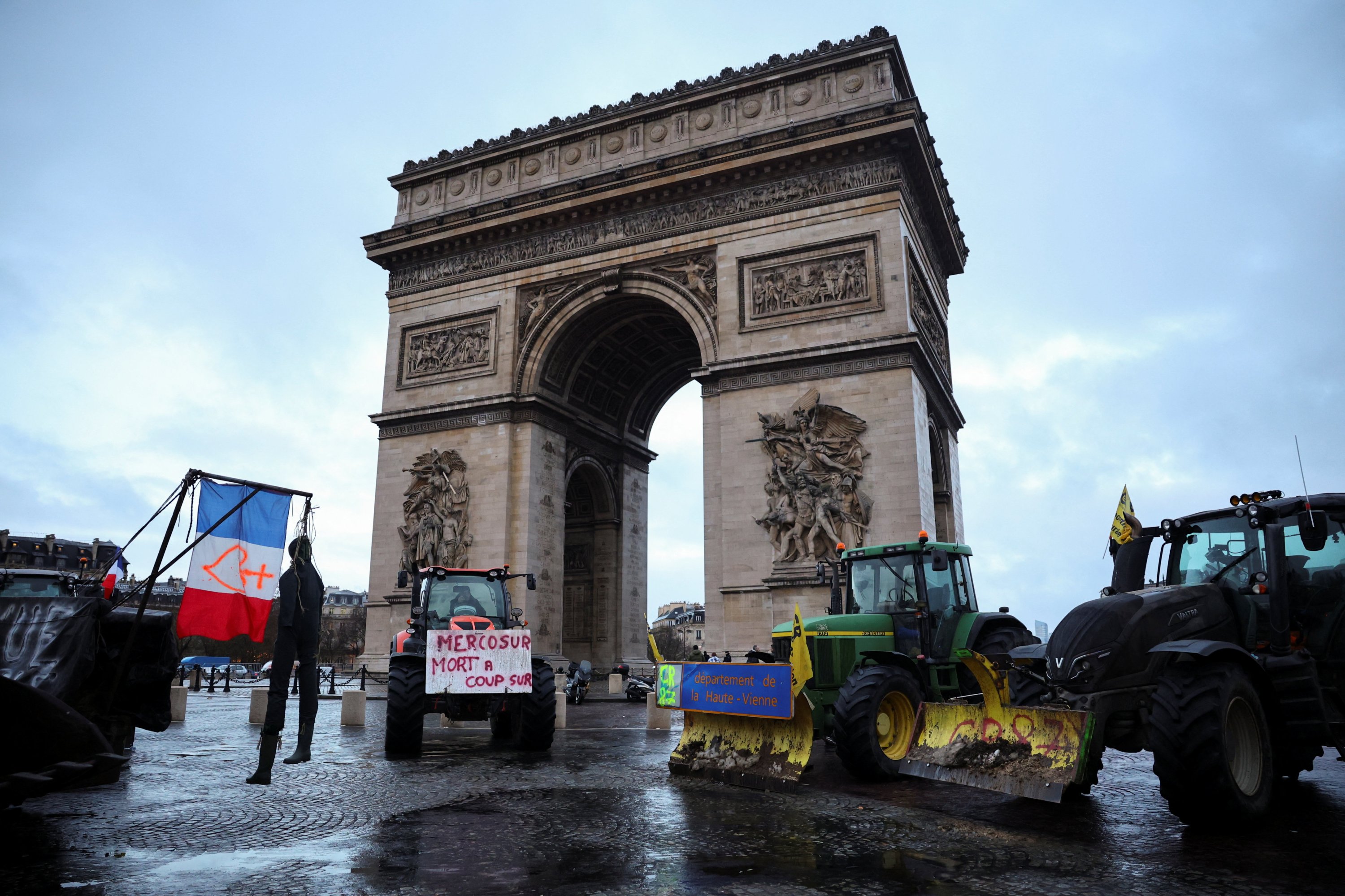
French farmers rolled into Paris on tractors on Thursday, blocking the areas around the city's top landmarks in a show of anger against the European Union's trade deal with the South American bloc Mercosur, which they fear will create unfair competition.
Dozens of tractors arrived before dawn and drove through Paris, with some pausing at the Eiffel Tower and others at the Arc de Triomphe, in a protest organized by the Rural Confederation union.
"We are between resentment and despair. We have a feeling of abandonment, with Mercosur being an example," Stephane Pelletier, a senior member of the Coordination Rurale union, told Reuters beneath the Eiffel Tower.
"We said we'd come up to Paris – here we are," said Ludovic Ducloux, co-head of one of the union's chapters.
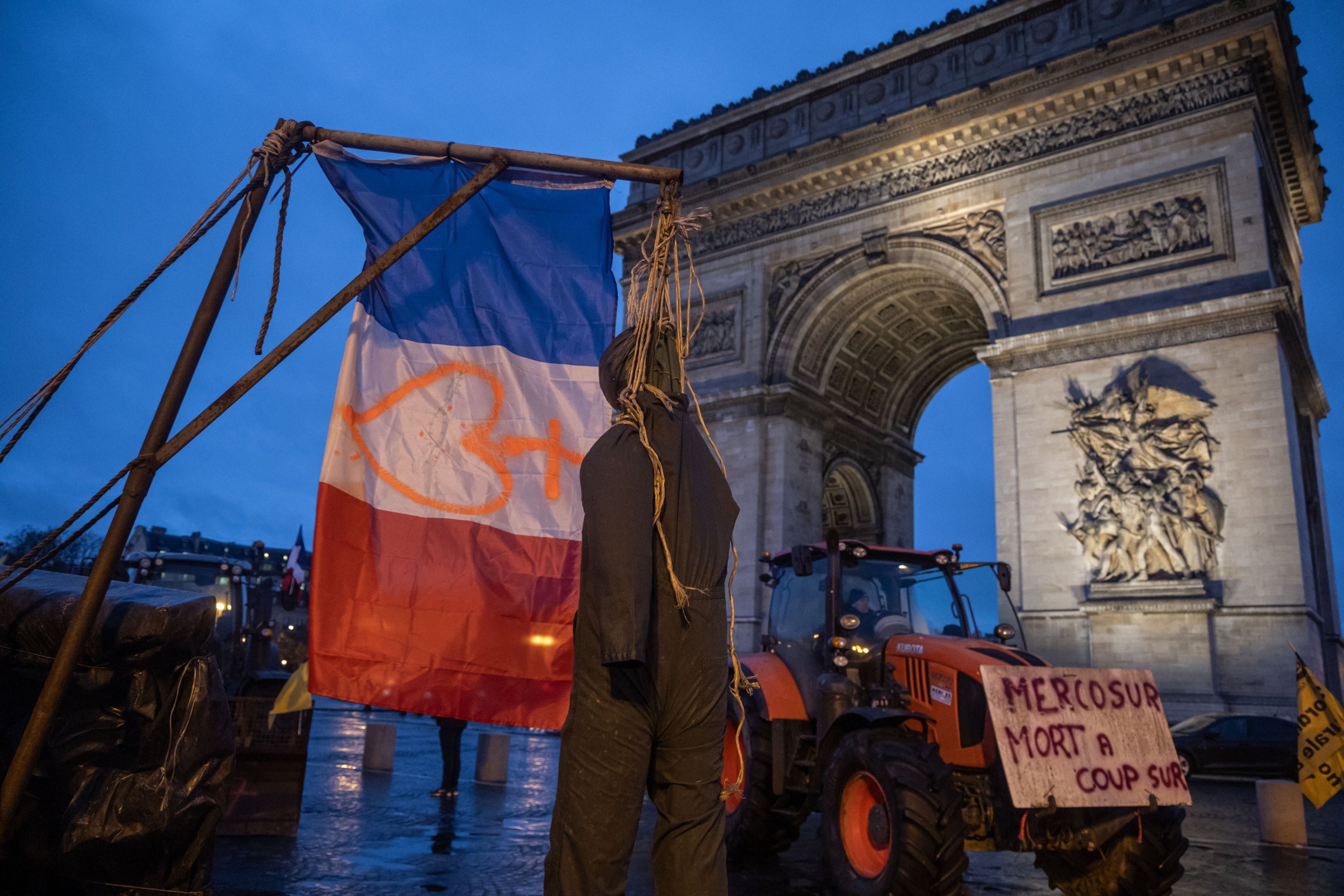
One of the tractors bore the message "No To Mercosur," referring to the deal with four South American nations.
The deal would create one of the world's biggest free-trade areas and help the 27-nation EU to export more vehicles, machinery, wines and spirits to Latin America. But farmers fear being undercut by a flow of cheaper goods from agricultural giant Brazil and its neighbors.
The farmers overran police checkpoints to enter the city, driving along the Champs Elysees avenue and blocking the road around the Arc de Triomphe monument before dawn on Thursday, while police surrounded them.
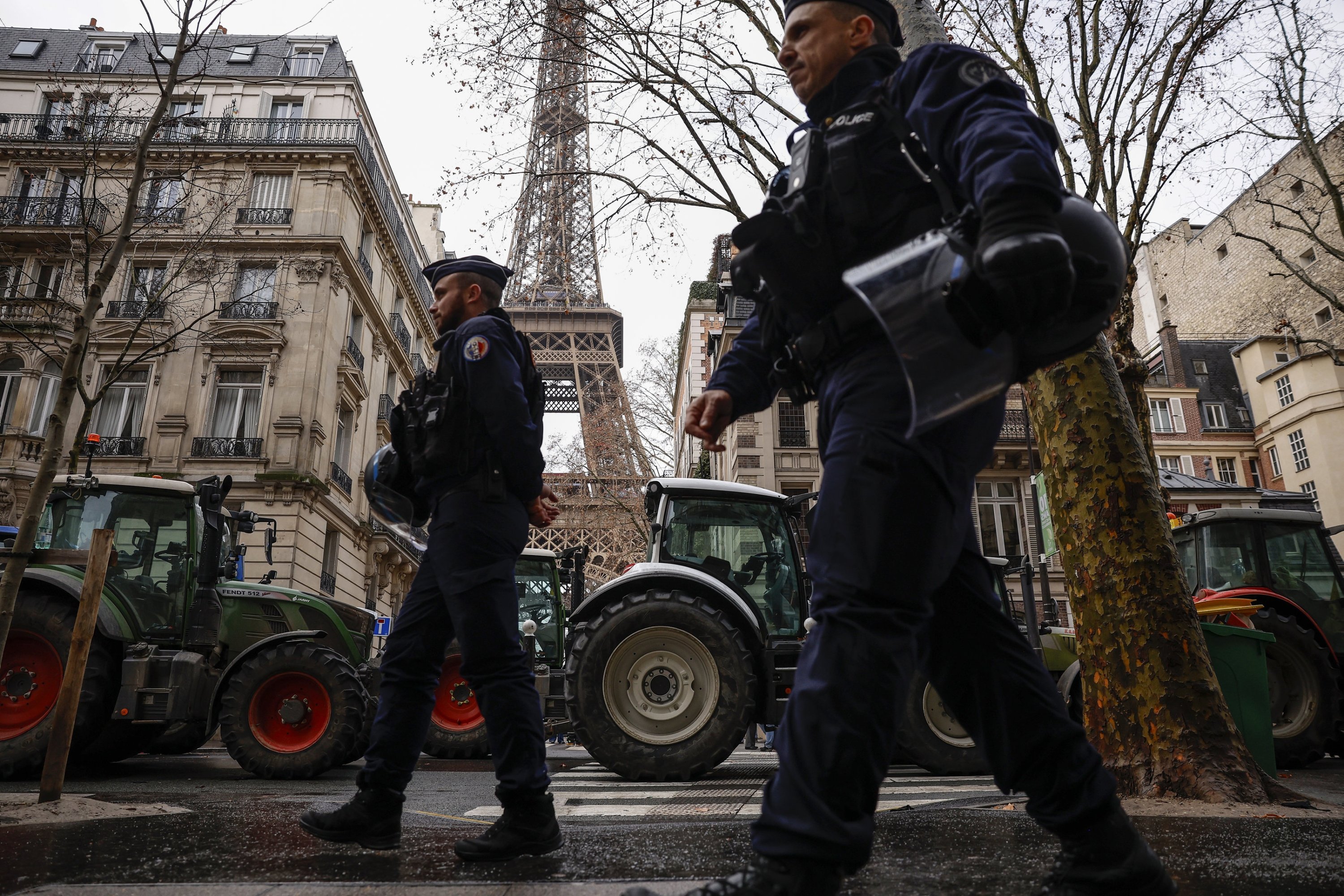
Dozens of tractors obstructed highways leading into the capital ahead of the morning rush hour, including the A13 leading into Paris from the western suburbs and Normandy, causing 150 kilometers (over 90 miles) of traffic jams, the transport minister said.
"We're not here to cause trouble," Damien Cornier, a 49-year-old farmer from the northwest Eure region, told Agence France-Presse (AFP).
"We just want to work and make a living from our profession."
Surrounded by a heavy police presence, farmers also demonstrated in front of the French Parliament's lower house, heckling the National Assembly President Yael Braun-Pivet when she came out to meet with them.
She said she would meet all trade unions in the afternoon, before security ushered her out of the tense crowd.
French policymakers have contributed to the "death of French agriculture over the past 30 years," Rural Confederation president Bertrand Venteau told Europe 1 radio.
Agriculture Minister Annie Genevard said farmers had "legitimate" demands but called for "calm" and "dialogue."
The protest piles yet more pressure on President Emmanuel Macron and his government, a day before EU member states are expected to vote on the trade accord.
France has long been a stiff opponent of the trade deal and even after extracting last-minute concessions, Macron's final position is not known.
In the early hours of Thursday, a small number of tractors briefly parked near the Eiffel Tower and more reached the Arc de Triomphe.
There were 100 tractors in the Paris region, the Interior Ministry told Agence France-Presse (AFP) earlier on Thursday, but "most are blocked at the gates of the capital."
In another protest near the southwestern city of Bordeaux, about 40 farm vehicles blocked access to a fuel depot, according to the local authorities.
As well as the trade deal, the farmers are also upset over a government decision to cull cows in response to the spread of nodular dermatitis, a bovine sickness widely known as lumpy skin disease.
At the end of last month, Macron met with farmers to discuss the trade pact and the culling of cows, another source of discontent among farmers.
During earlier protests, farmers blocked roads, sprayed manure and dumped garbage in front of government offices.
Belgian farmers have also staged mass protests against the trade deal, rolling some 1,000 tractors into Brussels in December.
More than 25 years in the making, the Mercosur accord would boost trade between the EU and the bloc, including Brazil, Paraguay, Argentina and Uruguay.
Plans to seal the deal at a gathering in Brazil on Dec. 20 ran into a late roadblock as heavyweights Italy and France demanded a postponement over concerns for the farming sector.
Germany and Spain are strongly in favor of the agreement, believing it will provide a welcome boost to their industries, hampered by Chinese competition and tariffs implemented by the U.S.
Ireland, however, said Thursday that it would vote against the trade deal, an AFP report said.
Rome and Paris have called for tougher safeguard clauses, tighter import controls and more stringent standards on Mercosur producers to protect their farmers.
But Italy hailed the benefits of the agreement on Wednesday, and Foreign Minister Antonio Tajani said the country had "always supported the conclusion of the deal."