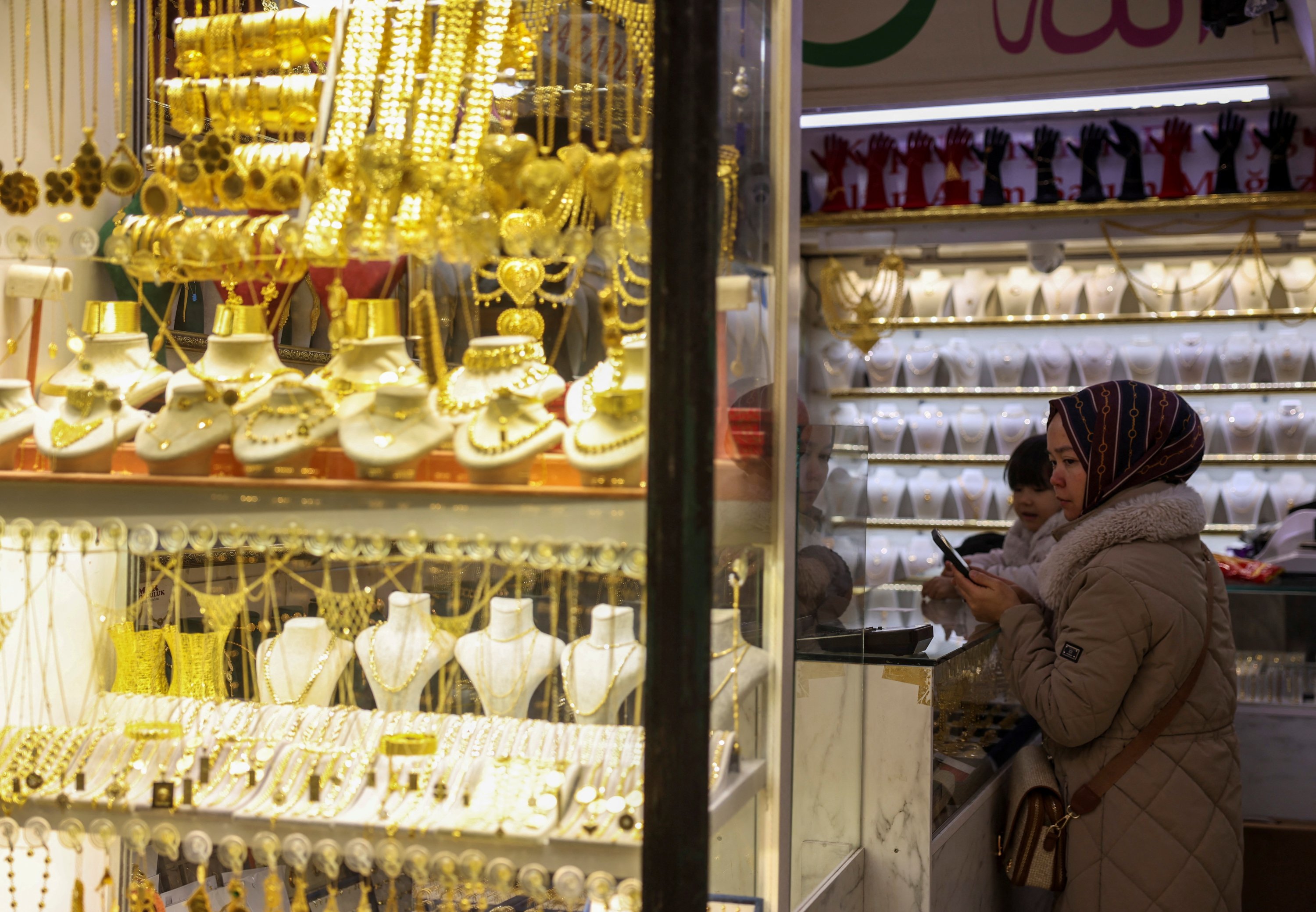
Gold‑loving Turks grew some $300 billion wealthier in the past year as record prices of precious metal swelled the value of their holdings to nearly half the size of the Turkish economy, a recent report indicated.
However, resulting resilience in domestic demand appears to be adding some pressure to the country's ongoing fight against inflation.
With global bullion soaring to all-time highs since the summer, the total value of Türkiye's gold stock has climbed to more than $750 billion, a Reuters report said. This is exceptionally high by global standards, considering Türkiye's gross domestic product (GDP) of about $1.57 trillion.
The central bank says $600 billion of that stock is "under‑the‑mattress," or "under-the-pillow" in Turkish, referring to gold held by households and companies outside the banking system – reflecting a long tradition of Turks holding tight to the metal as a safe, portable, tangible store of wealth.
The doubling of the value of these coins, bangles and other gold pieces in a year has encouraged spending, despite annual inflation above 30%. Economists and the central bank say this has complicated a disinflation path, prompting slower interest rate cuts.
Still, inflation has regressed notably compared to some 75% in May 2024 and about 85% back in November 2022, and authorities are voicing decisiveness to continue their policies aimed at curbing prices.
Gold hit $5,000 an ounce last month, driven by trade disruptions and geopolitical instability.
For Turks, the global gold rush offered some relief after years marked by higher inflation.
"I've been investing in physical gold for a year, buying it piece by piece whenever I save up," said 21-year-old air conditioning technician Furkan as he used cash to buy a gram of gold at an Istanbul shop.
"I believe prices will rise even further. I'm planning to buy a car."
Türkiye has among the highest levels of household gold ownership alongside India, Germany and Vietnam.
The precious metal, given as gifts at weddings and passed down through generations, is a hedge against inflation and lira depreciation, and a permissible investment under Islamic tradition that spurns interest-bearing banking.
Beyond what is under the pillow, Turkish banks store some $80 billion of the metal in bank deposits and investment funds, while the central bank owns about $80 billion in reserves, data show.
Gold, in particular, has helped the Central Bank of the Republic of Türkiye (CBRT) to accumulate holdings valued above $200 billion for the first time in recent months.
In a recent blog post, the central bank flagged that housing prices have risen markedly more in provinces with a higher share of gold deposits than elsewhere since the last quarter of 2023, when global bullion prices started to climb.
When households use gold-related wealth to buy homes without relying on credit, "demand remains strong even amid tight financial conditions," it said, calling this a "clear sign of a wealth effect."
Asim Gürsel, a gold shop owner in Istanbul, said that over the past year, customers were increasingly selling gold to buy cars or first homes in a reversal from past practices when they were largely selling homes to buy gold.
The central bank cut its key rate by a smaller-than-expected 100 basis points to 37% in January, when monthly consumer prices soared nearly 5%, and it has since slightly revised year-end inflation forecasts upward.
Gold prices jumped almost 25% in January alone, when the wealth effect in Türkiye amounted to $80 billion, capping a year in which it totaled $300 billion, according to Reuters calculations.