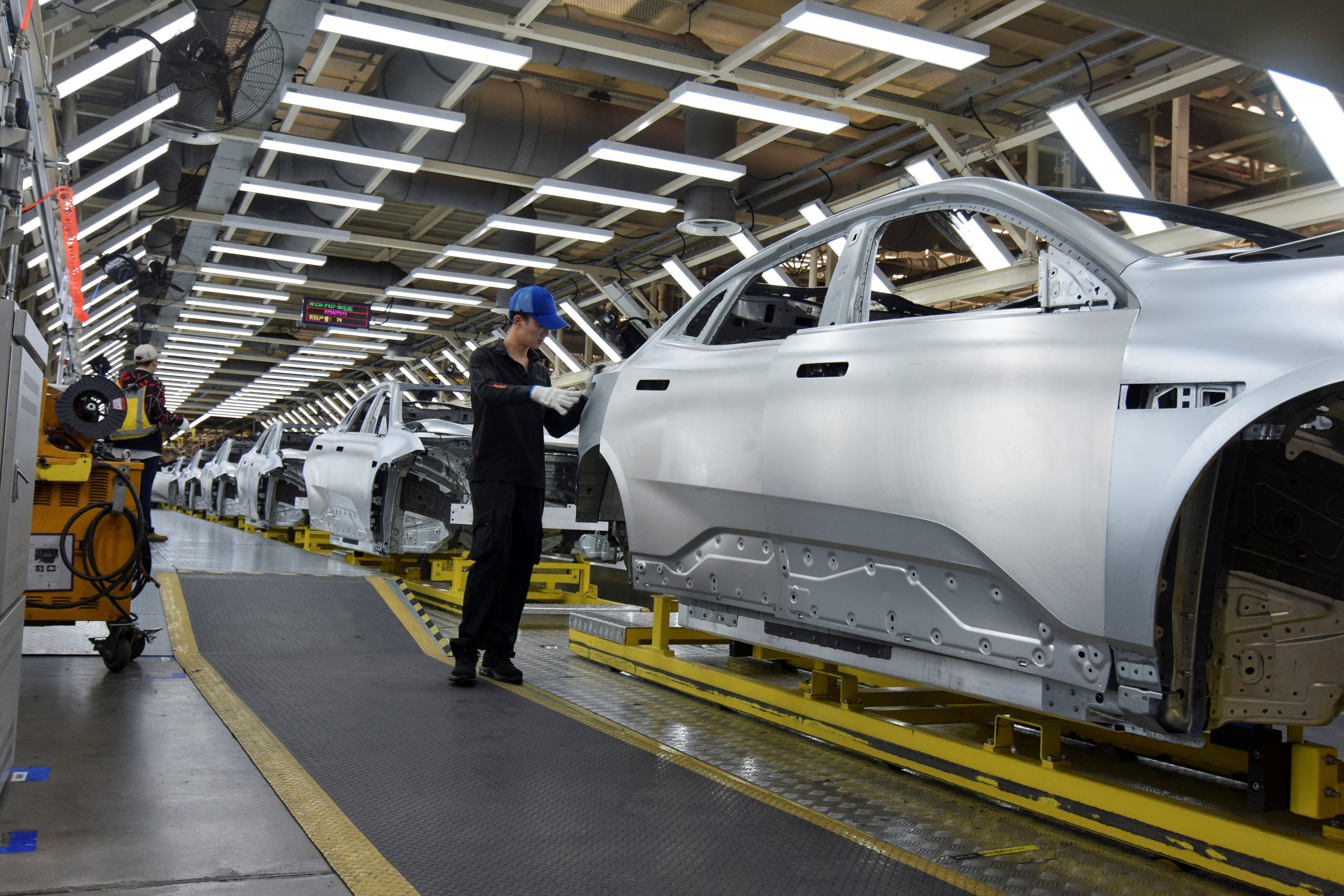
China's strong rhetoric against price wars among producers is raising expectations that Beijing could initiate industrial capacity cuts in a long-awaited, yet challenging, campaign against deflation, which carries risks to economic growth.
Communist Party leaders pledged this month to step up regulation of aggressive price-cutting, with state media running its harshest warnings yet against what it describes as a form of industrial competition that damages the economy.
These signals echo Beijing's supply-side reforms a decade ago, which aimed to reduce the production of steel, cement, glass, and coal. This was crucial in ending 54 consecutive months of falling factory gate prices.
This time, however, the fight against deflation will be much more complicated and poses risks to employment and growth, economists say. The trade war with the U.S., meanwhile, is intensifying price wars, squeezing factory profits.
Challenges Beijing didn't face last decade include high private ownership, misaligned incentives at local and national levels and limited stimulus options in other economic sectors to absorb the job losses resulting from any capacity cuts.
Beijing views employment as a key factor in maintaining social stability. Exporters and even the state sector are already shedding jobs and cutting wages, while youth unemployment runs at 14.5%.
"This round of supply-side reform is far, far more difficult than the one in 2015," said He-Ling Shi, economics professor at Monash University in Melbourne.
"The likelihood of failure is very high and if it does fail, it would mean that China’s overall economic growth rate will decline."
Economists expect that any efforts by Beijing to reduce capacity will be undertaken in small, cautious steps, with officials – keen to achieve annual economic growth of roughly 5% – keeping a close eye on spillover effects.
An expected end-of-July meeting of the Politburo, a decision-making body of the Party, might issue more industry guidelines, although the conclave rarely delivers a detailed implementation roadmap.
Analysts expect Beijing to first target the high-end industries that it once billed as the "new three" growth drivers, but which state media now singles out for fighting price wars: autos, batteries, and solar panels.
Their expansion accelerated in the 2020s as China redirected resources from the crisis-hit property sector to advanced manufacturing to move the world's No.2 economy up the value chain.
However, China's industrial complex, which accounts for a third of global manufacturing, appears bloated across the board.
Most sectors have capacity utilisation rates below the 80% "healthy" level, Societe Generale analysts said, blaming weak domestic demand and an investment-driven growth model that favours producers over consumers.
U.S. and EU officials have repeatedly complained that this model is flooding global markets with cheap goods made in China and endangers their domestic industries.
A foreign chemicals company manager, surnamed Jiang, who requested partial anonymity to discuss the industry, said that overcapacity in her sector was evident as early as 2023, yet firms continue to expand.
"If money is cheap and abundant, any company thinks it won't go bankrupt and can crush competitors to death," Jiang said.
For all the state support manufacturers receive, most are privately owned, unlike the raw material producers Beijing trimmed last decade, largely through blunt administrative orders.
Reducing capacity now requires a less predictable process of curbing subsidies, cheap land supply, preferential loans or tax rebates, then letting markets pick winners and losers.
But the local officials who would have to implement this have the opposite incentive: developing industry champions that draw supply chain investments and employment to their region.
"Local governments, in their efforts to transform the local economy, encouraged firms to invest in these new sectors," like solar or batteries, a policy adviser said on condition of anonymity due to the topic's sensitivity.
"There’s nothing inherently wrong with transformation and upgrading, but the problem is that everyone is targeting the same few sectors," said the adviser, adding that the U.S. trade war has exposed such industries as being "too big."
Yan Se, deputy director of the Institute of Economic Policy at Peking University, said local government resistance would turn "important and necessary" capacity cuts into a long-term, gradual process that won't end deflationary pressure on its own.
Stimulating demand would be more effective, Yan told a conference last week.
Producer prices dropped for the 33rd month in June.
China faces a painful trade-off between a deeper and shorter stretch of price falls as output cuts trigger job losses and a longer run of overcapacity and deflation that delays the blow to employment, economists say.
Macquarie estimates that the reforms of the last decade chopped tens of millions of jobs. However, an ambitious project to redevelop shantytowns across China, estimated by Morgan Stanley at 10 trillion yuan ($1.4 trillion), offered displaced workers new opportunities.
Manufacturing is now much less labor-intensive. Still, jobs will be lost and "there's no way" other economic sectors, also facing weak consumer demand, can absorb the shock, said Monash University's Shi.
In another echo of the last decade, high-level discussions of urban redevelopment resurfaced last week. But any new investment in that area would likely be too small to compensate for lost industrial activity and jobs.
"I don't think we can expect real estate to digest job losses from supply-side reforms anymore," said John Lam, head of Greater China property research at UBS.
"It was used for that in the past and it created overcapacity in our sector," said Lam. Authorities "don't seem to be going in that direction, which I think is correct."